How to Fix Construction Administration Software Gaps
Learn how to fix construction administration software gaps by improving RFIs, submittals, audit trails, workflows, and cross-project visibility.
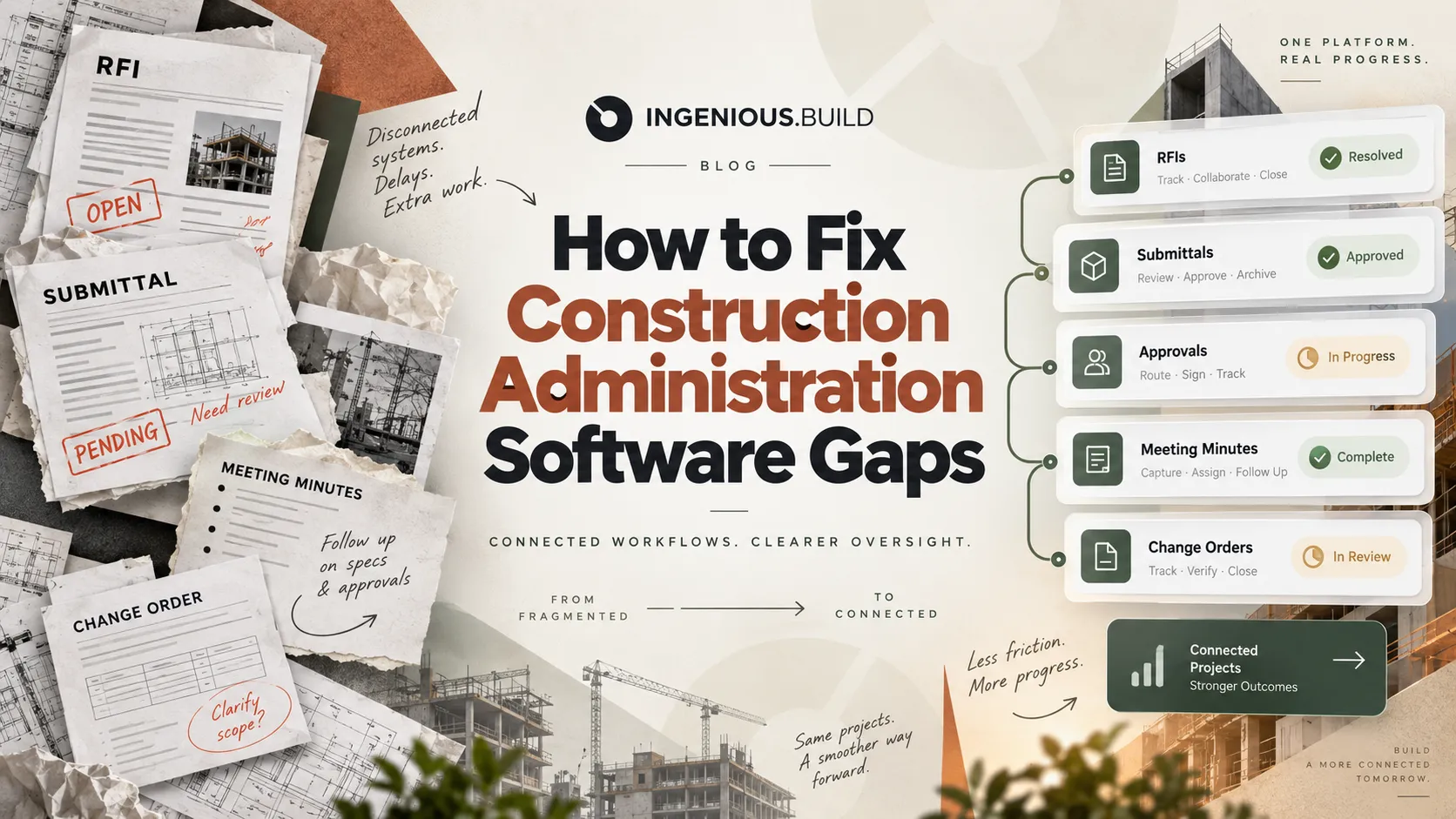
Construction administration rarely fails because a team does not have enough software. More often, the problem is that RFIs, submittals, approvals, drawings, meeting records and project correspondence are managed through separate workflows that do not create one reliable project record.
An RFI starts in email. A submittal log lives in a spreadsheet. Meeting decisions sit in PDFs. Drawings are stored in a shared drive. Program managers then spend hours trying to reconstruct what happened, who approved it and which version is current.
Construction administration software is designed to close these gaps by standardizing documentation, creating audit trails and connecting project workflows in a centralized system. For owner's representatives and program managers overseeing multiple projects, the goal is not simply better document storage. It is consistent control and cross-project visibility.
This guide explains how to identify construction administration software gaps, fix broken RFI and submittal workflows, improve audit trails and build a more standardized approach to construction administration.
What Are Construction Administration Software Gaps?
Construction administration software gaps are breaks in the systems, workflows or project records used to manage construction documentation and approvals.
A gap exists whenever important project information cannot be reliably created, routed, tracked or retrieved.
Common examples include:
- RFIs submitted through email instead of a structured workflow
- submittal logs updated manually in spreadsheets
- approvals without clear timestamps or ownership
- project teams using different document naming conventions
- meeting decisions disconnected from related project records
- multiple versions of drawings or documents in circulation
- inconsistent workflows between projects
- executives unable to compare administration performance across a program
These gaps create more than administrative inconvenience. They make it difficult to establish a complete audit trail and understand the current status of project decisions.
Why Construction Administration Gaps Become a Program Management Problem
A single project may be able to compensate for an inefficient process through manual coordination. At the program level, the same process becomes difficult to control.
Consider five projects using five different RFI logs. One project categorizes overdue RFIs by due date. Another tracks only open and closed status. A third manages RFIs primarily through email.
Each project may technically be tracking RFIs, but the program manager cannot reliably answer a basic question: Where are unresolved RFIs creating the greatest exposure across the program?
The same problem appears with submittals, approvals, meeting records and project documentation.
For program managers and owner's representatives, construction administration software should create consistency across projects. Standardized data makes cross-project reporting possible and helps leadership identify exceptions without manually reviewing every project.
The Most Common Construction Administration Software Gaps
1. RFI Management Gaps
RFIs clarify questions about drawings, specifications, design intent and project requirements. The process becomes difficult to control when questions and responses move through email or disconnected logs.
Common RFI management gaps include:
- unclear ownership
- missing due dates
- inconsistent numbering
- duplicate RFIs
- responses buried in email
- no connection to relevant drawings or documents
- limited visibility into overdue items
- incomplete response histories
A structured RFI management workflow should record the question, responsible parties, submission date, due date, related documentation, responses, status and complete history of actions. Current construction administration platforms commonly emphasize workflow routing, deadline tracking, document linking and auditable histories as core RFI capabilities.
The goal is not simply to create an RFI log. It is to make every RFI traceable from submission through resolution.
2. Submittal Management Gaps
Submittals often move through several stakeholders before approval. Contractors, consultants, architects, engineers and owners may all participate in the review process.
When submittal management is fragmented, teams struggle with:
- unclear review status
- outdated attachments
- missed due dates
- manual follow-ups
- inconsistent approval terminology
- limited revision history
- difficulty identifying bottlenecks
Construction administration software should provide a defined submittal workflow with clear reviewers, due dates, revision tracking, status history and supporting documentation.
A program manager should be able to identify overdue submittals across projects without requesting separate spreadsheets from every project team.
3. Audit Trail Gaps
An audit trail is the chronological record of actions, changes, approvals and decisions associated with a project workflow.
A complete construction audit trail should help answer:
- Who submitted the record?
- When was it submitted?
- Who received it?
- What changed?
- Which document version was reviewed?
- Who approved or rejected it?
- When did the status change?
- What supporting documentation was attached?
When these answers require searching through email inboxes, shared drives and meeting minutes, the project does not have a reliable centralized audit trail.
Modern construction administration systems use version tracking, approval routing, role-based access and time-stamped actions to preserve workflow history.
4. Standardized Documentation Gaps
Different project teams often develop their own processes over time.
One project calls a record "Pending Review". Another uses "With Architect". A third uses "Open". One team requires a due date for every RFI, while another does not.
Small differences become significant when leadership tries to compare projects. Standardized documentation establishes common requirements for:
- naming conventions
- required fields
- workflow statuses
- approval terminology
- document categories
- responsible roles
- reporting structures
Standardization does not mean every project must operate identically. It means core project information follows a consistent structure that can be understood and reported across the organization.
5. Cross-Project Visibility Gaps
Project-level software is not always sufficient for program management.
A project manager may know that 14 RFIs are overdue. A program manager needs to know whether overdue RFIs are increasing across the portfolio, which projects have the longest response times and where administration workflows are becoming a delivery risk.
Cross-project visibility should help program leaders monitor:
- open and overdue RFIs
- average RFI response time
- submittals awaiting review
- overdue approvals
- workflow bottlenecks
- documentation completeness
- project-level exceptions
- trends across projects
Construction data systems are most useful when they standardize how information is created and stored while enabling current visibility into project conditions.
How to Audit Your Current Construction Administration Process
Before replacing software, identify where the current process actually breaks. Start with four high-volume workflows: RFIs, submittals, meeting records and document approvals.
For each workflow, trace one real record from creation through closeout. Ask:
- Where is the record created?
- How is it submitted?
- Who receives it?
- How is responsibility assigned?
- Where is the due date recorded?
- How are reminders handled?
- Where are responses stored?
- How are revisions tracked?
- Who can change the status?
- Can the complete history be retrieved in one place?
Any point that requires a manual spreadsheet update, separate email search or undocumented handoff is a potential construction administration gap.
The objective is to audit the workflow, not simply count the number of software tools in use.
How to Fix RFI Management Gaps
The first step is to establish one defined RFI workflow.
Every RFI should begin as a structured project record rather than an informal message. Required information should include the project, RFI number, subject, question, responsible party, due date, related drawing or specification, attachments and status.
Next, define the routing process. The software should make clear who is responsible for the next action and preserve the response history.
Finally, standardize RFI reporting across projects.
At minimum, program managers should be able to monitor open RFIs, overdue RFIs, average response time and RFIs by project or responsible party.
For large programs, a searchable RFI log and complete audit history become particularly important because RFI volume may span multiple contractors, subcontractors and design teams.
How to Fix Submittal Management Gaps
Submittal workflows should be built around review accountability.
Start by defining standard statuses such as draft, submitted, under review, revise and resubmit, approved as noted, approved and closed. The exact terminology may vary by organization, but the same definitions should be used consistently.
Then define the review path for each submittal type.
The construction administration platform should record:
- submittal number and package
- specification section
- responsible contractor
- reviewers
- submission date
- required response date
- current status
- revisions
- comments
- final decision
Automated routing and reminders can help reduce manual follow-up, but automation should support a clearly defined process rather than compensate for an unclear one.
How to Build Better Construction Audit Trails
A good audit trail is created automatically as work happens. Teams should not have to assemble an audit record at the end of a project.
Each workflow action should preserve the user, timestamp, status, associated documents and relevant comments. Revised documents should remain connected to their history rather than replacing previous versions without context.
This is especially important for RFIs and submittals because project decisions often involve several stakeholders and multiple review cycles.
A strong construction administration audit trail provides a chronological record of the decision process. If a question arises months later, the team should be able to understand what was submitted, reviewed, changed and approved without reconstructing the history manually.
How to Standardize Construction Documentation Across Projects
Standardization should begin with the workflows that create the greatest reporting or compliance risk.
For most organizations, these include:
- RFIs
- submittals
- meeting minutes
- approvals
- drawing revisions
- project correspondence
Create a minimum data standard for each workflow.
For an RFI, that may include a project identifier, RFI number, responsible party, due date, status and linked documentation.
For a submittal, it may include a specification section, package, reviewer, required response date, revision number and final disposition.
Next, standardize statuses and ownership rules.
Finally, apply the same reporting definitions across projects. "Overdue RFI" should mean the same thing on every project.
The result is standardized documentation that still allows project teams to manage project-specific details.
From Project-Level Administration to Cross-Project Visibility
Program management requires a different level of information than individual project management.
Project teams need detailed records. Program leaders need exceptions, trends and comparisons.
A construction administration platform should allow leadership to move from a program-level dashboard into the underlying project record.
For example, a program manager may see that one project has a growing number of overdue submittals. From there, the manager should be able to identify the affected packages, responsible reviewers and review history.
Useful cross-project construction administration metrics include:
Open RFI count: Total unresolved RFIs by project.
Overdue RFI rate: Percentage of open RFIs beyond their required response date.
Average RFI response time: Time between submission and formal response.
Open submittals: Submittals currently moving through review workflows.
Overdue submittal rate: Percentage of active submittals beyond the required review date.
Average review duration: Time required to complete a submittal review cycle.
Revision frequency: Number of records requiring additional review cycles.
Administration exceptions: Projects or workflows outside defined program thresholds.
These metrics help program managers focus on the workflows requiring attention instead of reviewing every individual record.
Construction Administration Software vs Email, SharePoint and Teams
Email, shared drives, Microsoft SharePoint and Microsoft Teams can support communication and file sharing, but they do not automatically create structured construction administration workflows.
A file repository can store an RFI response. It does not necessarily assign the next action, enforce a due date, maintain standardized RFI statuses or create program-level RFI reporting.
Dedicated construction administration software is built around records and workflows. RFIs, submittals, approvals and project documentation remain connected to ownership, status, history and related project information.
For program managers, this distinction becomes increasingly important as the number of projects and stakeholders grows.
When Point Solutions Create New Administration Gaps
Adding another RFI tool or submittal tracker may solve an immediate problem while creating a broader information gap.
If RFIs exist in one platform, submittals in another, meeting records in a third and project financials elsewhere, teams still have to reconstruct the relationship between project decisions.
For example, an RFI may lead to a design clarification that affects a submittal, schedule activity, and potential change order. Managing each record independently limits the team's ability to understand the complete project context.
A unified construction administration platform connects related workflows so project records can be reviewed as part of the broader project history.
This does not mean every construction organization needs one software product for every business process. It means the systems responsible for construction administration should preserve connected records and avoid creating new information silos.
What to Look for in a Unified Construction Administration Platform
When evaluating construction administration software, focus on workflow control and information quality rather than the length of the feature list.
The platform should provide structured RFI management, submittal workflows, document version control, time-stamped audit trails, standardized documentation and role-based accountability.
For program management, also evaluate whether the system can standardize workflows across projects and provide cross-project visibility.
Ask vendors to demonstrate a complete workflow using a realistic project scenario.
Instead of asking, "Do you have RFI management?" ask the vendor to show how an RFI is submitted, routed, reviewed, revised, closed, reported and retrieved six months later.
For submittals, ask to see multiple review cycles and the complete history of every action.
The quality of a construction administration platform becomes much clearer when evaluated through real workflows rather than feature checklists.
How INGENIOUS.BUILD Helps Close Construction Administration Gaps
INGENIOUS.BUILD centralizes RFIs, submittals, project documentation and other construction administration workflows within a connected project environment. Its construction administration module is designed to keep workflow status and project records in one place rather than distributing them across separate logs and communication channels.
For owners, owner's representatives and program managers, the value of a unified environment is the connection between project-level administration and broader project visibility.
Instead of manually consolidating RFI and submittal information across projects, teams can manage structured workflows and maintain project histories within the same construction management environment.
The goal is not simply to digitize construction paperwork. It is to create more consistent documentation, clearer accountability and better visibility into the administrative workflows affecting project delivery.
Practical Construction Administration Gap Checklist
Your organization may have construction administration software gaps if:
- RFIs are regularly initiated through email
- project teams maintain separate manual RFI logs
- submittal status must be confirmed through meetings
- reviewers receive repeated manual follow-ups
- project decisions are difficult to trace months later
- document versions are stored in multiple locations
- projects use different workflow statuses
- leadership manually consolidates administration reports
- overdue items cannot be viewed across projects
- related RFIs, submittals, and project records are disconnected
One isolated issue may be a process problem. If several of these conditions exist across multiple projects, the organization likely has a broader construction administration system gap.
Final Thoughts
Construction administration gaps become expensive when teams cannot reliably track decisions, approvals, documentation and workflow ownership.
Fixing those gaps requires more than moving spreadsheets into the cloud. Organizations need structured RFI management, consistent submittal workflows, automatic audit trails, standardized documentation and cross-project visibility.
For program managers, owner's representatives and construction executives, the strongest construction administration systems create a clear connection between individual project records and program-level oversight.
Frequently asked questions
What is construction administration software?
Construction administration software helps construction teams manage structured project workflows such as RFIs, submittals, approvals, document control, meeting records and audit trails. It centralizes project records and helps teams track ownership, status and workflow history.
How does construction administration software improve RFI management?
Construction administration software creates a structured RFI workflow with defined ownership, due dates, related documents, responses, statuses and audit history. This makes open and overdue RFIs easier to track than email-based processes.
Why are audit trails important in construction administration?
Audit trails document who performed an action, when it occurred, what changed and which records were involved. They improve accountability and make it easier to reconstruct project decisions during reviews, closeout, audits or disputes.
How can program managers standardize construction documentation?
Program managers can define required fields, naming conventions, workflow statuses, ownership rules and reporting definitions for core processes such as RFIs and submittals. Construction administration software can then apply these standards consistently across projects.
What is cross-project visibility in construction administration?
Cross-project visibility is the ability to monitor construction administration workflows across multiple projects. Program managers can compare RFI response times, overdue submittals, approval bottlenecks and other administration metrics without manually consolidating individual project reports.
What should I look for in construction administration software?
Look for structured RFI management, submittal tracking, document control, version history, audit trails, workflow accountability, standardized documentation, reporting and cross-project visibility. Program managers should also evaluate whether the platform can apply consistent workflows across multiple projects.