|

MENU


.svg)
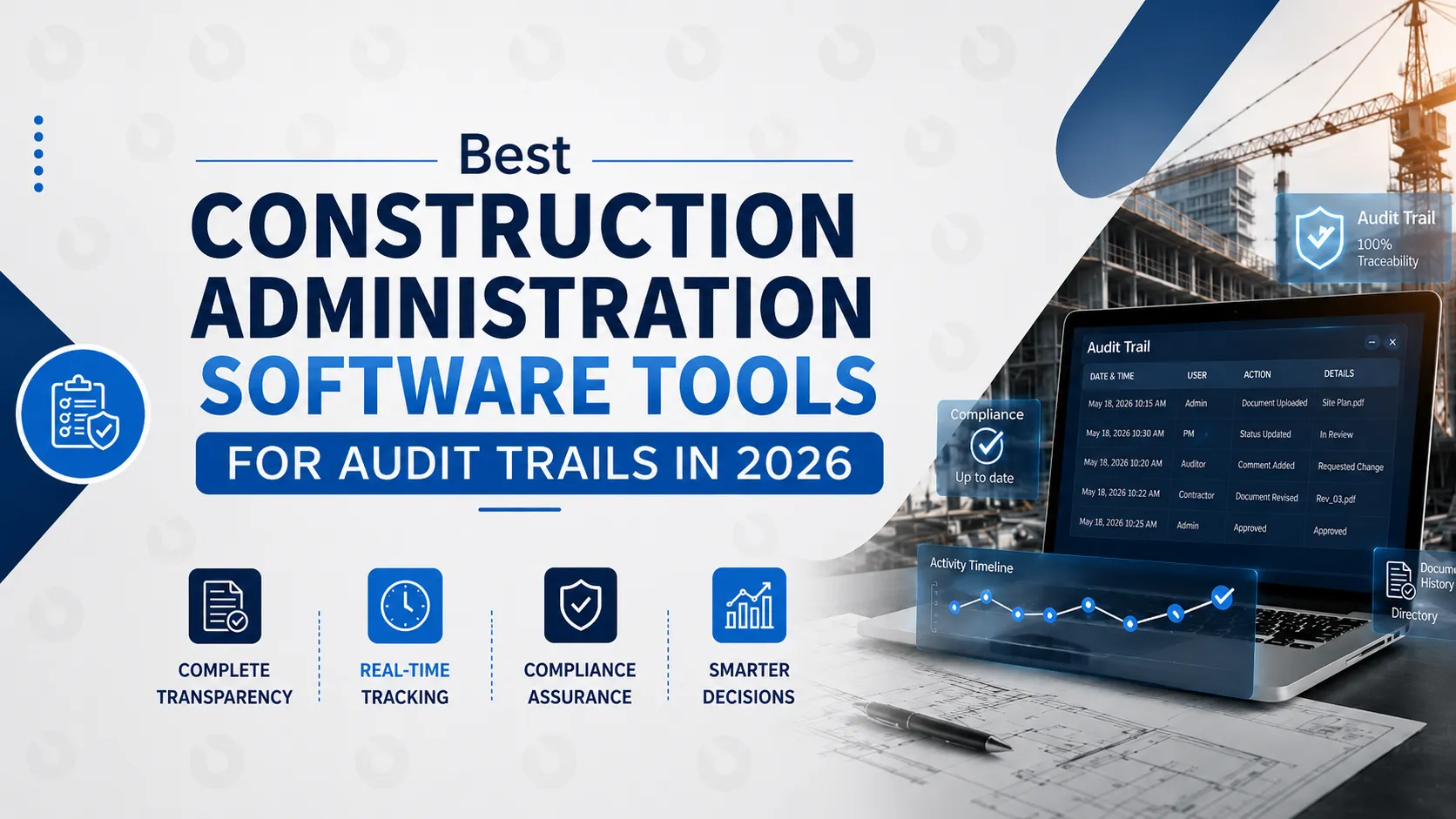
Construction projects generate enormous amounts of documentation. RFIs, submittals, meeting minutes, approvals, drawing revisions, change orders, inspection logs and compliance records all need to be tracked accurately - often across multiple stakeholders and over long project timelines.
The problem is that many teams still manage this information across disconnected tools, inboxes and spreadsheets. That creates operational risk.
When documentation is fragmented, teams struggle with:
This is why construction administration software has become increasingly important for owners, developers and owner’s representatives.
Modern platforms do more than store documents. They create structured workflows, centralized records and audit-ready visibility across the full project lifecycle. This guide compares the best construction administration software tools in 2026, with a specific focus on:
Construction administration software is a platform that helps project teams manage, track, organize and document construction workflows throughout the project lifecycle.
Unlike general project management tools, construction administration platforms focus heavily on:
For owners and developers, these systems improve visibility into project execution while reducing operational and legal risk.
Construction projects involve thousands of decisions across multiple companies and stakeholders.
Without clear audit trails, teams often struggle to answer basic but critical questions:
Strong audit trails improve:
As projects become larger and more regulated, audit-ready construction documentation is becoming a core operational requirement, not just an administrative task.
Most construction administration problems are not caused by missing information.
They are caused by disconnected workflows and inconsistent documentation processes.
On many projects, teams still rely heavily on email chains, spreadsheets, shared folders, and manual tracking systems. Over time, this creates gaps between decisions, approvals, and execution.
Common construction administration failures include:
These issues often appear small individually. But together, they create operational risk long before problems become visible financially.
By the time delays, disputes or rework emerge, teams are often forced to reconstruct project history manually - which becomes difficult, time-consuming, and expensive.
Modern construction administration platforms help reduce these risks by centralizing workflows and creating structured, traceable records throughout the project lifecycle.
Each platform was evaluated based on:
Best for: connected audit trails and owner-level visibility
INGENIOUS.BUILD is designed to centralize construction administration workflows across owners, developers, architects and contractors.
The platform combines:
inside one connected environment.
This creates a strong audit trail because communication, approvals and documentation remain tied directly to project workflows rather than scattered across inboxes and external tools.
Strengths
Best for
Owners, developers and project teams needing visibility across complex multi-stakeholder projects.
Best for: contractor-led construction administration
Procore remains one of the most widely adopted construction administration platforms in large commercial construction.
Its strengths include:
Procore provides strong auditability across contractor workflows, especially for large GC-led projects.
Strengths
Tradeoffs
Best for: document-heavy and BIM-driven environments
Autodesk Construction Cloud excels in:
The platform is particularly valuable where technical documentation and model coordination are critical.
Strengths
Tradeoffs
Best for: owner-driven capital program administration
Kahua focuses strongly on owner workflows, capital programs and portfolio-level visibility.
It supports:
Best for: email-centric project documentation management
Newforma is widely used in architecture and engineering workflows to improve document organization and project communication tracking.
Strengths
Best for: large international infrastructure projects
Aconex is built around highly controlled document workflows and formal communication tracking.
Strengths
Tradeoffs
Best for: ERP-connected construction administration
CMiC combines construction administration with ERP functionality.
Strengths
Tradeoffs
Best for: field-level documentation and issue tracking
Fieldwire improves visibility into:
Best for: residential construction administration
Buildertrend supports:
Best for: design-to-construction coordination
Revizto focuses on model coordination and issue tracking between design and field teams.
This is one of the most common comparisons for owners evaluating construction administration software.
Strongest for:
Best when teams want:
Strongest for:
Best when teams need:
Strongest for:
Best when:
Construction disputes are often caused less by the issue itself and more by the inability to clearly reconstruct what happened.
When project records are fragmented, teams struggle to verify:
This creates risk during schedule disputes, cost claims and compliance reviews. Construction administration software reduces that risk by creating structured, time-stamped records tied directly to project workflows.
Instead of relying on scattered emails or manual logs, teams can maintain centralized histories for:
This improves accountability while making project history significantly easier to audit and validate later. For owners and developers, that visibility is increasingly valuable as projects become larger, more regulated and more financially complex.
When evaluating platforms, focus on systems that improve both visibility and accountability.
The most important capabilities typically include:
The goal is not just storing records. It is creating a system where project decisions remain visible, traceable and actionable throughout the full lifecycle.
Many construction disputes and operational issues happen because information is inconsistent or difficult to trace.
Standardized documentation improves:
It also makes projects significantly easier to manage at scale. As organizations grow, standardized workflows become one of the biggest differentiators between reactive and operationally mature project teams.
Construction administration is no longer just about paperwork. It is about maintaining visibility, accountability and control across increasingly complex projects.
The best construction administration software platforms help teams centralize workflows, improve auditability, reduce communication gaps and standardize documentation across stakeholders.
For owners, developers and owner’s representatives, this visibility is becoming essential - especially as projects grow larger and more technically demanding.
INGENIOUS.BUILD helps construction teams manage RFIs, submittals, approvals, document control and audit trails inside one connected system built for real project workflows.
Book a demo to see how centralized construction administration improves coordination and reduces project risk.
Construction administration software helps teams manage project documentation, approvals, RFIs, submittals, audit trails and workflows throughout the construction lifecycle.
Audit trails improve accountability, document decisions, support compliance and reduce risk during disputes or claims.
Top platforms include INGENIOUS.BUILD, Procore, Autodesk Construction Cloud, Aconex and Kahua depending on project type and workflow needs.
Key features include RFI management, submittal tracking, document control, approval workflows, audit trails, reporting and standardized documentation workflows.
INGENIOUS.BUILD focuses heavily on connected owner visibility, centralized workflows and audit-ready coordination, while Procore is often stronger in contractor-led field collaboration.

INGENIOUS.BUILD
.svg)
.svg)

Company Type

Product Solutions
Information
.svg)
Speak to a Product Specialist
Streamline your Development & Construction projects with our cutting-edge project management software.
Discover why people are switching to INGENIOUS today!
By submitting this form, you agree with our Privacy Policy.