|

MENU


.svg)
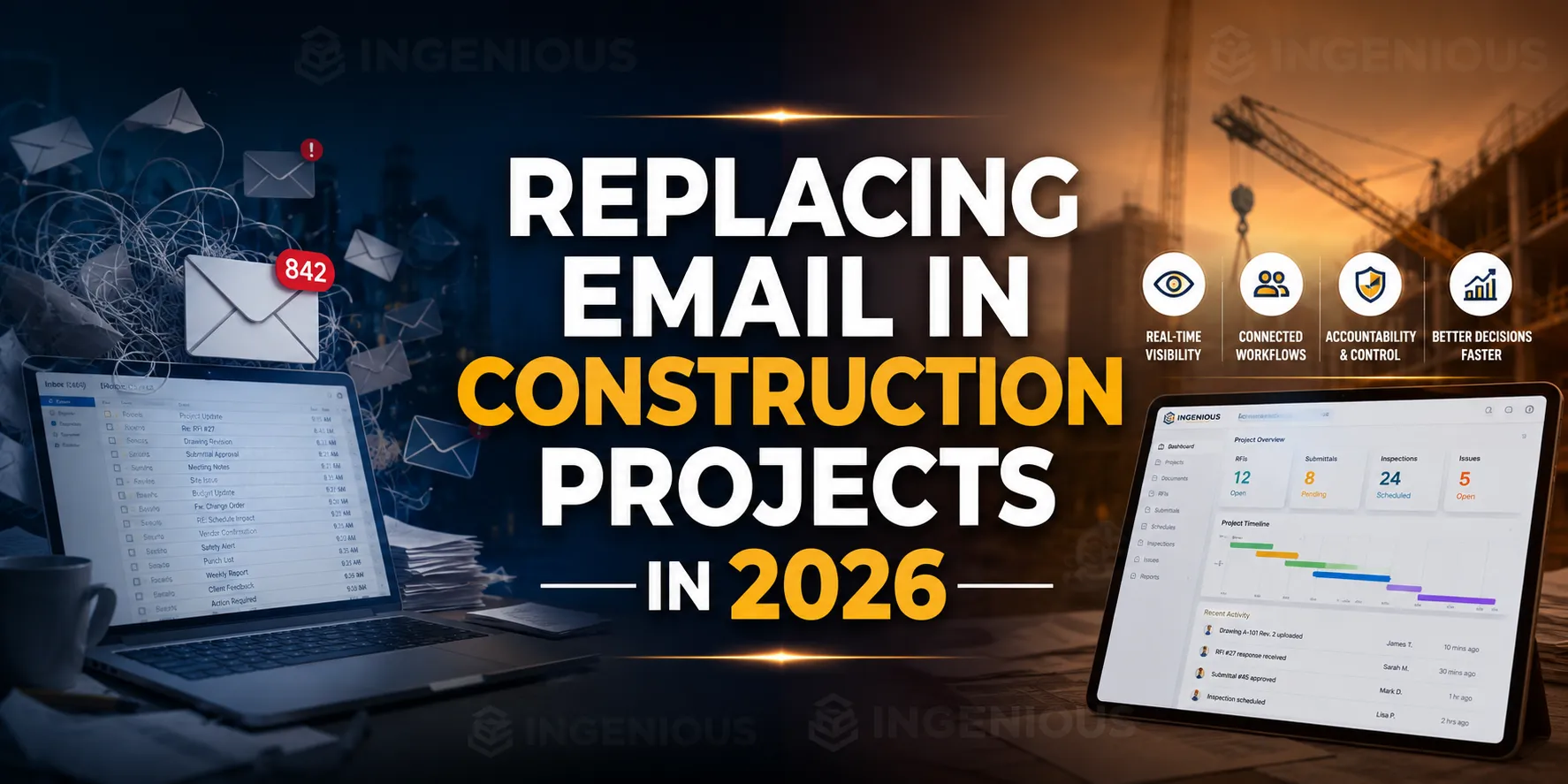
Email was never designed to run construction projects. It was designed for communication, not coordination.
For years, construction teams relied on inboxes because projects were smaller, workflows were simpler and fewer stakeholders needed to stay aligned in real time. But modern construction projects operate very differently.
Today’s projects involve:
All moving simultaneously across fast-changing schedules, budgets, drawings, approvals and documentation. As project complexity has increased, email has become one of the biggest operational bottlenecks in construction project management.
Important information gets buried. Teams work from outdated documents. Approvals disappear inside long threads. RFIs become difficult to track. And no one has a clear real-time view of project status.
This is why more construction teams are replacing email-centric workflows with connected construction project management platforms. The shift is not just about communication. It is about visibility, accountability, coordination and operational control.
Email still plays an important role in project management. It is useful for external communication, formal notifications, client updates and sharing information between stakeholders who may not work inside the same system.
In construction, project management emails are often used for:
The problem is not the email itself. The problem is when email becomes the primary system for managing construction workflows.
Modern projects generate too much operational complexity for inboxes to function as the central source of truth. Important information becomes fragmented across conversations instead of being tied directly to schedules, RFIs, drawings, approvals and field execution.
That is why construction teams are increasingly shifting from email-based project management toward centralized construction management platforms.
Many construction teams still rely heavily on project management emails because that is how projects have historically been coordinated. Over time, however, email-driven workflows create operational friction.
Teams begin spending large amounts of time:
As project complexity increases, communication becomes harder to manage consistently. This creates delays, duplicated work, unclear accountability and gaps between office teams and field teams. Email supports communication, but it does not provide structured project coordination.
Construction communication problems rarely come from lack of messages. They come from fragmented workflows. On many projects, critical information is spread across:
That fragmentation creates operational risk.
Teams spend time searching for updates instead of managing execution. Decisions become difficult to trace. Approvals slow down. Field teams struggle to confirm the latest revisions. Owners lose visibility into project status.
As projects become larger and more complex, email stops scaling effectively. Modern construction teams are increasingly adopting centralized construction communication software and workflow platforms because they provide:
The goal is not to eliminate communication. It is to connect communication directly to project workflows.
Email works reasonably well for conversations. It works poorly for operational coordination.
Construction projects involve constant changes across schedules, drawings, RFIs, submittals, procurement, budgets and field execution. When those workflows depend heavily on email, problems begin appearing quickly.
One of the biggest issues is version confusion.
A revised drawing may be sent by email, but there is no guarantee everyone is working from the latest file. Teams end up checking inboxes, shared folders and downloaded PDFs trying to confirm which revision is current. RFIs also become difficult to manage. Responses get buried inside long email chains, ownership becomes unclear and teams lose visibility into what is still open or overdue.
Approval workflows create another challenge. Important decisions often happen informally across inboxes without structured tracking or auditability. Later, during disputes or change events, reconstructing project history becomes difficult.
Field coordination suffers as well. Site teams do not work efficiently inside inboxes. They need fast access to drawings, issues, schedules, inspections, punch items and action lists directly from the field.
This is one of the most important distinctions in modern construction management. Communication is simply the exchange of information.
Coordination is the structured management of workflows, responsibilities, approvals, schedules and project execution.
Email supports communication. It does not coordinate construction workflows.
For example:
Sending a drawing revision by email is communication. Tracking who reviewed it, who approved it, whether subcontractors received it and how it affects scheduling is coordination.
Modern construction project management platforms are designed around coordination rather than isolated communication. That shift fundamentally changes how projects operate.
One of the biggest advantages of modern construction project management software is reducing email overload. Instead of relying on long email chains for every update, teams can manage communication directly inside connected workflows.
For example:
This significantly reduces the amount of manual communication required to keep projects moving.
Teams spend less time forwarding updates or searching for information and more time managing execution. For owners and project managers, this also improves visibility because project status becomes easier to track in real time rather than through disconnected email summaries.
Email was designed as a general communication tool. Construction projects require operational systems. Modern construction workflows depend on relationships between:
Email does not connect these systems together.
A project manager may approve a change in one thread while procurement is working from another document version and field teams are referencing outdated information entirely. This creates disconnected decision-making across the project lifecycle.
Construction project management platforms solve this problem by centralizing workflows into one connected environment where information remains visible, traceable and actionable.
Leading construction teams are increasingly moving toward centralized construction collaboration platforms that combine communication, documentation and workflow management inside one system.
Instead of relying on fragmented inboxes, teams manage:
inside connected construction management software. This changes project coordination significantly.
Instead of searching through inboxes for updates, teams can see project status in real time. Approvals remain traceable. Drawings stay centralized. Responsibilities become visible across stakeholders.
For owners and developers, this also improves governance, reporting and operational visibility across projects.
Modern construction management platforms do not eliminate communication. They replace fragmented communication workflows with structured operational coordination.
Instead of:
teams work directly inside connected workflows.
For example: An RFI can be submitted, assigned, tracked, answered, documented and linked to drawings and schedules inside the platform itself.
A drawing revision can automatically update stakeholders while maintaining version history and audit visibility. Meeting action items can be assigned with deadlines and tracked through completion rather than disappearing inside notes or inboxes. This improves both execution speed and accountability.
Owners and developers often experience the downside of email-driven projects more severely than contractors.
When project communication is fragmented, owners lose visibility into:
Instead of receiving structured real-time visibility, they depend on manually assembled updates and disconnected reporting.
This is one reason why owner-side construction management software adoption is growing rapidly.
Modern construction administration platforms help owners maintain:
As projects grow larger and involve more consultants, trades and vendors, this visibility becomes increasingly important.
Many construction teams do not realize how much operational time is lost to fragmented communication until workflows begin breaking down consistently.
Common warning signs include:
These are usually signs that communication systems are no longer supporting project complexity effectively.
The difference between email-based construction workflows and modern construction project management platforms becomes obvious as projects grow more complex.
With email-driven workflows, communication is fragmented across inboxes, attachments, spreadsheets and disconnected tools. Project updates are difficult to track, approvals are often handled manually and important information can easily disappear inside long threads.
Version control also becomes a constant challenge. Teams spend time trying to confirm whether they are working from the latest drawing, document or revision. Field communication slows down because updates are not connected directly to project workflows.
Construction project management platforms solve these problems by centralizing communication, documentation and coordination inside one system.
Instead of scattered conversations, teams gain:
The goal is not simply improving communication. It is creating a system where project information stays visible, traceable and actionable across the entire construction lifecycle.
Not all construction communication tools solve the same problems. The most effective platforms combine communication with workflow coordination and operational visibility.
When evaluating construction project management software, look for:
The goal is not simply sending messages faster. It is reducing operational friction across the entire project lifecycle.
INGENIOUS.BUILD is designed to centralize construction workflows so teams spend less time chasing information and more time managing execution.
The platform connects:
inside one connected construction management environment.
Instead of relying on disconnected inboxes and spreadsheets, project stakeholders can coordinate directly within live workflows tied to actual project execution.
This improves visibility, accountability and collaboration across owners, architects, contractors and field teams.
Email is still useful in construction. But it should support project workflows, not function as the workflow itself.
Modern construction projects move too quickly and involve too much operational complexity for fragmented communication systems to scale effectively.
That is why more teams are replacing email-centric coordination with connected construction project management platforms that improve visibility, accountability, and execution across the full project lifecycle.
INGENIOUS.BUILD helps construction teams centralize workflows, reduce communication fragmentation and manage projects with greater operational clarity. Book a demo to see how connected construction management workflows reduce project friction and improve coordination across stakeholders.
Construction teams are replacing email because modern projects require centralized visibility, structured workflows, document control and real-time coordination that inboxes cannot provide effectively.
Common issues include outdated documents, buried RFIs, fragmented approvals, poor version control, slow coordination and lack of audit-ready project records.
Modern construction teams use construction management platforms that centralize RFIs, submittals, schedules, approvals, documents and project communication inside one connected system.
Construction communication software helps project stakeholders coordinate workflows, documentation, approvals and field updates across construction projects.
Centralized communication improves visibility, accountability, coordination speed, document control and operational transparency across all project stakeholders.

INGENIOUS.BUILD
.svg)
.svg)



Company Type

Product Solutions
Information
.svg)
Speak to a Product Specialist
Streamline your Development & Construction projects with our cutting-edge project management software.
Discover why people are switching to INGENIOUS today!
By submitting this form, you agree with our Privacy Policy.