|

MENU


.svg)
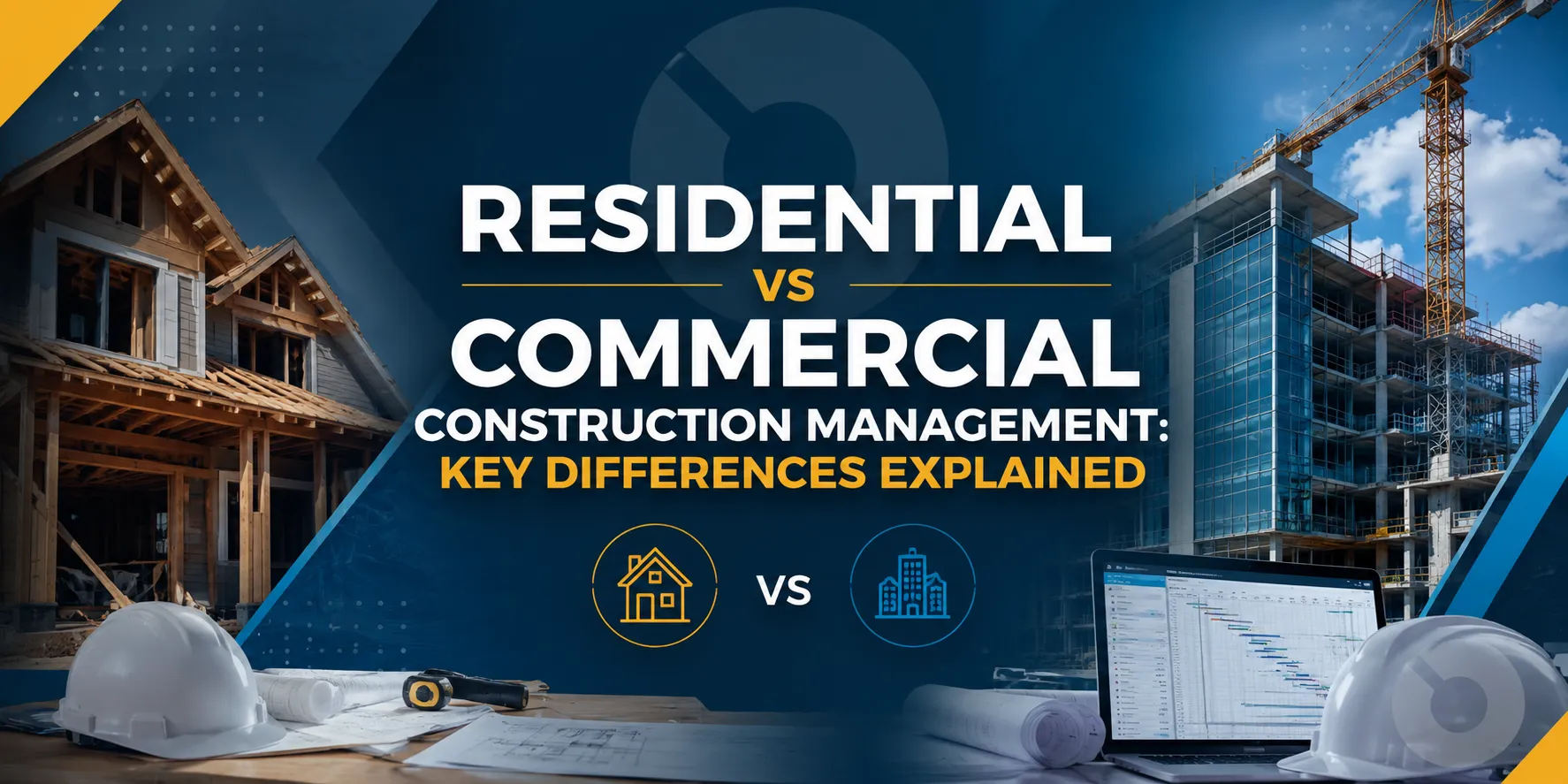
Residential and commercial construction may appear similar from the outside.
Both involve budgets, schedules, contractors, permits, procurement, inspections and project coordination. But operationally, they function very differently.
The difference between residential and commercial construction management affects:
Understanding these differences is important for developers and owners, contractors, PMs and construction technology buyers, because the workflows, operational challenges and management systems required for each environment are often completely different.
This guide explains the difference between residential and commercial construction management, how the two sectors operate, and why construction software requirements increasingly diverge as projects scale.
Residential construction focuses on buildings intended for people to live in.
This includes:
Residential projects are often smaller in scale than commercial developments, although large multifamily or mixed-use residential projects can still become highly operationally complex.
Residential construction management typically emphasizes:
Many residential projects also involve more direct owner interaction throughout construction.
Commercial construction focuses on buildings intended for business, institutional, industrial or operational use.
This includes:
Commercial construction projects are usually larger, involve more stakeholders and require significantly more operational coordination.
Commercial construction management often includes:
The scale of coordination is typically much higher.
The biggest difference between residential and commercial construction is operational complexity.
Residential construction is often more relationship-driven and client-focused.
Commercial construction is usually process-driven and coordination-focused.
Residential projects generally involve:
Commercial projects typically involve:
This changes how projects are managed operationally.
Construction management workflows differ significantly between residential and commercial environments.
Residential construction managers often focus heavily on:
The operational environment is usually faster-moving and more relationship-oriented.
Smaller residential builders may still rely heavily on:
because projects are often less documentation-heavy.
Commercial construction management involves far more operational coordination.
Teams often manage:
This is why commercial construction teams are more likely to require centralized construction management platforms with connected workflows and real-time visibility.
The difference between residential and commercial buildings goes beyond size.
Commercial buildings are typically designed around:
Residential buildings are primarily designed around:
Commercial buildings also tend to involve:
That complexity directly affects construction management workflows.
Industrial construction is often considered separate from both residential and commercial construction because of its technical requirements.
Industrial projects include:
Compared to residential and commercial projects, industrial construction typically involves:
Operationally, industrial projects are often the most documentation-heavy and technically demanding.
Commercial construction costs are generally much higher than residential construction costs due to:
Commercial projects also typically involve:
Residential projects may have lower overall cost but can still experience profitability challenges when:
The management approach matters significantly in both sectors.
Profitability depends heavily on:
Residential construction may offer:
Commercial construction may offer:
However, commercial projects also carry:
The most profitable construction companies are usually not simply the largest.
They are the ones with the strongest operational systems and project visibility.
Stakeholder management differs significantly between residential and commercial projects.
Residential projects usually involve:
Communication is often more direct and relationship-based.
Commercial projects often involve:
This creates much more operational complexity around approvals, reporting and coordination.
Client expectations also differ significantly.
Residential clients often prioritize:
Commercial clients usually prioritize:
As a result, commercial construction teams often require more structured operational systems.
Small developers entering commercial construction often underestimate the operational difference between the two sectors.
Commercial projects generally require:
A workflow that functions adequately for residential projects may break down quickly on larger commercial developments with multiple consultants and contractors.
This is one reason many growing developers eventually adopt construction management platforms designed for more complex operational coordination.
AI adoption is growing across both residential and commercial construction, but the use cases often differ.
Residential construction budgeting tools frequently focus on:
Commercial construction AI tools increasingly focus on:
Commercial environments generate much larger operational datasets, which makes centralized construction management systems increasingly important for AI-driven reporting and forecasting.
Commercial construction projects generate significantly more operational data than residential projects.
Teams must coordinate:
Managing this through spreadsheets and disconnected systems becomes difficult at scale.
This is why commercial construction teams increasingly adopt centralized construction management platforms that connect:
inside one operational environment.
Residential construction teams may prioritize:
Commercial construction teams usually prioritize:
The larger and more complex the project environment becomes, the more important centralized coordination becomes.
INGENIOUS.BUILD is designed for operationally complex construction environments where visibility and coordination matter across multiple stakeholders and workflows.
The platform centralizes:
inside one connected operational system.
This helps owners, developers and contractors improve coordination across commercial projects while reducing workflow fragmentation and visibility gaps.
Residential and commercial construction management may share similar terminology, but operationally they are very different environments.
Residential projects are typically faster-moving and more relationship-driven.
Commercial projects involve significantly greater complexity around:
As projects scale, operational visibility becomes increasingly important.
That is why commercial construction teams are increasingly adopting centralized construction management platforms that improve coordination, reporting consistency, and project visibility across stakeholders.
INGENIOUS.BUILD helps commercial construction teams centralize workflows, reduce operational fragmentation, and manage projects with greater clarity and control.
Book a demo to see how connected construction management workflows improve visibility across commercial construction projects.
Residential construction focuses on housing and living spaces, while commercial construction focuses on business, institutional, industrial and operational facilities.
Residential construction management is usually more relationship-focused and lightweight operationally, while commercial construction management requires more formal coordination, reporting, procurement and documentation workflows.
Commercial construction can generate larger contracts and higher revenue potential, but it also involves greater operational complexity, overhead and risk.
Commercial projects involve more stakeholders, technical systems, approvals, procurement coordination, documentation requirements and compliance obligations.
Commercial construction teams often use centralized construction management platforms that support budgeting, scheduling, RFIs, approvals, procurement workflows, reporting and document control.
Residential construction focuses on housing, commercial construction focuses on business and institutional buildings and industrial construction involves technically specialized facilities like manufacturing and energy infrastructure.

INGENIOUS.BUILD
.svg)
.svg)


Company Type

Product Solutions
Information
.svg)
Speak to a Product Specialist
Streamline your Development & Construction projects with our cutting-edge project management software.
Discover why people are switching to INGENIOUS today!
By submitting this form, you agree with our Privacy Policy.