Nine Reasons Subcontractor Pay Applications Get Rejected
Explore nine common reasons subcontractor pay applications get rejected, from missing waivers and backup to billing errors and incomplete documentation.
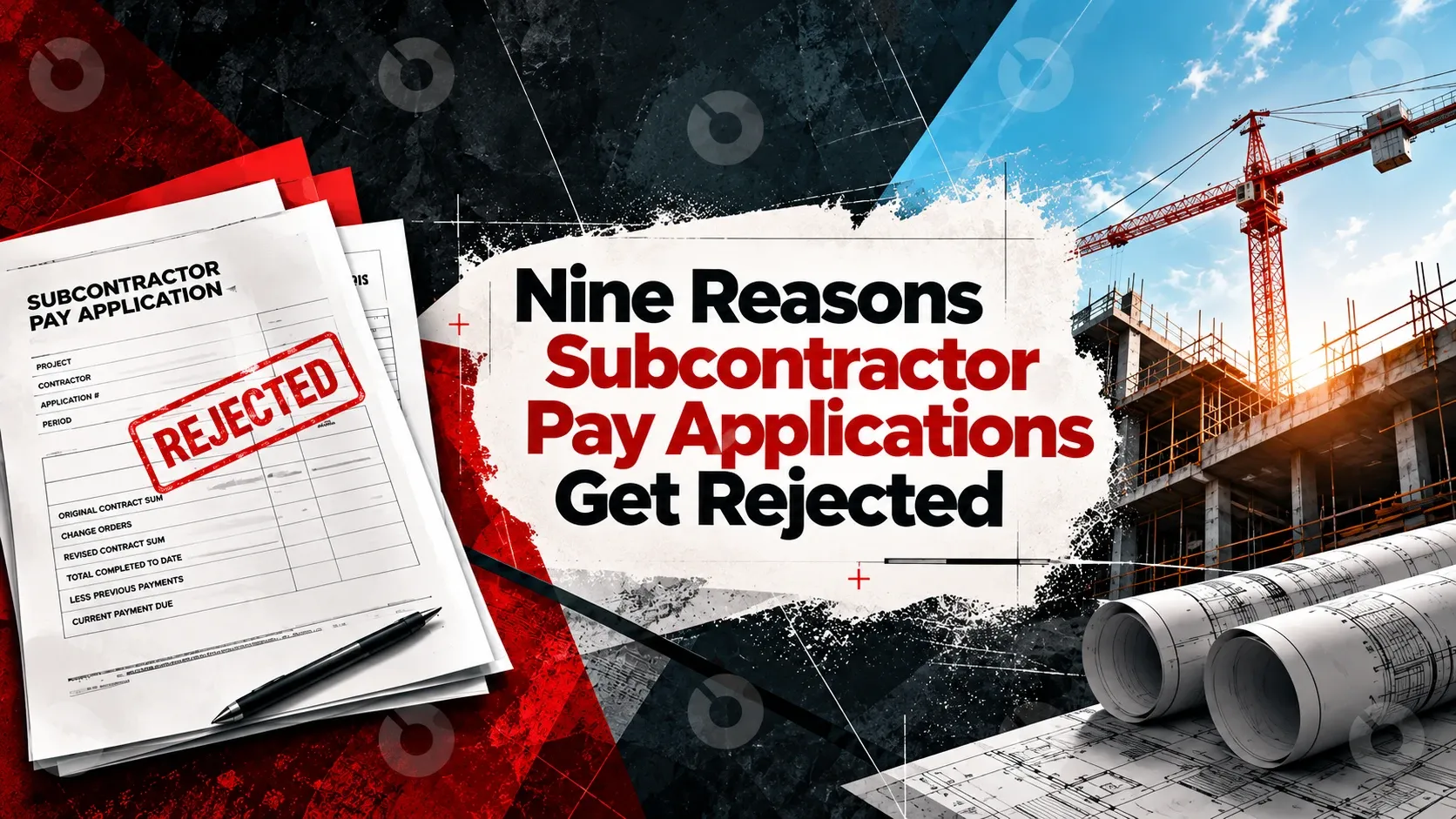
A rejected pay application rarely fails on substance. It fails because the schedule of values does not match the executed commitment, because change order work was billed inside base scope lines, because a lower-tier waiver is missing or misdated, because stored materials arrived without an invoice, or because your retainage math disagrees with the general contractor's ledger. Each of those is a 30-day cash event, and each is predictable.
What the GC's AP reviewer actually sees
Understanding the rejection means understanding the desk it lands on. The accounts payable reviewer at the general contractor is not reading your narrative. They open your G702 and G703 next to the commitment record in their accounting system and run a short list of checks.
Does the contract sum on the G702 match the executed subcontract plus approved change orders? Do the G703 line items and scheduled values match the commitment line for line? Does previous billing tie to what was actually paid, not what was submitted? Are the required waivers attached, dated correctly, and for the right amounts? Does retainage withheld equal the contract rate applied to work completed?
Anything that does not tie gets the whole application set aside, not the offending line. The reviewer is processing dozens of applications inside a three-day window before the GC's own owner application has to be assembled. They do not chase. They kick it back and move to the next one.
That is the mechanic worth internalizing: the cost of a defect is not proportional to its size. A $400 line coded to the wrong cost code holds up the entire $180,000 application, because the GC will not certify a document that does not reconcile.
Failure one: a schedule of values that does not match the executed commitment
This is the most common defect and the most self-inflicted. The subcontractor builds an SOV at buyout, the GC's project accountant enters the commitment with different line breakdowns or different values, and nobody reconciles the two until the first application.
The symptom is a G703 with lines the GC's system has never seen, or a contract sum that is off by the value of a change order executed after the SOV was locked. The reviewer cannot map your lines to their lines, so percent complete cannot be validated.
The fix is entirely on your side of the table and belongs before the first billing: get written confirmation that your SOV as submitted is the SOV loaded into the GC's commitment, with identical line descriptions, identical scheduled values, and a total that ties to the executed subcontract. Do it once, at buyout, and you never have to do it again on that job.
Failure two: front-loaded values the reviewer has seen before
Weighting mobilization, submittals and early-activity lines above their real cost is old practice, and every GC project accountant knows the pattern. The consequence is not usually a moral objection. It is a sustained argument about percent complete on every subsequent application, and a reviewer who now reads your submissions with suspicion.
A defensible SOV survives audit because the values reconcile to your own estimate and your own cost codes. The ones that do not turn every cycle into a negotiation you fund out of working capital.
Failure three: percent complete that does not match the field
Your foreman says the second floor rough-in is done. The GC's superintendent walked it on the 22nd and logged three areas still open. You bill 85 percent, the reviewer checks with the super, and the line comes back at 70.
Percent complete is the one number the GC verifies against an independent observer. Where the sub and the superintendent have not walked the work together before submission, the difference is discovered during review, which means during the window when there is no time left to argue.
Trades that hold a short pencil-copy walkthrough with the superintendent before the formal submission almost never lose a cycle to this. The disagreement happens on the 20th, when it costs a conversation, instead of the 3rd, when it costs a month.
Failure four: stored materials billed without documentation
Billing stored materials requires more than a line on the G703. Most subcontracts require a supplier invoice, proof of payment or a bill of sale, evidence the material is insured, evidence it is segregated and identified to the project, and for off-site storage, a warehouse receipt and sometimes the owner's prior written consent.
Submitting the line without the packet is a guaranteed hold. Worse, stored materials are often the largest single line on an early application, so the amount at risk is high precisely when your cash position is thinnest.
Assemble the packet when the material is delivered, not when the billing is drafted. The invoice is in your AP system three weeks before you need it; the photo of the tagged, segregated pallet takes ninety seconds on delivery day and is impossible to recreate later.
Failure five: unapproved change order work billed as base scope
You performed the work. The GC's PM told you to proceed. The change order is sitting unexecuted somewhere between the owner's rep and the owner. So you bury the cost in an existing line and bill an inflated percent complete.
The reviewer sees a line at 62 percent that the superintendent's log says has not moved since last month, and the entire application stops. You have also damaged the change order claim itself, because your own billing record now shows the work priced inside base scope.
Approved change orders belong on their own G703 lines, in the order they were executed, with the change order number in the description. Pending work stays off the application and inside a tracked pending log with the direction that authorized it. The discipline that keeps that log clean is the same discipline described in how to manage construction change orders in 7 steps, and the delay between field direction and execution is itself the thing to attack, which is covered in how to reduce change order delays.
Failure six: missing or misdated lower-tier lien waivers
Most subcontracts make waivers a condition precedent. The standard pattern is a conditional waiver from you for the current payment, plus unconditional waivers from every sub-subcontractor and supplier for the payment they already received.
| Waiver type | Who signs | Covers | Common defect |
|---|---|---|---|
| Conditional progress | Subcontractor | Current application amount | Amount does not match G702 line 9 |
| Unconditional progress | Lower tiers | Previous payment received | Submitted before funds cleared |
| Conditional final | Subcontractor | Final payment including retainage | Missing consent of surety |
| Unconditional final | Lower tiers | All payments to date | Supplier who never returned it |
The defect that costs the most cycles is the supplier who will not return a waiver on time. That is a process problem inside your own office: waiver requests should go out with the payment run, not with the next application. If you are waiting on the supplier when the GC is waiting on you, the calendar has already beaten you.
Jurisdictional statutory forms add a second trap. A generic waiver where a statutory form is required is legally deficient and will be rejected by any GC whose counsel has trained their AP team.
Failure seven: retainage math that disagrees with the ledger
Retainage rejections come from three places. The rate changed after a milestone and the modification was never executed, only emailed. Retainage was applied to stored materials when the subcontract excludes them, or excluded when it includes them. Or previously withheld retainage was released on one side of the relationship and not recorded on the other.
Your cumulative retainage balance must equal the GC's cumulative retainage balance every single cycle. When it drifts, it drifts silently for months and surfaces at closeout, when the disputed amount is the entire remaining value of your contract and your leverage is gone.
Failure eight: previous billing that ties to submitted, not paid
The G702 asks for less previous certificates for payment. Many subcontractor billing clerks pull the number from what was submitted last month, not what the GC actually certified. If any line was reduced in review, every subsequent application inherits the error and compounds it.
Reconcile against the payment received and the certified G702 returned to you, not your own prior submission.
Failure nine: late submission against a cycle you do not control
The subcontract states a date. The GC's internal deadline for rolling subcontractor applications into the owner application is usually earlier and often unwritten. Submitting on the contractual date rather than the operational one can still cost a full cycle.
Ask the project accountant, at buyout, for the actual internal cutoff and the owner's certification date. Then build your billing calendar backwards from it: waivers requested two weeks prior, superintendent walk five days prior, submission two days before the real deadline.
What you can fix alone, and what needs a shared record
Five of these nine are entirely inside your control: SOV discipline, defensible values, stored material packets, waiver chasing, and calendar management. Fix those and you remove most of the risk of a kicked-back application.
The other four are reconciliation failures. Percent complete, change order status, retainage balances and previous billing all depend on two organizations holding the same number in two different systems. Email and attached spreadsheets guarantee drift, because the correction is made in one copy and the other keeps circulating. The broader mechanics of running this well across a portfolio are covered in how contractors manage construction projects efficiently and in the practice of real-time cost tracking.
This is where a shared system earns its place. On INGENIOUS.BUILD, the subcontract, its schedule of values, every executed change order, the retainage position and each application against it are one record that both the trade and the general contractor are reading, so the reconciliation happens continuously rather than in the three-day window before certification.
The reputational effect matters as much as the cash. A trade whose applications certify clean every month, with waivers attached and percent complete that matches the walk, is the trade the project accountant processes first and the PM calls for the next job.
Frequently asked questions
What is the difference between AIA G702 and G703?
G702 is the one-page application and certificate for payment: contract sum, change orders to date, work completed, retainage, previous payments and current amount due. G703 is the continuation sheet, a line-by-line schedule of values showing scheduled value, prior billed, this period, stored materials and percent complete for each line.
Why do subcontractor pay applications get rejected most often?
The most common causes are a schedule of values that does not match the executed subcontract or its approved change orders, work billed against change orders that are still pending, missing or incorrectly dated lower-tier lien waivers, stored materials billed without invoices or proof of insured off-site storage, and retainage calculated differently from the general contractor's ledger.
Can a general contractor reject a pay application for missing lien waivers?
Yes. Most subcontracts make conditional waivers from the subcontractor and unconditional waivers from lower-tier suppliers and sub-subcontractors for the prior payment a condition precedent to payment. If any required waiver is missing, misdated, or names the wrong amount, the application is incomplete and the reviewer is contractually obliged to hold it.
Should a subcontractor bill for pending change order work?
No. Billing pending change order work inside base contract lines is the fastest way to lose an entire cycle, because it inflates percent complete on scope that has not moved and the reviewer cannot reconcile it. Carry approved change orders as their own schedule of values lines and track pending work separately until execution.
How is retainage shown on a pay application?
Retainage is withheld per the subcontract rate, calculated on work completed plus, depending on the terms, stored materials. It appears on the G702 as a deduction from the total completed and stored to date, producing the amount due this period. Reduced retainage after a milestone must match the executed modification, not an email.
How long does pay application approval take in construction?
On a typical monthly cycle, a subcontractor submits around the 25th, the general contractor reviews and rolls it into the owner application early the following month, the owner or lender certifies and funds, and the subcontractor is paid on pay-when-paid terms. A rejection at any point usually costs a full cycle, not a few days.