Lien Waiver Management: The Gate on Every Draw, Not a Closeout Task
See why lien waivers should control every payment draw, not just closeout, and how better tracking protects owners from payment and lien risk.
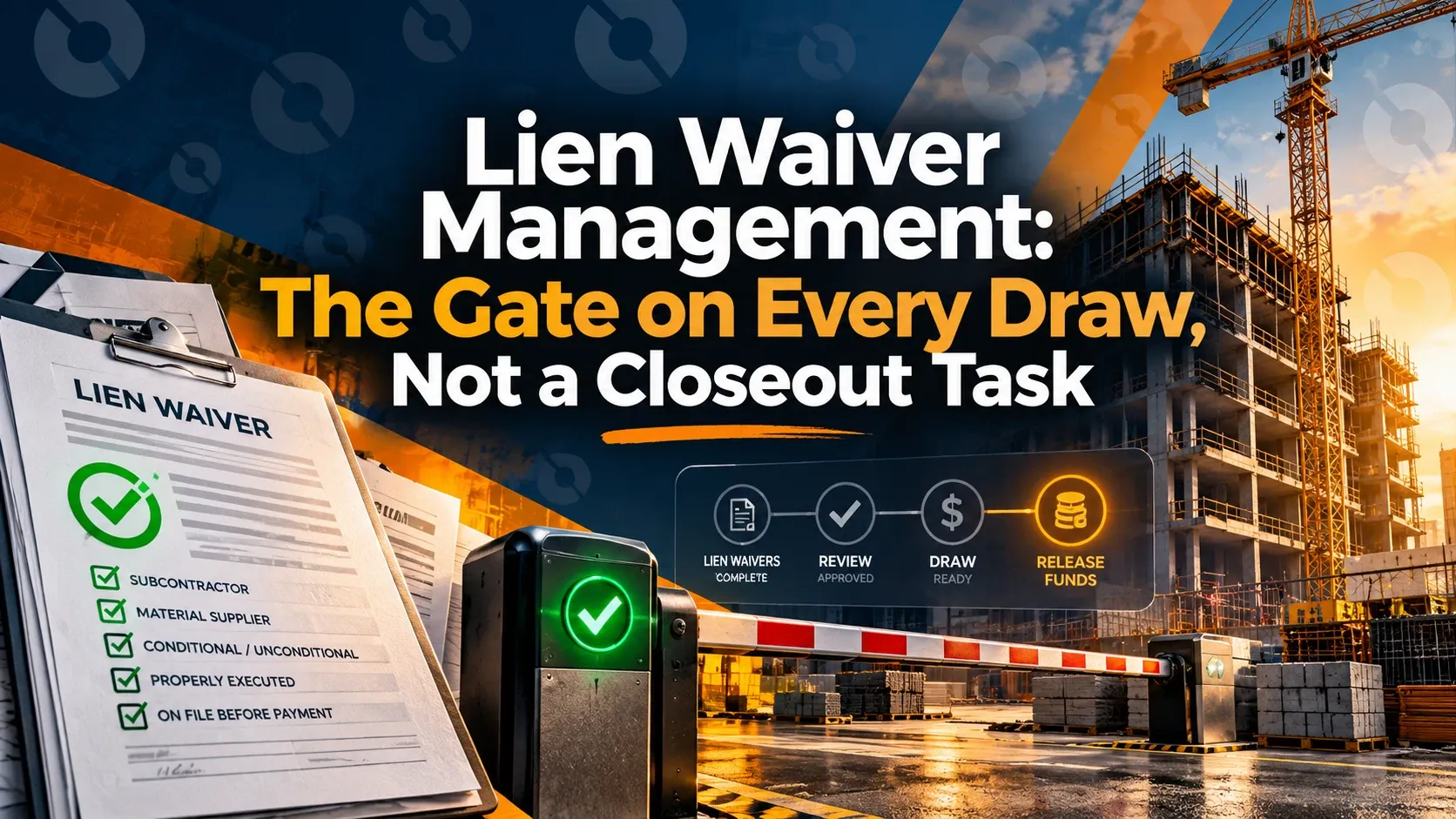
A lien waiver is the document that releases a party's right to file a mechanic's lien against the property for work already paid. On a GC-run project it is not closeout paperwork, it is the gate on every draw: the owner's lender will not fund a requisition until the conditional waivers for the current period and the unconditional waivers for the prior period are complete down through every tier. One missing supplier waiver holds the entire requisition.
Why one second-tier waiver stalls a seven-figure requisition
The exposure runs past the party you contracted with. A drywall subcontractor can be paid in full and still leave the owner exposed if that sub never paid its board supplier, because the supplier's lien rights attach to the property, not to the subcontract. The owner's title company and lender know this, which is why the funding condition is written against the whole chain rather than the first tier.
The practical consequence is a cliff-edge dependency. A $4M requisition with forty-one line items does not get funded 97% because one supplier of one subcontractor has not returned a signed form. It gets held, in full, until the package is clean or the GC posts a bond or indemnity in place of the missing waiver.
That dependency is what makes waiver management a cost problem rather than a filing problem. The GC has already funded the work in place. Every week the requisition sits unfunded is a week of carried labor and material against the GC's own line of credit, and the cause is a one-page PDF that a plumbing sub's vendor in another state has not gotten around to signing.
Conditional vs unconditional lien waivers, and when each one is used
The distinction is about what triggers the release. A conditional waiver releases lien rights only if and when payment actually clears. An unconditional waiver releases them on signature, regardless of whether the money ever arrives. Signing an unconditional waiver before funds land gives away the only leverage a trade has.
| Conditional waiver | Unconditional waiver | |
|---|---|---|
| Releases rights | Only when payment clears | Immediately on signature |
| Exchanged | With the pay application, before payment | After the payment has settled |
| Covers | Current pay period | Prior pay period |
| Risk if misused | Low | Signer loses lien rights on money never received |
The two forms are also split by period, which is what produces the rolling ledger. In a typical cycle the subcontractor submits its pay application for May along with a conditional progress waiver for May, plus an unconditional progress waiver for April now that April's check has cleared. The GC assembles both sets and mirrors the same structure upward in its own requisition to the owner.
Final waivers follow the same split and carry more weight. A final unconditional waiver releases everything through completion, including retainage, so it is signed only after the final payment clears. Final conditional waivers go into the closeout package alongside the warranty and as-built documentation, and they are a routine holdup on retainage release when they were never collected during the job.
Several states prescribe statutory forms — California, Texas, Florida, Georgia, Arizona, Massachusetts, Michigan, Mississippi, Missouri, Nevada, Utah and Wyoming among them — and a waiver that does not conform to the required form can be unenforceable. Form selection belongs to the project jurisdiction, not to the template the accounting department has used for a decade.
Lien waiver requirements by tier
Tier determines who signs, which form applies, and how hard the document is to get. The further down the chain, the less relationship the GC has with the signer and the longer the turnaround.
- First tier (subcontractors and direct vendors). Contractual relationship with the GC, payment leverage is direct, and the subcontract can make a complete waiver package a condition of payment. These are the easy ones.
- Second tier (sub-subcontractors and the subs' material suppliers). No contract with the GC. Collection runs through the subcontractor, who has no particular urgency once its own check is in hand. This is where most draw delays originate.
- Third tier and below (suppliers to sub-subs, equipment rental, fabricators). Often invisible until a preliminary notice arrives. Frequently out of state, frequently working from a national credit department that processes waiver requests on its own schedule.
- Parties who served preliminary notice. Any party that filed a notice is a known claimant and belongs on the waiver log whether or not anyone identified them at buyout.
The common failure is treating the tier-two list as something to discover at the first pay application. By then the subcontractor is mobilized, has no incentive to disclose its vendors, and the GC has lost the moment where disclosure was cheap.
How to collect lower-tier lien waivers without chasing them
Collection is won at buyout. The subcontract should name the lower-tier parties required to furnish waivers, specify the form by jurisdiction, state the due date relative to each pay application, and make payment contingent on a complete package. A sub that will not disclose its vendor list before award is telling you something.
Four mechanisms do most of the work:
- Vendor disclosure at buyout. Require a schedule of sub-subcontractors and suppliers with contact information for the person who actually signs waivers, which is usually a credit manager, not the estimator you negotiated with.
- Joint checks where the credit risk is real. A joint check to the sub and its supplier resolves the payment and the waiver together, and it is far easier to arrange at buyout than mid-job.
- Preliminary notice intake as a trigger. Every preliminary notice that arrives adds a row to the waiver log for that commitment. Notices are not filed and forgotten, they are the GC's free early warning that a party it never contracted with has lien rights.
- Payment contingency enforced on the first cycle. The first time a subcontractor's payment is held for an incomplete waiver package, the behavior changes for the rest of the job. The tenth reminder email does nothing.
Building a lien waiver tracking process tied to commitments
A folder of signed PDFs is a filing cabinet, not a tracking system. The question a GC needs answered on the 20th of the month is narrower: for this requisition, which required waivers are outstanding, from which tier, against which commitment, for how much.
That means the waiver record attaches to the commitment and the pay period, not to a document library. Each row carries the commitment, the tier, the party, the waiver type, the period covered, the amount, the through-date, and status. Status is binary — received and reconciled, or not — because "sent for signature" does not fund a draw.
Reconciliation is the part most processes skip. A waiver for $186,000 against an approved current payment of $214,500 is not a complete waiver, it is a partial release with a $28,500 gap and nobody notices until the title company does. The amount on the waiver and the through-date have to be checked against the approved pay application line, and anything with exception language for disputed amounts flagged before the requisition goes out. This is the same reconciliation discipline that construction cost tracking demands of commitments and change orders, applied to the release documents that sit downstream of them.
The admin cost is the argument. A project engineer assembling a forty-commitment requisition by hand pulls waiver PDFs from email, opens each one to read the amount, cross-references the pay application in a separate system, rekeys the shortfalls into a spreadsheet, and sends reminder emails. Two days a month on a document that contains four fields. Multiply by projects in flight and it is a headcount, paid out of margin, producing nothing a client would value.
Where the ledger lives
The waiver log belongs where the commitments and pay applications already are, because every piece of data it needs — approved current payment, period dates, retainage, the subcontractor's vendor list — lives there. Keeping it in a parallel spreadsheet guarantees that the two disagree during the week you can least afford it.
INGENIOUS.BUILD handles waivers this way: required waivers generate from the commitment and the pay period, conditional and unconditional status track against each payment cycle, lower-tier parties sit on the same record as the subcontract they flow from, and the requisition package shows what is outstanding before the deadline rather than after. The requisition stops being an assembly exercise and becomes a status check.
None of this removes the supplier in another state who signs when they feel like it. It removes the two days of discovery that currently stand between the GC and knowing that supplier is the problem — and it moves that discovery from the day before the draw deadline to the day the pay application was submitted.
Frequently asked questions
What is the difference between a conditional and an unconditional lien waiver?
A conditional waiver releases lien rights only once payment actually clears, so it is safe to sign before funds arrive. An unconditional waiver releases those rights immediately on signature, whether or not the money ever lands. Standard practice: exchange conditional waivers with the pay application, unconditional waivers after the payment settles.
Why does a general contractor need lien waivers from a subcontractor's suppliers?
Anyone who supplies labor or material to a project can file a lien against the property, including parties with no contract with the general contractor. A second-tier supplier that goes unpaid can lien the owner's property even after the GC has paid the subcontractor in full, so the GC collects waivers down the chain to clear that exposure.
When should lien waivers be collected during the pay application cycle?
Conditional waivers for the current period are collected with the subcontractor's pay application, before the general contractor submits its requisition to the owner. Unconditional waivers covering the prior period are collected after that payment has cleared, which makes each month's requisition package depend on last month's funds actually arriving.
What should a lien waiver amount be checked against?
The waiver amount should reconcile to the approved current payment on that subcontractor's pay application for that period, and the through-date should match the period end. Waivers that cite a lump sum with no period, omit retainage treatment, or carry exception language for disputed amounts should be rejected before the requisition is assembled.
How can a GC enforce lower-tier lien waiver requirements?
Enforcement starts in the subcontract: list the lower-tier parties required to furnish waivers, set the form and the due date relative to each pay application, and make the subcontractor's payment contingent on a complete package. Collect the vendor list at buyout, before mobilization, when the subcontractor still wants the award.
Do lien waiver requirements vary by state?
Yes. Several states, including California, Texas, Florida, Georgia, Arizona, Massachusetts, Michigan, Mississippi, Missouri, Nevada, Utah and Wyoming, prescribe statutory waiver forms, and using a non-conforming document can leave the waiver unenforceable. Form selection should be driven by project jurisdiction, not by whatever template the accounting department has used before.