Informative
What Is Capital Project Delivery (and How It Differs From Construction Management)
Learn what capital project delivery means, how it differs from construction management, and how owners manage funding, planning, execution, and portfolio performance.
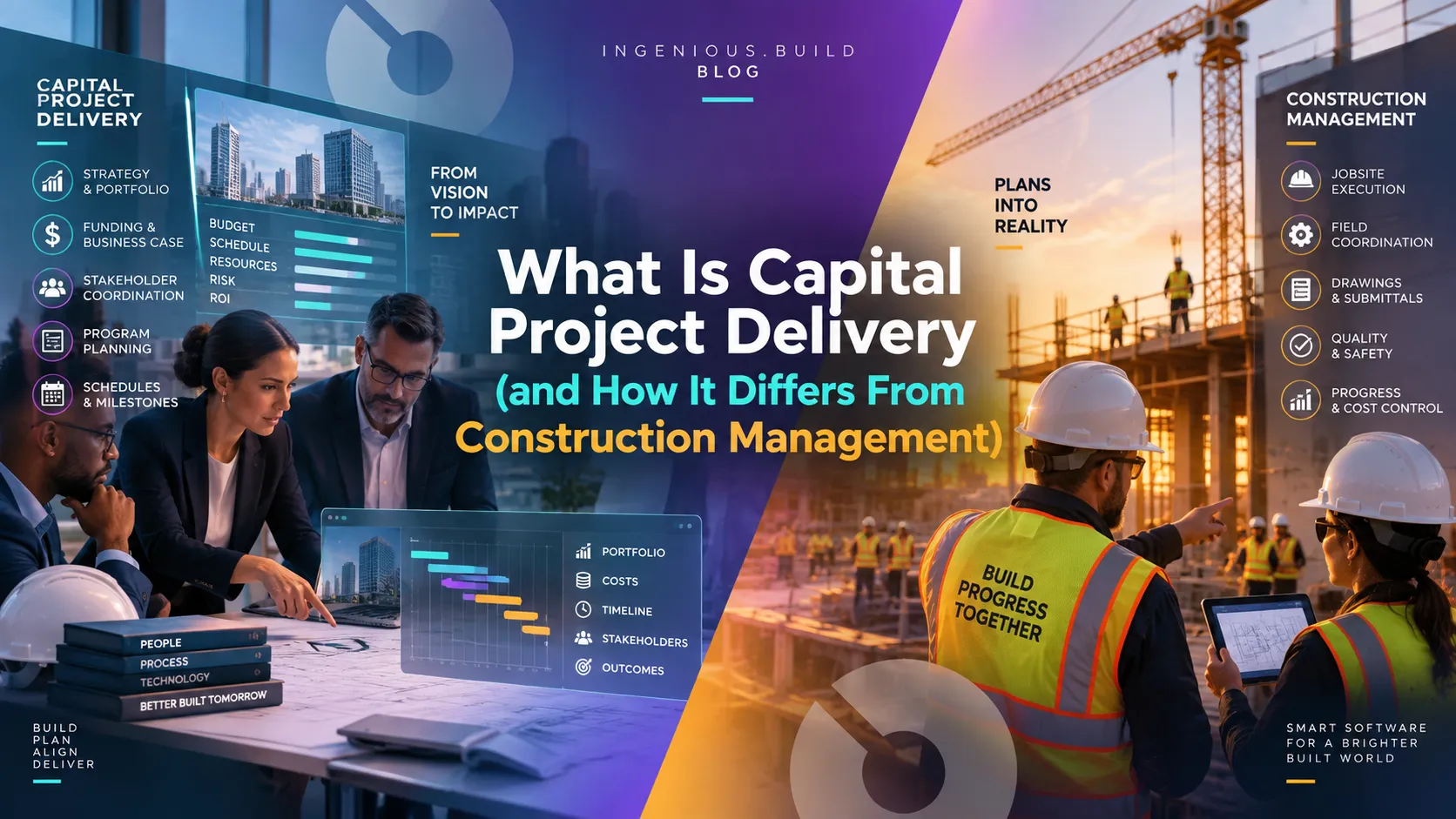
Two people can stand in front of the same half-built hospital and describe completely different projects.
For the general contractor, the project began at notice to proceed and ends at substantial completion. Roughly two years, one contract, a defined scope.
For the health system that owns it, the project began four years earlier when a board approved a capital plan, and it won't end until the building is commissioned, occupied, and performing against the case that justified funding it. Seven years, dozens of contracts, and a number that has to be defended to a board every quarter along the way.
Both are managing the same building. Only one of them is doing capital project delivery.
What capital project delivery is
Capital project delivery is the owner-side discipline of taking a capital investment from initial business case through planning, funding, design, procurement, construction, commissioning and handover into operation. It covers the full lifecycle of the asset's creation rather than the construction window alone, and it's concerned with whether the investment achieves what it was funded to achieve, not only whether the building was built correctly.
That's the whole definition. Everything below unpacks it.
What makes a project a "capital" project
The word capital isn't decorative. It comes from accounting, and the distinction genuinely matters because it determines who approves the spend and how it's reported.
Capital expenditure creates or materially improves an asset with a useful life beyond the current period. It sits on the balance sheet and depreciates over time. Operating expenditure covers running costs and hits the income statement in the period it's incurred.
Replacing a roof is typically capital. Patching a roof is typically maintenance. Most organizations set a dollar threshold plus a useful-life test to draw the line, and where exactly it falls varies by organization and jurisdiction.
The practical consequences are real. Capital spend usually requires board or executive approval, it's often funded differently from operations through bonds, grants, debt or dedicated reserves, it's planned on a multi-year horizon, and it's reported to lenders, investors or the public against that plan. None of that applies to an operating expense.
This is why owners have capital planning departments and contractors don't. The approval and reporting machinery exists because of how the money is classified.
The capital project lifecycle
Most owners run something resembling this sequence, with different names depending on the sector.
- Strategic planning and business case. What problem does this solve, does it fit the organization's strategy, what alternatives exist. This stage often kills projects, which is the point.
- Capital planning and prioritization. The project competes against other candidates for limited funding. Scoring, ranking, scenario modeling, and eventually a place in an approved capital plan.
- Funding authorization. Board approval, bond issuance, grant award, debt arrangement. The money becomes real and reporting obligations attach to it.
- Design. Concept through construction documents, with the owner managing the design team and reconciling program against budget as the design develops.
- Procurement. Bidding or negotiating the construction contract, selecting a delivery method, and awarding.
- Construction. The phase most people picture. From the owner's seat this is contract administration, change order governance, payment certification and progress verification, not building.
- Commissioning and handover. Systems tested, documentation transferred, facilities teams trained, occupancy permits obtained.
- Operations and benefits realization. Did the asset deliver what the business case promised. Very few organizations formally close this loop, which is why the same optimistic assumptions keep appearing in new business cases.
Construction, the part that dominates the conversation, is one stage of eight.
Stage gates and why the front end decides everything
Most mature capital programs run a stage-gated process, where the project has to clear a defined decision point before advancing to the next phase. Each gate is a genuine off-ramp: decision-makers can fund the next stage, send it back, or stop.
The front-end portion of this has a name. Front-End Loading, sometimes called front-end planning, divides early definition into three phases. FEL-1 assesses the business case and strategic alternatives. FEL-2 develops and selects a concept. FEL-3, also called FEED in industrial contexts, defines scope, cost, schedule and execution plan in enough detail to authorize full funding. The approach originated in oil, gas and petrochemicals in the 1980s and spread into infrastructure and buildings.
Here's the part worth knowing. Research by Independent Project Analysis, drawn from more than 25,000 capital projects, found that the completeness of front-end loading is the single best predictor of a project's safety, cost, schedule and operability outcomes. Not contractor selection. Not execution discipline. How well the project was defined before anyone broke ground.
That finding reframes where owner attention should go. The decisions that determine whether a capital project succeeds are largely made before the construction phase that gets all the software, all the meetings and most of the management energy.
Why capital projects overrun
If front-end definition decides outcomes, it's worth knowing what goes wrong there. Bent Flyvbjerg's research at Oxford, drawn from a large database of completed projects, found average cost overruns of roughly 45% on rail projects, 34% on bridges and tunnels, and 20% on roads, measured in real terms.
He identifies two causes, and the distinction matters because they need different remedies.
Optimism bias is unintentional. Planners systematically underestimate cost and duration and overestimate benefits, the same way people underestimate how long any task will take. It's a cognitive pattern, not a character flaw, and it shows up even among experienced professionals working in good faith.
Strategic misrepresentation is deliberate. Costs get lowballed and benefits inflated because that's what gets a project approved. In environments with political or organizational pressure to proceed, the incentive structure rewards the optimistic estimate, and the people who made it are rarely still accountable when the real number arrives.
The proposed remedy is reference class forecasting: instead of building an estimate bottom-up from this project's assumptions, look at the actual outcomes of a class of comparable completed projects and adjust accordingly. It's the outside view rather than the inside view. The approach has been endorsed by the American Planning Association and used by governments including the UK, Netherlands, Denmark, Switzerland and Hong Kong. The UK Department for Transport's guidance applies optimism bias uplifts by project type, with rail and fixed links carrying the largest.
Worth noting that this isn't settled. Several researchers dispute how much of the overrun problem is genuinely behavioral versus driven by scope change, procurement structure and execution factors. The debate is live.
What isn't disputed is the practical lesson for owners: an estimate built entirely from the inside, without checking it against what similar projects actually cost, is the normal way capital projects get approved and a significant part of why they overrun. If your organization has completed projects, its own historical data is a reference class, and most owners have never assembled one.
Capital project delivery versus construction management
These terms get used as synonyms and they describe different jobs.
Who's doing it. Capital project delivery is owner-side, run by the organization funding and keeping the asset, or by an owner's representative acting for them. Construction management is the discipline of building the thing, whether that's a GC, a CM at risk, or a CM agency.
When it starts and stops. Capital project delivery spans business case to benefits realization. Construction management spans mobilization to closeout. Different windows, and the delivery window contains the construction one.
What success means. For construction management, success is the building delivered on time, on budget, safely, to spec. For capital project delivery, success is the investment achieving its purpose. A building can be built flawlessly and still fail as a capital project, if it was the wrong building.
The unit of management. Construction management manages a project. Capital project delivery manages a project inside a program inside a portfolio, competing for the same funding as everything else.
What's being controlled. Construction management controls cost against a contract. Capital project delivery controls capital against an approved plan, across multiple contracts and funding sources.
Who the reporting serves. A GC reports to the owner. An owner reports to a board, a lender, a bond market, a regulator or the public, each with different formats and obligations.
The risk profile. Construction management carries execution risk, meaning schedule, labor, means and methods. Capital project delivery carries investment risk: was this the right project, at the right time, at a defensible cost.
The overlap is the construction phase, where both parties are managing the same work from different sides of the contract. That shared window is why the terms blur.
Terms that get confused with it
- Capital planning decides which projects get funded. Capital project delivery executes the ones that do. Planning is a portfolio activity, delivery is a project and program activity, and they connect through the approved capital plan.
- Capital project management is often used interchangeably with capital project delivery. Where people distinguish them, management refers to running an individual project and delivery to the end-to-end system including governance and funding.
- Program management coordinates related projects sharing funding, governance or objectives. A hospital system's five-year facilities program is a program; the new patient tower is a project within it.
- Project controls is the cost, schedule, risk and reporting discipline that supports delivery. A function inside it, not a synonym for it.
- PMIS, meaning project management information system, is the software category owners use to run capital project delivery.
- Owner's representative is a firm or individual performing capital project delivery on an owner's behalf, common where the owner lacks in-house capacity or is running more projects than their team can carry.
- Project delivery method is a different thing entirely, despite sharing the word. It refers to how a specific project is contracted and built: design-bid-build, design-build, construction manager at risk, or integrated project delivery. Capital project delivery is the owner-side discipline; the delivery method is one decision made within it, at the procurement stage. An owner practising capital project delivery chooses a delivery method for each project, and may choose differently on different projects in the same program.
Who does what
A capital project involves several parties with genuinely different jobs.
The owner funds the asset, keeps it, and carries the investment risk. The owner's representative manages delivery on the owner's behalf. The design team develops the design and typically performs construction administration within their scope. The general contractor or construction manager builds it and manages the trades. Subcontractors perform the work. On institutional and public projects, add funding bodies, regulators and community stakeholders with approval authority or reporting claims.
The owner is the only party present for the full lifecycle. Everyone else joins and leaves.
Why owners think in programs, not jobs
This is the mental model shift that explains most of what follows.
A general contractor thinks in projects because that's how the work arrives and how it's paid for. One project, one contract, one P&L.
An owner with a capital program thinks in portfolios because the money is shared. Approving one project means declining another. A delay in one frees capacity that another could use. Funding drawn from a bond issue carries reporting obligations across every project it touches. The unit that matters isn't the job, it's the plan.
Three consequences follow.
Comparability beats depth. Knowing precisely where one project stands is less useful than knowing how all fifteen compare. A report that requires opening each project separately doesn't answer the question being asked.
Money is traced by source, not just by project. When a program draws on bonds, grants and general funds, spend has to be attributable to the right source because each reports differently. This single requirement drives more owner software decisions than any other.
Consistency has compounding value. If every project documents differently, cross-project analysis is impossible and the organization never learns anything from its own history. Standardization is worth more to an owner than it is to a contractor.
How owners measure delivery success
Contractors measure against a contract. Owners need different instruments, and most use fewer than they should.
- Variance to approved budget, not to the contractor's contract value. These are different numbers. The approved capital budget includes design fees, owner contingency, FF&E, permits and soft costs that never appear in a construction contract.
- Variance to the authorized schedule, measured from funding authorization rather than notice to proceed. A project that took eighteen months to get through design after approval has already consumed schedule the board was counting on.
- Estimate accuracy over time. How did the estimate at each gate compare to the final cost, across your last ten projects. This is the single most useful metric most owners don't track, and it's what builds a reference class.
- Change order rate by cause. Not just how many, but whether they trace to design gaps, field conditions or owner-driven scope change. Each points at a different fix, and only one of them is the contractor's problem.
- Forecast reliability. How close was your six-month-out portfolio spend forecast to actual. If it's consistently wrong in the same direction, the problem is systematic rather than situational.
- Benefits realization. Did the asset do what the business case said it would. Rarely measured, which is precisely why the same assumptions keep getting approved.
The pattern worth noticing: most of these require data from multiple projects over time. An owner who can't compare across their own portfolio can't measure any of them, which is a large part of why capital delivery improves slowly in many organizations.
It looks different by sector
The discipline is consistent. The constraints aren't.
- Healthcare builds on operating sites where infection control governs phasing, clinical operations can't pause, and regulatory approval layers on top of normal permitting.
- Higher education works around academic calendars, funds from a mix of bonds, state allocations, grants and donations, and manages a perpetual deferred maintenance backlog alongside new construction.
- Public infrastructure carries procurement rules that constrain who can be selected and how, prevailing wage obligations, public records requirements, and political timelines that don't follow project logic.
- Corporate real estate moves fastest and is most sensitive to business change, since a facility approved for a growth plan can become surplus before it opens.
- Industrial and energy runs the most formal stage-gate discipline, which is where FEL originated, and where downtime costs during tie-ins often exceed construction costs.
If you're evaluating how another organization runs capital delivery, check whether their constraints resemble yours before adopting their process.
Where owner-side delivery actually breaks down
Not usually in construction. The recurring failures cluster at the seams.
- Between planning and delivery. The capital plan lives in a spreadsheet, the projects run in another system, and the two reconcile at year-end if at all. Forecasts describe a portfolio that has already moved on.
- Between phases. Assumptions made during design don't transfer to the team running construction, so budget context is lost. The estimator who knew why a line was priced that way is on the next project.
- Between funding and spend. Money attributed to the wrong source, discovered during audit.
- Between construction and operations. The facilities team inherits a building with incomplete asset data and starts rebuilding records from closeout documents.
- Between projects. The same mistakes recur because nothing structured carried forward from the last one.
Every one of those is an information problem rather than a construction problem, which is why better contractors don't solve them.
Why contractor software doesn't fit owner work
Most construction software was built for contractors, because that's where the volume is. Used by an owner, it produces a predictable pattern: enormous detail about field execution, and no clean answer to what the portfolio costs.
The mismatches are specific. Contractor platforms organize around a single project rather than a portfolio. They handle cost against a contract rather than capital against an approved plan. They rarely support funding source attribution, because contractors don't need it. They cover the construction window, not planning or benefits realization. And they treat other parties as external participants, which is backwards when you're the owner and everyone else is working for you.
None of that makes contractor software bad. It makes it contractor software.
Owner-side delivery needs systems built around the owner's actual unit of work: capital allocated across a portfolio, spent through multiple contracts, drawn from multiple sources, reported to people who never set foot on the site.
Where INGENIOUS.BUILD fits
INGENIOUS.BUILD is built for the owner side of this. Capital planning connects to live project financials, so forecasts reflect what's actually committed rather than what was assumed at approval. Funding source tracking attributes spend by source across a program. Budgets, contracts, change orders and pay applications run in the same system as the RFIs, submittals and closeout documentation that generate them.
Every party works in their own workspace, connected on shared projects, which matches how capital delivery actually functions: the owner is constant, everyone else joins and leaves, and the owner needs the record to survive all of it.
It isn't a CPM scheduling engine or an accounting system, and you'll run those alongside it. What it's built to be is the system of record for capital project delivery, from the request that starts a project to the closeout package that ends it.
Book a demo to see how it handles a portfolio rather than a job.
The short version
Construction management is about building the thing correctly. Capital project delivery is about making sure it was the right thing, funded defensibly, delivered against a plan, and handed over in a state the organization can operate.
The construction phase is where the money is spent. The front end is where the outcome is decided. Owners who organize their attention and their systems around the full lifecycle rather than the construction window tend to get better results from the same contractors.
FAQ
What is capital project delivery?
The owner-side discipline of taking a capital investment from business case through planning, funding, design, procurement, construction, commissioning and handover into operation, measured by whether the investment achieved its purpose rather than only whether the asset was built correctly.
What's the difference between capital project delivery and construction management?
Capital project delivery is owner-side and spans the full lifecycle from business case to benefits realization, controlling capital across a portfolio. Construction management is builder-side, spans mobilization to closeout, and controls cost against a contract. The construction phase is where both overlap.
What is capital project management?
Often used interchangeably with capital project delivery. Where distinguished, capital project management refers to running an individual capital project while delivery refers to the end-to-end system including governance, funding and portfolio context.
What are the stages of the capital project lifecycle?
Strategic planning and business case, capital planning and prioritization, funding authorization, design, procurement, construction, commissioning and handover, then operations and benefits realization. Construction is one stage of eight.
What makes a project a capital project?
It creates or materially improves an asset with a useful life beyond the current accounting period, so the cost is capitalized on the balance sheet rather than expensed. Most organizations apply a dollar threshold alongside a useful-life test.
What is front-end loading in capital projects?
A stage-gated approach dividing early project definition into three phases: business case assessment, concept selection, and detailed project definition ending in full funding authorization. Research across more than 25,000 capital projects identifies front-end loading completeness as the single best predictor of cost, schedule, safety and operability outcomes.
What's the difference between capital planning and capital project delivery?
Capital planning decides which projects get funded by prioritizing candidates against available capital. Capital project delivery executes the approved ones. They connect through the approved capital plan.
Who is responsible for capital project delivery?
The owner organization, usually through a capital projects group, PMO or facilities department, often supported by an owner's representative managing delivery on their behalf.
Why don't contractor platforms work for owners?
They organize around a single project rather than a portfolio, track cost against a contract rather than capital against a plan, rarely support funding source attribution, cover only the construction window, and treat other parties as external participants, which is backwards when the owner is the one everyone reports to.
Why do capital projects go over budget?
Research by Bent Flyvbjerg identifies two main causes: optimism bias, where planners unintentionally underestimate cost and duration, and strategic misrepresentation, where costs are deliberately lowballed to secure approval. Measured average overruns include roughly 45% on rail, 34% on bridges and tunnels, and 20% on roads in real terms. Some researchers argue scope change and execution factors play a larger role than behavioral causes.
What is reference class forecasting?
Estimating a project by looking at the actual outcomes of comparable completed projects rather than building the estimate bottom-up from the current project's assumptions. It's endorsed by the American Planning Association and used by several national governments to correct optimism bias in capital estimates.
Is capital project delivery the same as a project delivery method?
No. Capital project delivery is the owner-side discipline covering the full investment lifecycle. A project delivery method, such as design-bid-build or design-build, is how one project is contracted and built, a decision made at the procurement stage within capital project delivery.
How do owners measure capital project delivery performance?
Variance to the approved capital budget rather than the construction contract, schedule variance from funding authorization, estimate accuracy across completed projects, change order rate broken down by cause, portfolio forecast reliability, and benefits realization against the original business case.
Does capital project delivery differ by sector?
The discipline is consistent but constraints differ significantly. Healthcare builds on operating clinical sites, higher education works around academic calendars and mixed funding, public infrastructure carries procurement and disclosure rules, corporate real estate moves fastest, and industrial runs the most formal stage-gate processes.