|

MENU


.svg)
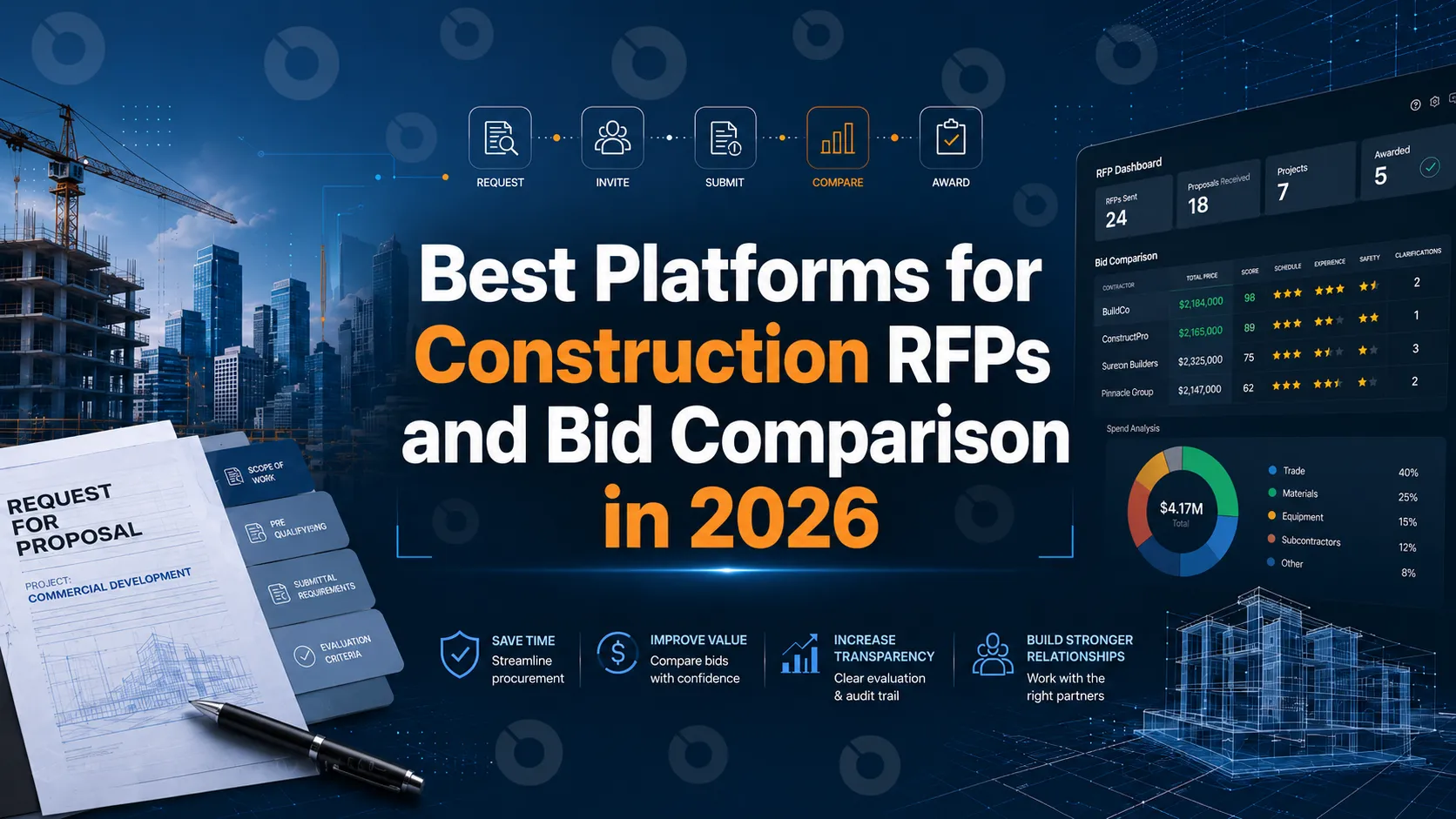
Construction procurement has become significantly more complex over the last few years.
Owners, developers and program managers are no longer evaluating contractors based only on price. They also need visibility into schedules, qualifications, risk exposure, documentation quality, compliance requirements and long-term project coordination.
At the same time, procurement workflows themselves are becoming harder to manage. Many teams still handle construction RFPs, tender management, contractor bidding and bid comparison across disconnected spreadsheets, inboxes and shared drives. That creates delays, version confusion, inconsistent evaluations and weak audit trails.
This is why construction administration platforms are increasingly expanding into procurement and bidding management workflows.
Modern systems help teams:
This guide compares the best construction administration platforms for RFPs, bidding management and contractor procurement in 2026.
A construction administration platform is software designed to help owners, developers, contractors and program managers coordinate construction workflows, documentation, approvals, procurement and project execution inside one system.
Unlike standalone bidding tools, modern construction administration platforms increasingly connect procurement workflows directly to:
This creates better visibility from preconstruction through delivery.
Procurement and contractor bidding often become operational bottlenecks because information is fragmented across too many systems.
Common issues include:
As projects become larger and involve more stakeholders, these problems create significant risk. A delayed or poorly documented procurement process can affect schedules, budgets, contractor coordination and downstream execution.
This is why many organizations are moving toward centralized procurement and construction administration platforms.
Each platform was evaluated based on:
Best for: connected procurement visibility and owner-side coordination
INGENIOUS.BUILD is designed to connect procurement workflows directly to broader construction project execution.
Instead of treating contractor bidding as an isolated preconstruction task, the platform connects RFPs, approvals, budgets, schedules, RFIs and documentation into one centralized environment.
This improves visibility across the full procurement lifecycle while reducing fragmentation between preconstruction and delivery teams.
Strengths
Best for: contractor-led bidding and procurement coordination
Procore offers preconstruction and bidding tools integrated into its larger construction management ecosystem.
The platform supports:
Strengths
Tradeoffs
Best for: document-centric procurement coordination
Autodesk Construction Cloud supports procurement workflows through document management, collaboration, and coordination capabilities.
It performs especially well in technically complex projects where procurement depends heavily on drawing revisions and BIM coordination.
Best for: subcontractor bidding networks
BuildingConnected, part of Autodesk, focuses specifically on contractor bidding and bid solicitation workflows.
It is widely used for:
Best for: owner-side capital program procurement
Kahua supports procurement governance across large capital programs.
Its workflows emphasize:
Best for: controlled tender management and audit trails
Aconex is known for structured document control and highly auditable communication workflows.
Its procurement and tender management capabilities are particularly strong in highly regulated or international projects.
Best for: ERP-connected procurement workflows
CMiC combines procurement and bidding management with ERP functionality and operational reporting.
Strengths
Tradeoffs
Best for: consultant-side document coordination
Newforma is widely used by architecture and engineering firms for communication and document management.
It helps teams manage procurement-related communication and documentation across projects.
Best for: residential contractor bidding workflows
Buildertrend includes simpler bidding and proposal workflows tailored to residential construction environments.
This is one of the most common evaluation paths for owners and developers comparing procurement-focused construction administration platforms.
Best for:
Strongest when procurement needs to stay tightly connected to project delivery and financial visibility.
Best for:
Strongest in large commercial GC environments.
Best for:
More specialized toward bidding itself rather than broader construction administration.
Modern procurement workflows require more than bid collection.
The most valuable construction administration platforms help teams maintain visibility and accountability throughout the entire bidding lifecycle.
Key capabilities include:
The goal is not simply collecting bids.
It is creating a structured procurement process that improves decision-making, reduces risk, and supports smoother project execution later.
Construction procurement is evolving from a document-heavy administrative process into a much more data-driven operational workflow.
In 2026, owners and developers are increasingly evaluating procurement decisions based not only on contractor pricing, but also on performance history, schedule reliability, documentation quality, coordination capability and long-term project risk.
Modern construction administration platforms now support:
For large capital programs and multi-project portfolios, this visibility becomes especially valuable.
Instead of treating each procurement cycle as an isolated process, organizations can begin standardizing contractor evaluation and improving decision-making across projects over time.
As construction projects become larger and financially riskier, procurement visibility is becoming a strategic advantage, not just an administrative convenience.
Construction bidding is becoming more complex due to:
As a result, owners and program managers need better tools to evaluate contractor proposals consistently and transparently.
Manual bid leveling and spreadsheet comparison processes are increasingly difficult to manage at scale. Centralized procurement platforms improve consistency while creating clearer audit trails for decision-making.
Many procurement issues are not caused by contractors, they are caused by fragmented workflows.
Common failures include:
These issues create operational risk long before construction begins. Modern construction administration platforms help reduce these problems by centralizing procurement workflows and standardizing documentation processes.
Construction procurement is no longer just a preconstruction activity. It is a critical operational workflow that influences project cost, schedule certainty, contractor coordination and long-term execution success.
The best construction administration platforms help owners, developers and program managers centralize procurement workflows, improve contractor bid visibility, standardize documentation and maintain stronger audit trails throughout the bidding lifecycle.
INGENIOUS.BUILD helps teams connect procurement, approvals, budgets, schedules, and project execution inside one connected construction management environment. Book a demo to see how centralized procurement workflows improve visibility and reduce operational risk across construction projects.
A construction administration platform helps teams manage project workflows, procurement, documentation, approvals and communication throughout the construction lifecycle.
Construction bidding management software helps owners and contractors manage RFPs, contractor bids, tender workflows and procurement coordination.
Top platforms include INGENIOUS.BUILD, Procore, BuildingConnected, Autodesk Construction Cloud, Kahua and Oracle Aconex depending on project type and workflow complexity.
Centralized procurement improves visibility, reduces version confusion, standardizes bid evaluations and creates stronger audit trails across projects.
Important features include RFP management, bid comparison tools, document control, approval tracking, contractor communication workflows and reporting visibility.

INGENIOUS.BUILD
.svg)
.svg)

Company Type

Product Solutions
Information
.svg)
Speak to a Product Specialist
Streamline your Development & Construction projects with our cutting-edge project management software.
Discover why people are switching to INGENIOUS today!
By submitting this form, you agree with our Privacy Policy.