Best Residential Construction Software for Businesses (2026 Guide)
A 2026 guide to the best residential construction software, helping growing businesses improve project visibility, financial control, and operational efficiency.
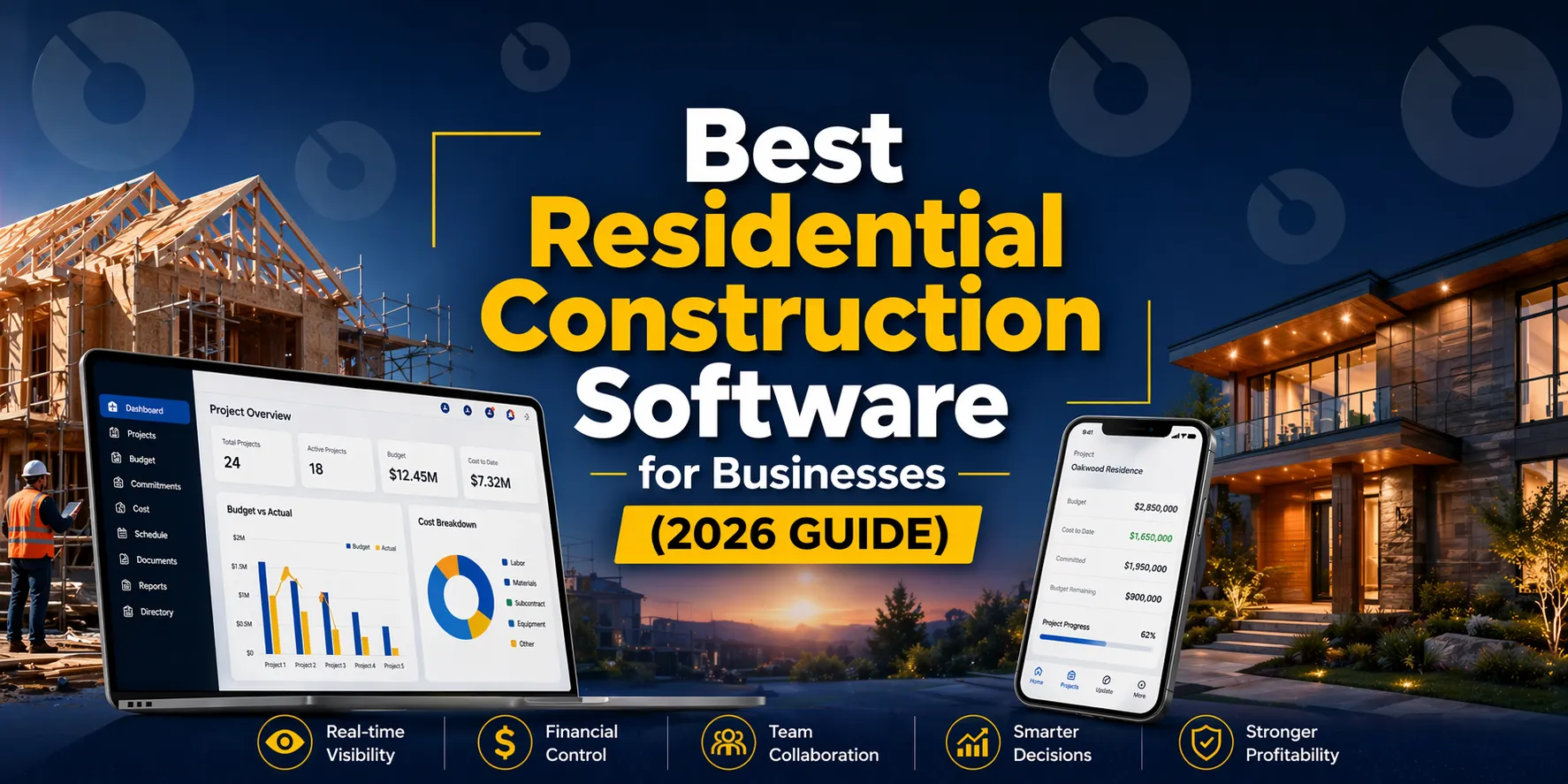
As residential construction businesses grow, operational complexity increases fast.
What starts as a few projects quickly becomes:
- multiple job sites running in parallel
- distributed teams (office + field)
- increasing subcontractor coordination
- tighter margins and higher financial risk
At that point, spreadsheets and disconnected tools stop working.
That’s why companies are investing in residential construction software, not just to manage projects, but to improve operational efficiency, visibility and profitability.
This guide focuses on:
- the best residential construction software for businesses
- scalable tools for project management, estimating and cost control
- how to evaluate software from an operational perspective
- what growing construction companies should prioritize
What Is Residential Construction Software?
Residential construction software is a centralized platform that helps construction companies manage projects, financials, teams and operations in one system.
It typically supports:
- project execution and coordination across jobs
- financial tracking, budgeting and job costing
- subcontractor, crew and vendor management
- scheduling, documentation and reporting
In business terms, it replaces fragmented tools (spreadsheets, emails, disconnected apps) with standardized, scalable workflows that improve visibility, control and operational efficiency.
Signs Your Current Software Is Holding Your Business Back
If you recognize 2–3 of these, it’s probably time to upgrade:
- budgets are tracked in spreadsheets (not in real time)
- teams rely on email or WhatsApp for coordination
- estimating doesn’t connect to project execution
- reporting takes hours (or days) to prepare
- you don’t have clear visibility across all projects
- mistakes or miscommunication happen frequently
Best Residential Construction Software for Businesses in 2026
These platforms are evaluated based on scalability, operational control and business impact.
1. INGENIOUS.BUILD
Best for: growing construction businesses needing structure and visibility
INGENIOUS.BUILD is designed to connect project workflows with financial oversight, helping companies manage multiple projects with clarity.
Why construction businesses choose it:
- centralized budgeting, commitments and cost tracking
- standardized workflows across teams and projects
- real-time visibility into project performance
- strong coordination between field and office
- scalable across multiple projects and stakeholders
Ideal for companies moving from project-level tracking to portfolio-level control
2. Buildertrend
Best for: residential construction companies with strong client interaction needs
Buildertrend is widely adopted by residential builders for its all-in-one approach.
Business strengths:
- integrated scheduling, budgeting, and communication
- client portals for transparency
- strong adoption in residential workflows
Considerations:
- costs increase as the business scales
- may require additional tools for deeper financial visibility
3. JobTread
Best for: small-to-midsize construction businesses prioritizing simplicity
JobTread offers a modern interface with a strong focus on estimating and budgeting.
Business strengths:
- fast onboarding and ease of use
- strong link between estimates and project budgets
- responsive customer support
Limitations:
- less suited for complex, multi-project operations
4. Buildxact
Best for: businesses focused on estimating and preconstruction
Buildxact is primarily an estimating and takeoff platform.
Business strengths:
- accurate cost estimation
- supplier pricing integrations
- streamlined quoting
Limitations:
- limited project execution and operational workflows
5. Houzz Pro
Best for: residential construction businesses combining operations with lead generation
Houzz Pro blends CRM and project management.
Business strengths:
- integrated lead generation
- client management and proposals
- useful for design-build firms
Limitations:
- less suitable for complex project execution
- value tied to marketing ecosystem
6. CoConstruct Ecosystem
Best for: smaller residential construction businesses
Still widely used, particularly for custom home builders.
Limitations:
- slower product evolution
- limited scalability for growing operations
Best Software for Residential Construction Estimating
For construction companies, estimating is not just about accuracy, it’s about consistency and profitability.
Top tools include:
- Buildxact - strong for takeoffs and supplier pricing
- JobTread - connects estimating directly to project budgets
- Buildertrend - integrates estimating into broader workflows
The key is ensuring estimates translate directly into live project budgets.
How to Choose the Right Residential Construction Software
Choosing the wrong tool can slow your team down for months. Use this quick decision guide based on your business stage and needs:
Choose a simple tool (e.g. JobTread, BuildBook) if
- you run a small team (1–5 projects at a time)
- your workflows are still evolving
- you need quick setup and low friction
- estimating and basic tracking are your main priorities
Choose an all-in-one residential tool (e.g. Buildertrend) if
- you want client communication + project management in one place
- you run repeatable residential workflows
- you need scheduling, selections, and budgeting together
Choose a scalable platform (e.g. INGENIOUS.BUILD) if
- you manage multiple projects simultaneously
- you need real-time budget and cost visibility
- your teams (field + office) are not fully aligned
- you’re moving toward standardized operations
Rule of thumb:
- Early stage - simplicity
- Growth stage - structure
- Scaling stage - visibility + control
What Construction Businesses Should Look For
Choosing software isn’t about features, it’s about operational impact.
1. Standardization of workflows
Can your company run projects the same way across teams?
2. Financial visibility
Can leadership see:
- budgets vs actuals
- commitments and cost exposure
- project profitability
3. Scalability
Will the system still work when you:
- double project volume
- add new teams
- expand into new markets
4. Ease of adoption
If field teams don’t use it, the system fails.
5. Customer support and reliability
Construction timelines don’t wait for software issues.
The best residential construction management software is the one that your entire organization actually uses.
Free Residential Construction Software for Businesses
Free tools can support early-stage operations but rarely scale.
Useful for:
- small teams testing workflows
- basic task tracking
Not suitable for:
- financial tracking
- multi-project coordination
- long-term growth
Most construction businesses outgrow free tools quickly.
When Your Business Needs More Advanced Software
You likely need a more robust platform if:
- you manage multiple projects simultaneously
- financial tracking is fragmented or delayed
- teams operate in silos (field vs office)
- reporting takes too long or lacks accuracy
At this stage, the focus shifts from managing projects to managing operations at scale.
Key Takeaways
- Residential construction software is critical for operational scalability
- The best tools connect project workflows with financial visibility
- Ease of use and adoption are as important as features
- Estimating, budgeting, and execution should be connected
- Growing businesses need systems, not just tools
Final Thoughts
Most construction companies don’t struggle because they lack tools. They struggle because their tools don’t scale with their business.
The shift happening in the industry is clear: from disconnected tools to integrated, business-level systems.
If your company is growing and you need:
- better visibility
- stronger coordination
- more predictable financial outcomes
it may be time to upgrade your tech stack.
Frequently asked questions
What is the best residential construction software for businesses?
Top platforms include INGENIOUS.BUILD, Buildertrend, JobTread and Buildxact, depending on company size and operational needs.
What software do residential construction companies use?
Most companies use a combination of estimating tools, project management platforms, and accounting systems, often integrated.
What is the best construction software for managing crews?
Look for platforms with mobile access, real-time updates and workflow coordination across field and office teams.
What is the best software for residential construction estimating?
Buildxact and JobTread are strong options, especially when connected to project budgeting systems.