|

MENU


.svg)
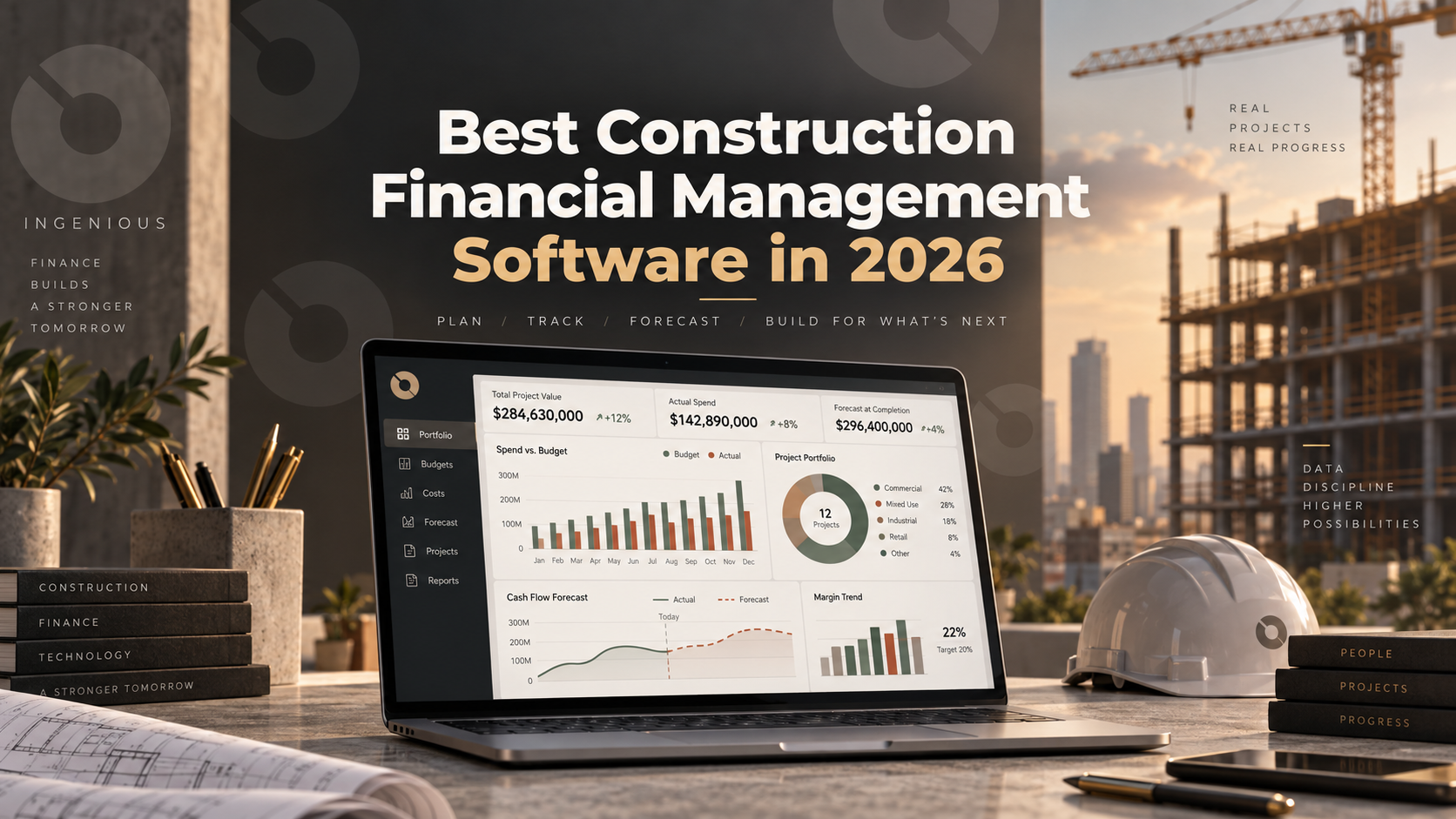
Construction projects generate enormous amounts of financial data. Budgets change, commitments grow, invoices arrive daily, change orders affect profitability and forecasts constantly evolve. Without the right financial management software, maintaining accurate project visibility becomes increasingly difficult.
Many organizations still rely on disconnected accounting systems, spreadsheets and manual reporting to manage project financials. While these tools may support accounting, they often lack the operational visibility construction teams need to manage active projects.
Modern construction financial management software connects project budgets, commitments, contracts, forecasts, reporting and project controls within a single platform. This allows owners, developers, contractors and finance teams to make faster, better-informed decisions throughout the project lifecycle.
In this guide, we'll compare the best construction financial management software solutions in 2026, explain what features matter most and help you choose the right platform for your organization.
Construction financial management is the process of planning, monitoring, forecasting and controlling project finances throughout the construction lifecycle.
Unlike traditional accounting, which records historical transactions, construction financial management focuses on future financial performance. It connects project budgets, commitments, invoices, change orders, forecasts, cash flow and profitability to help organizations make informed decisions before financial issues become project risks.
Effective construction financial management supports cost control, forecasting, executive reporting and portfolio-level decision-making.
Construction financial management software helps organizations plan, monitor and control project finances throughout the construction lifecycle.
Unlike traditional accounting software, construction financial management platforms provide real-time visibility into project performance by connecting financial data with operational workflows.
Most platforms include capabilities such as:
The objective is to help organizations understand not only what has been spent, but what projects are expected to cost at completion.
Construction organizations manage significantly more financial complexity than most industries.
Project teams must coordinate:
Without connected financial data, organizations often experience:
Construction financial management software helps reduce these risks by creating a single source of truth for project financial information.
Strong construction financial management extends far beyond tracking project budgets. It provides continuous visibility into project performance, helping teams control costs, improve forecasting, and make informed financial decisions throughout the project lifecycle.
Key financial management processes typically include:
Project Budgeting – Establishing and maintaining approved project budgets from preconstruction through closeout.
Job Costing – Tracking labor, materials, equipment, subcontractors, and other project costs against the budget.
Commitment Management – Monitoring contracts, purchase orders, and subcontractor commitments to understand future financial obligations.
Contract and Change Order Management – Managing contract values, approved changes, and pending change orders while assessing their impact on project budgets.
Invoice and Payment Management – Streamlining invoice approvals and ensuring project costs are accurately recorded.
Cash Flow Forecasting – Projecting future spending to support funding decisions and maintain adequate cash flow throughout construction.
Forecasting and Financial Reporting – Continuously updating projected final costs, identifying budget variances, and generating reports for project teams and executives.
Portfolio Financial Management – Monitoring financial performance across multiple projects to improve capital allocation and portfolio-level decision-making.
The best construction financial management platforms combine accounting visibility with project controls.
Key capabilities include:
Track approved budgets, revisions and cost performance throughout the project lifecycle.
Monitor contracts, purchase orders and subcontractor commitments alongside project budgets.
Understand how approved and pending change orders affect financial performance.
Continuously forecast project completion costs instead of relying solely on historical spending.
View financial performance across multiple projects using standardized dashboards and executive reports.
Connect with ERP systems, accounting software, procurement platforms, and document management systems to eliminate duplicate data entry.
Modern platforms increasingly use AI to generate financial summaries, identify risks, and improve reporting efficiency.
Best for: Owners, developers, owner's representatives and contractors seeking connected construction financial management.
INGENIOUS.BUILD combines project financials, construction administration, project management and portfolio reporting within a single platform. Instead of separating operational workflows from financial data, it connects budgets, commitments, contracts, change orders, reporting and project controls to provide complete project visibility.
Strengths
Potential limitations
Best for: Enterprise contractors managing complex commercial construction projects.
Procore combines project financial management with field collaboration, project controls, document management and reporting. It is one of the most widely adopted construction management platforms globally.
Strengths
Potential limitations
Best for: Large capital programs and enterprise project portfolios.
Oracle Primavera Unifier focuses on governance, capital planning, forecasting, financial controls, and portfolio management for highly complex construction programs.
Strengths
Potential limitations
Best for: Owner-side capital project management.
Kahua provides configurable financial workflows designed for owners and developers managing multiple projects. Its flexibility makes it well suited for organizations with customized governance and reporting requirements.
Strengths
Potential limitations
Best for: Contractors seeking integrated ERP and construction financial management.
CMiC combines project management, accounting, payroll, equipment management and financial reporting within a unified ERP platform designed specifically for construction organizations.
Strengths
Potential limitations
Although the terms are often used together, construction financial management software and construction accounting software serve different purposes.
Construction accounting software focuses on recording financial transactions, payroll, accounts payable, accounts receivable and general ledger management.
Construction financial management software builds on accounting by providing visibility into project budgets, commitments, forecasts, change orders, contingencies, and portfolio performance.
Many organizations use both together, connecting accounting systems with construction management platforms to create complete financial visibility.
Different stakeholders rely on construction financial management for different reasons.
Monitor budgets, forecasts, contingency usage and capital allocation across multiple projects.
Provide consistent financial reporting while overseeing project performance on behalf of owners.
Manage job costs, subcontractor commitments, change orders and project profitability.
Connect accounting systems with project operations to improve reporting accuracy and forecasting.
Review portfolio dashboards, financial KPIs and project forecasts to support strategic decision-making.
Strong financial management depends on consistent reporting. Important reports include:
Compares approved budgets against actual costs and commitments.
Projects the expected final project cost based on current financial performance.
Tracks approved, pending and projected change orders.
Summarizes contract values, purchase orders and subcontract commitments.
Forecasts future spending and funding requirements.
Provides executives with financial visibility across multiple projects.
Managing construction finances becomes increasingly difficult as projects grow in size and complexity. Many organizations continue to rely on disconnected systems, manual reporting, and spreadsheet-based workflows that limit financial visibility.
Common challenges include:
Fragmented Project Data – Budgets, contracts, invoices, schedules, and project documentation are often stored in different systems, making it difficult to maintain a single source of truth.
Delayed Financial Reporting – Manual reporting processes slow decision-making and prevent stakeholders from seeing real-time project performance.
Spreadsheet Reconciliation – Finance and project teams frequently spend hours consolidating information across spreadsheets, increasing the risk of errors and duplicate data entry.
Limited Forecasting Visibility – Without continuous forecasting, organizations often identify budget overruns only after they have already impacted project performance.
Disconnected Accounting and Project Management Systems – When accounting software and construction management platforms are not integrated, financial information can become inconsistent and difficult to reconcile.
Inconsistent Portfolio Reporting – Developers and capital program managers overseeing multiple projects often struggle to compare financial performance when reporting standards vary between projects.
Modern construction financial management software addresses these challenges by connecting budgets, commitments, contracts, forecasts, and reporting within a single platform. The result is greater financial transparency, improved forecasting, and faster, more informed decision-making across the entire project lifecycle.
AI is becoming an important capability within construction financial management software. Rather than replacing finance teams, AI helps automate repetitive analysis and improve financial visibility.
Common AI applications include:
The value of AI increases significantly when project financials, schedules, contracts, and operational workflows are connected within a single platform.
Before selecting a platform, consider the following:
Selecting software based on long-term operational requirements rather than feature lists alone helps organizations achieve greater value over time.
Construction financial management software helps organizations manage project budgets, commitments, forecasts, change orders, reporting and financial performance throughout the construction lifecycle.
Construction accounting focuses on recording financial transactions. Construction financial management focuses on planning, forecasting, budgeting, reporting and managing project financial performance.
The best platform depends on your organization. Owners and developers often evaluate solutions such as INGENIOUS.BUILD, Kahua and Oracle Primavera Unifier, while contractors frequently consider Procore and CMiC based on their project size and financial management needs.
Most organizations track budget performance, commitments, forecast at completion, change orders, cash flow, contingency usage, and portfolio financial dashboards.
Many modern platforms now include AI capabilities that help generate reports, identify financial risks, analyze budget performance and improve forecasting. The effectiveness of these features depends on having connected project and financial data.
Construction financial management extends far beyond accounting. It provides the financial visibility organizations need to manage budgets, forecasts, commitments and project performance throughout the construction lifecycle.
As projects become larger and portfolios become more complex, connected construction financial management platforms help owners, developers and contractors reduce manual reporting, improve forecasting accuracy and make more informed financial decisions.
Whether you're managing a single commercial development or a multi-billion-dollar capital program, investing in the right construction financial management software can improve cost control, reporting and overall project success. Book a demo to see INGENIOUS.BUILD in action!

INGENIOUS.BUILD
.svg)
.svg)



Company Type

Product Solutions
Information
.svg)
Speak to a Product Specialist
Streamline your Development & Construction projects with our cutting-edge project management software.
Discover why people are switching to INGENIOUS today!
By submitting this form, you agree with our Privacy Policy.