Informative
How Construction Managers Use AI for Site Monitoring: Tools, Workflows and Real-World Applications
Learn how AI helps construction managers monitor site progress, documentation, safety risks, and project visibility with connected construction data.
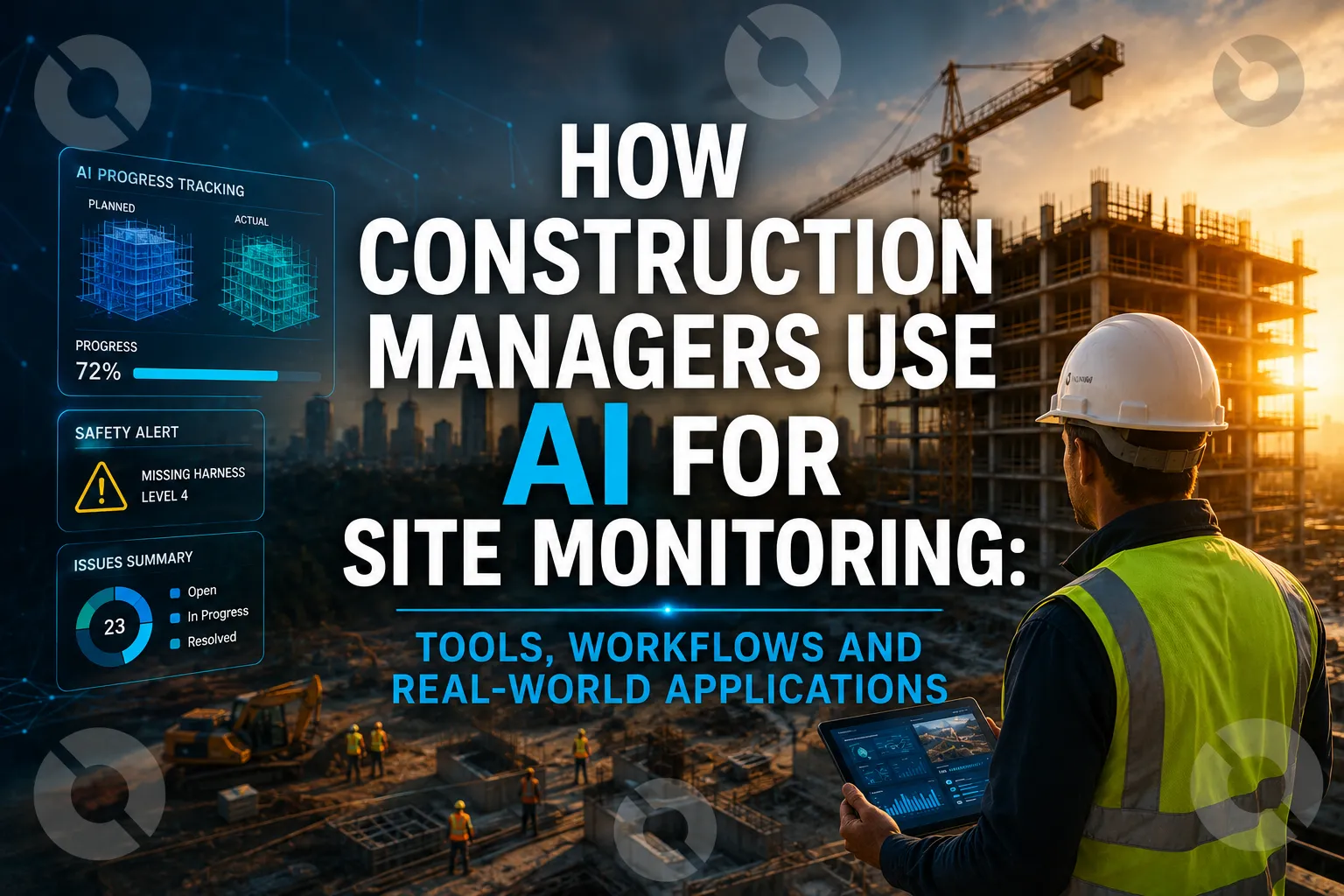
Construction managers are responsible for maintaining visibility across constantly changing jobsites.
On any given day, they need to understand:
- what work has been completed
- what work is falling behind
- whether safety requirements are being followed
- which issues require immediate attention
- how field progress aligns with the project schedule
Historically, this information came from site walks, phone calls, spreadsheets, photos, daily reports and manual updates from subcontractors.
The problem is that modern construction projects generate far more information than teams can realistically process manually.
This is where AI construction monitoring is beginning to change how projects are managed.
Rather than replacing site supervision, AI helps construction managers gain faster visibility into project conditions, progress, documentation and emerging risks.
This guide explains how construction managers can use AI for site monitoring, what AI construction monitoring tools actually do and where the technology delivers the most value today.
What Is AI Construction Monitoring?
AI construction monitoring is the use of artificial intelligence to analyze project information and improve visibility into construction progress, safety, documentation and field operations.
Construction AI monitoring systems can work with:
- site photos
- videos
- drone imagery
- field reports
- schedules
- project documentation
- inspections
- daily logs
The goal is not simply collecting more information. The goal is helping project teams identify issues faster and make better operational decisions.
How AI Is Used for Construction Site Monitoring
The most effective AI site monitoring workflows focus on improving operational visibility rather than replacing field personnel.
Today's construction managers are using AI to support:
Construction Progress Tracking
One of the most common applications of AI in construction is tracking project progress.
AI can help compare:
- completed work
- planned schedules
- field documentation
- site imagery
to identify areas where progress may be ahead or behind plan.
Instead of waiting for manual updates, project teams can gain faster visibility into project status.
This is particularly valuable on:
- data center construction
- logistics facilities
- healthcare projects
- higher education campuses
- large commercial developments
where multiple trades may be working simultaneously.
Construction Photo Management
Construction projects generate thousands of site photos throughout the project lifecycle.
Many teams struggle with:
- organizing photos
- finding historical images
- linking photos to project activities
- documenting issues consistently
AI tools for construction photo management can help automatically categorize images, identify relevant project areas and improve searchability across large photo libraries.
This reduces time spent manually organizing documentation while improving visibility into project history.
AI-Powered Construction Documentation
Construction site monitoring extends beyond photos.
AI can help analyze:
- daily reports
- inspection logs
- meeting notes
- RFIs
- submittals
- field observations
to surface relevant project information and identify potential issues.
Instead of manually reviewing hundreds of project records, teams can quickly locate critical information and unresolved items.
AI Solutions for Automatic Construction Progress Tracking
Automatic construction progress tracking is one of the fastest-growing areas of construction AI.
Traditionally, progress reporting relies heavily on:
- manual site walks
- contractor updates
- spreadsheet tracking
- periodic reporting
AI introduces a more continuous approach.
By analyzing field data, project documentation and site imagery, AI systems can help identify:
- completed activities
- schedule deviations
- potential delays
- coordination issues
- productivity trends
This helps construction managers focus their attention on areas that require action.
The value is not eliminating progress reporting. It is improving the speed and accuracy of project visibility.
AI Tools for Construction Site Management
AI tools for construction site management typically focus on four major areas:
Project Visibility
AI helps consolidate information across multiple project workflows and surface relevant updates more quickly.
Documentation Management
AI improves access to project records, drawings, reports and historical information.
Progress Monitoring
AI helps compare planned work against actual site conditions and project updates.
Operational Reporting
AI reduces the administrative burden of creating reports and communicating project status.
The strongest AI implementations connect directly to construction workflows rather than operating as standalone tools.
AI Construction Monitoring for Safety Directors
Construction safety directors often oversee multiple projects simultaneously.
This creates challenges around:
- incident visibility
- inspection tracking
- compliance documentation
- field observations
- corrective actions
AI can help organize and analyze safety-related information across projects to improve visibility into:
- unresolved safety issues
- recurring incidents
- inspection status
- compliance trends
Rather than replacing safety professionals, AI helps them process larger volumes of information more efficiently.
This becomes especially valuable for organizations managing multiple active jobsites.
AI Models for Construction Tracking
Several types of AI models are being applied to construction tracking workflows.
These include systems that analyze:
- project documentation
- schedules
- images and videos
- historical project data
- field reports
The goal is to transform large volumes of project information into actionable operational insights.
As construction datasets become larger and more connected, AI models become more useful for identifying patterns and surfacing issues that might otherwise go unnoticed.
What AI Cannot Replace on the Jobsite
Despite rapid advancements, AI is not a substitute for field leadership.
Construction projects still require:
- superintendent expertise
- project manager judgment
- subcontractor coordination
- site inspections
- stakeholder management
- real-world problem solving
AI cannot walk a project, negotiate with contractors or resolve field conflicts.
What it can do is reduce administrative work and improve access to project information.
The most successful organizations use AI as a support tool for construction professionals rather than a replacement for them.
Why Connected Project Data Matters
One of the biggest misconceptions about AI construction monitoring is that better algorithms alone solve visibility problems.
In reality, AI is only as effective as the data it can access.
Many construction organizations still manage:
- schedules in one platform
- budgets in another
- documentation elsewhere
- approvals through email
- field updates in disconnected systems
This fragmentation limits AI's effectiveness.
The strongest AI workflows operate within connected construction environments where schedules, budgets, RFIs, submittals, reports and documentation are linked together.
This gives AI the context needed to generate meaningful insights.
The Future of AI Construction Monitoring
The future of construction monitoring is unlikely to involve fully autonomous jobsites.
Instead, the industry is moving toward AI-assisted project management where construction professionals have access to:
- better project visibility
- faster reporting
- improved documentation retrieval
- earlier risk identification
- stronger operational insights
The companies that benefit most from AI will not necessarily be those with the most advanced algorithms. They will be the organizations with the most connected project data and operational workflows.
How INGENIOUS.BUILD Supports AI-Powered Construction Monitoring
AI is most valuable when it operates within connected project workflows.
INGENIOUS.BUILD centralizes:
- schedules
- budgets
- RFIs
- submittals
- meeting minutes
- approvals
- project documentation
- reporting workflows
inside a single construction management platform.
This creates the operational visibility needed for AI-powered reporting, project monitoring and decision support.
Rather than relying on fragmented systems, teams can work from connected project data that improves coordination across owners, developers, contractors and project stakeholders.
Final Thoughts
AI construction monitoring is not about replacing construction managers or site supervisors.
It is about helping them process information faster, improve visibility and make better decisions.
Today's most practical AI applications focus on:
- construction progress tracking
- photo and document management
- reporting
- safety oversight
- project visibility
As projects become larger and more data-intensive, AI will increasingly become part of everyday construction operations.
The organizations that gain the most value will be those that combine AI with connected construction workflows and centralized project information.
Book a demo to see INGENIOUS.BUILD in action!
FAQ
How can AI be used in construction site monitoring?
AI can analyze project photos, reports, schedules, documentation and field data to improve visibility into project progress, safety and operational risks.
What is AI construction monitoring?
AI construction monitoring uses artificial intelligence to help construction teams track progress, manage documentation, improve reporting and identify project issues earlier.
Can AI automatically track construction progress?
AI can assist with automatic construction progress tracking by analyzing site imagery, field updates, schedules and project documentation to identify completed work and potential delays.
What are the best AI tools for construction site management?
The best AI tools typically support project visibility, reporting, documentation management, schedule monitoring and connected construction workflows.
Can AI replace construction site supervisors?
No. AI can improve visibility and reduce administrative work, but site supervision, field coordination and operational decision-making still require experienced construction professionals.
Why is connected data important for construction AI?
AI performs best when schedules, budgets, RFIs, documentation and project updates are connected. Fragmented systems limit AI's ability to provide meaningful project insights.