Informative
AI for Capital Project Management: How Owners and Developers Gain Real-Time Project Visibility
See how AI helps owners and developers improve real-time visibility, reduce reporting delays, and identify capital project risks earlier.
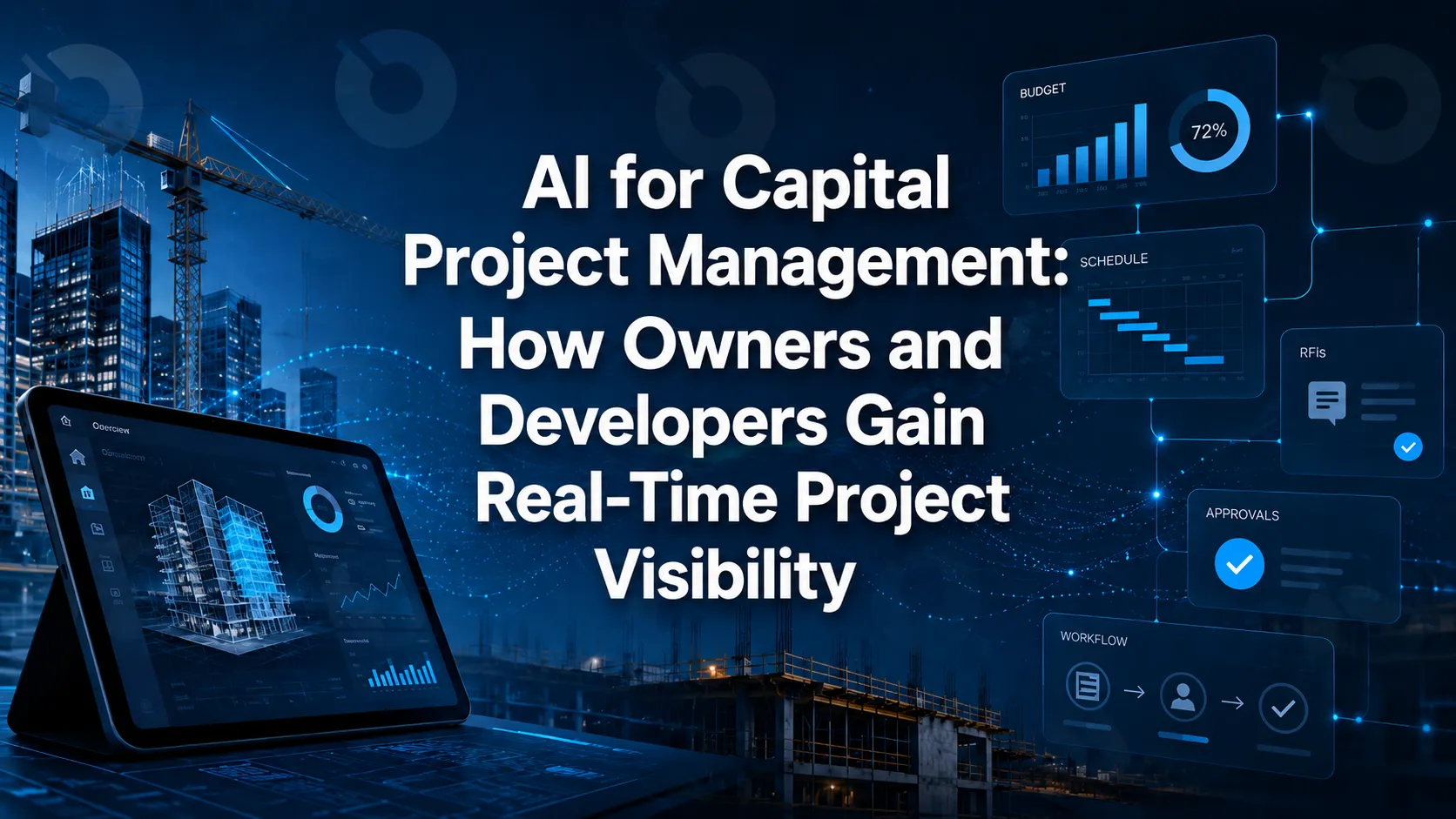
Capital projects have never generated more data. Most capital project teams still rely on spreadsheets, disconnected software systems, email threads and manually assembled reports. As projects grow larger and portfolios become more complex, this approach becomes increasingly difficult to scale.
This is why AI is becoming one of the most important technologies in capital project management. Rather than replacing project teams, AI helps organizations analyze project information faster, improve visibility across portfolios, identify risks earlier, and make better decisions throughout the project lifecycle.
In this guide, we'll explore how AI is being used in capital project management today, where it delivers the most value, and what owners, developers, and construction teams should look for when evaluating AI-powered project management platforms.
What Is AI for Capital Project Management?
AI for capital project management refers to the use of artificial intelligence to improve planning, reporting, forecasting, risk management, project controls and portfolio visibility across capital projects.
Unlike traditional project management software, AI helps organizations:
- analyze large volumes of project data
- identify emerging risks
- surface operational bottlenecks
- automate reporting workflows
- improve decision-making
The goal is not simply automation.
The goal is creating better visibility across the project lifecycle.
Why AI Is Becoming Important in Capital Project Management
Capital projects are becoming larger, more complex and more data-intensive.
Organizations managing capital programs must coordinate:
- budgets and forecasts
- schedules and milestones
- contractors and consultants
- procurement workflows
- approvals and compliance
- project documentation
- stakeholder reporting
Whether managing a data center development, healthcare expansion, higher education campus, infrastructure project or industrial facility, project leaders face a common challenge:
Too much information and not enough visibility.
Many capital project teams still rely on a combination of spreadsheets, email threads, PDFs, disconnected software systems, and manually generated reports.
This fragmentation makes it difficult to answer critical questions:
- Which projects are at risk?
- Where are budgets drifting?
- Which approvals are causing delays?
- What procurement issues could impact delivery?
- Which contractors require attention?
This is where AI is beginning to transform capital project management.
How AI Is Used in Capital Project Management
The most successful organizations use AI to support specific project management workflows.
AI for Capital Project Reporting
One of the largest administrative burdens in capital project management is reporting.
Project teams regularly prepare:
- executive updates
- owner reports
- board presentations
- portfolio reviews
- project status summaries
AI can help generate reports by analyzing project data across schedules, budgets, RFIs, procurement workflows, and project documentation.
This allows teams to spend less time creating reports and more time managing project outcomes.
AI for Construction Risk Management
Risk management is one of the most valuable applications of AI in capital projects.
AI can help identify:
- schedule risks
- procurement bottlenecks
- unresolved approvals
- budget exposure
- contractor performance issues
- recurring project delays
Instead of manually reviewing hundreds of project records, teams can focus on the risks most likely to impact project outcomes.
AI for Capital Planning and Asset Management
AI tools for capital management and asset planning help organizations evaluate:
- project prioritization
- capital allocation
- resource planning
- asset lifecycle decisions
- long-term investment strategies
This is particularly valuable for organizations managing multiple facilities or capital programs simultaneously.
AI-Driven Procurement Management
Procurement delays remain one of the leading causes of schedule overruns.
AI-driven procurement platforms help improve visibility into:
- long-lead equipment
- procurement approvals
- vendor performance
- material availability
- procurement-related schedule risks
By identifying issues earlier, project teams can reduce delays and improve project predictability.
Top AI Use Cases in Capital Project Management
Organizations are increasingly using AI to improve visibility and decision-making across capital programs. The most common use cases include:
- executive and board reporting
- project risk identification
- budget forecasting
- procurement monitoring
- capital planning
- project portfolio management
- contractor performance analysis
- document retrieval and search
- schedule risk detection
- change order analysis
The highest-performing organizations typically start with reporting and risk management before expanding into forecasting and portfolio oversight.
AI for Developers, Owners and Program Managers
Capital project stakeholders often struggle with visibility. While contractors manage day-to-day execution, owners and developers need clear answers regarding project performance.
AI helps provide:
- portfolio-level reporting
- budget visibility
- schedule forecasting
- risk identification
- executive summaries
- project health monitoring
This allows owners to make faster decisions without waiting for manually assembled reports.
AI for Industrial Capital Projects
Industrial projects often involve:
- large budgets
- complex procurement requirements
- multiple contractors
- extensive compliance requirements
- long project timelines
Industrial AI platforms are increasingly being used to improve project controls, reporting and operational visibility across these large-scale programs.
The larger the project, the greater the potential value of AI-assisted decision-making.
Why Data Center and Industrial Projects Are Adopting AI Faster
Large-scale industrial and data center projects generate enormous amounts of project data and often involve aggressive delivery schedules.
AI helps improve:
- procurement visibility
- schedule forecasting
- reporting
- contractor coordination
- risk identification
As project complexity increases, AI becomes more valuable as a decision-support tool.
Agentic AI in Capital Management
One of the newest developments in capital project management is agentic AI.
Unlike traditional AI systems that respond to requests, agentic AI can proactively monitor project conditions and recommend actions.
Examples include:
- identifying overdue approvals
- flagging procurement risks
- monitoring schedule changes
- surfacing budget concerns
- generating project summaries automatically
While still evolving, agentic AI represents a significant shift from reactive reporting toward proactive project management.
Key AI Features in Capital Project Management Software
When evaluating AI-enabled project management software, focus on capabilities that improve operational visibility rather than simply automating isolated tasks.
The most valuable features include:
AI Reporting
Automated project summaries, executive updates and portfolio reporting.
AI Document Intelligence
Search, retrieval, and summarization of project records, contracts, RFIs and submittals.
AI Risk Detection
Identification of emerging schedule, budget, procurement and operational risks.
AI Forecasting
Improved visibility into project outcomes based on current performance.
AI Workflow Analysis
Insights across approvals, procurement, reporting and project controls.
Is AI Useful for Construction Companies?
Yes. AI is becoming increasingly useful for construction companies because projects generate enormous amounts of operational information.
AI can help teams:
- reduce administrative work
- improve reporting
- organize project documentation
- identify risks earlier
- improve visibility into project performance
The greatest benefits typically come from improving decision-making rather than replacing construction professionals.
Why Connected Project Data Matters
AI is only as effective as the information it can access. Many organizations still manage:
- schedules in one system
- budgets in another
- procurement elsewhere
- approvals through email
- documents across multiple platforms
This fragmentation limits AI's effectiveness.
Connected project environments allow AI to understand relationships between budgets, schedules, risks, procurement activities, approvals and project documentation.
Without connected data, AI can only see part of the project picture.
With connected data, AI becomes significantly more useful.
The Future of AI in Capital Project Management
The future of AI in capital project management is not about replacing project managers.
It is about helping organizations manage increasingly complex projects more effectively.
As AI continues to evolve, capital project teams will increasingly use it to:
- improve portfolio visibility
- automate reporting
- identify risks earlier
- improve forecasting
- streamline decision-making
Organizations that combine AI with connected project data will be best positioned to realize these benefits.
How INGENIOUS.BUILD Supports AI-Powered Capital Project Management
AI is most effective when it operates inside connected project workflows. INGENIOUS.BUILD centralizes:
- budgets
- schedules
- RFIs
- submittals
- procurement workflows
- approvals
- project documentation
- reporting
inside a single project management environment.
This creates the foundation for AI-powered reporting, risk identification, project visibility and capital program oversight.
Rather than working across fragmented systems, teams can leverage AI within the context of actual project execution. Book a demo to see how it works!
FAQ
What is AI for capital project management?
AI for capital project management uses artificial intelligence to improve reporting, forecasting, risk management, project controls, procurement visibility and portfolio oversight.
Is AI useful for construction companies?
Yes. AI helps construction teams improve visibility, reduce administrative work, identify risks earlier and make better project decisions.
How is AI used in capital planning?
AI supports capital planning through forecasting, project prioritization, resource allocation, asset management and portfolio analysis.
What is agentic AI in capital management?
Agentic AI refers to AI systems that proactively monitor project conditions, identify issues and recommend actions instead of simply responding to user requests.
Why does connected project data matter for AI?
AI relies on access to project information. Connected data environments provide the context needed for more accurate reporting, forecasting and decision-making.