|

MENU


.svg)
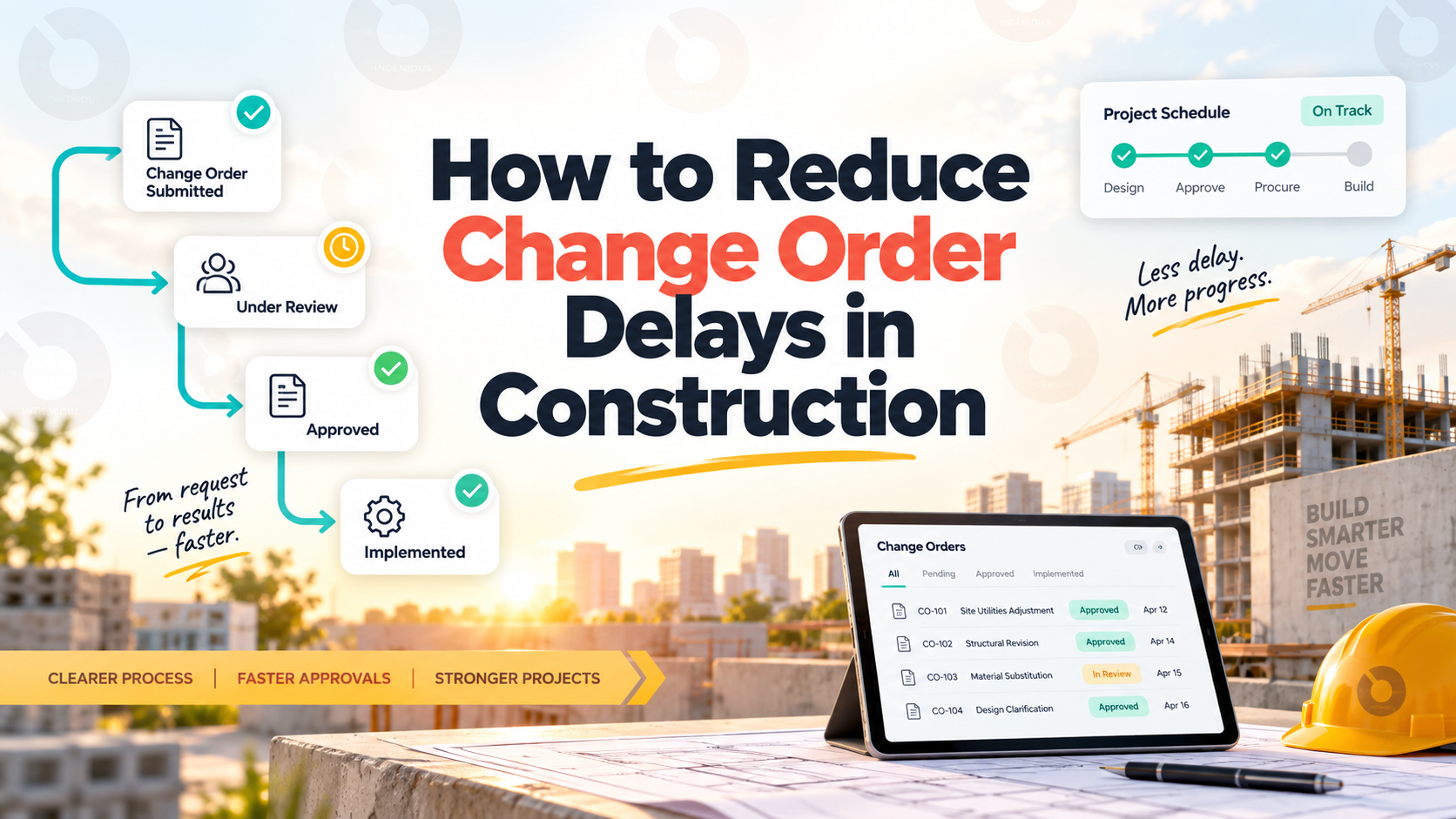
A change order shouldn't take three weeks to approve. But on most projects, it does — not because the change itself is complicated, but because the request bounces between an email thread, a phone call, and someone's desk before anyone actually signs off. Change order management is one of the most common sources of delay in construction, and almost none of it comes from the change itself. It comes from how slowly information moves between the people who need to approve it. This guide covers why change orders cause delays, what they actually cost, and how connected workflows fix the bottleneck.
A change order is a written modification to a construction contract's scope, cost, or schedule, agreed to after the original contract is signed. It becomes binding once signed by the relevant parties — typically the owner, contractor, and often the architect.
A change order is usually made because of one of a few recurring causes:
Who pays for the change generally follows who caused it: owner-requested changes are typically billed to the owner, while changes resulting from contractor error are usually the contractor's responsibility. Design-related changes are often negotiated between the owner and the design team, depending on the contract terms.
A Construction Change Directive (CCD) is a distinct tool from a standard change order, and it exists specifically to prevent delay. A CCD allows the owner and architect to direct the contractor to proceed with a change immediately, even before the cost or schedule impact has been agreed. The alternative — waiting for full agreement before any work happens — is exactly the kind of delay a CCD is designed to avoid when time is more critical than immediate cost certainty.
Once work proceeds under a CCD, the cost and schedule impact still needs to be negotiated and documented, typically converting into a standard change order once terms are settled.
The process is fairly consistent across projects, even though the speed varies enormously:
Every step in that sequence is a place a change order can stall. The more of those steps happen over email, phone calls, or in-person conversations without a shared record, the longer the process takes.
The delay rarely comes from the complexity of the change itself. It comes from a handful of predictable bottlenecks:
Most delay-causing back-and-forth traces back to a proposal missing one of these five things. A change order built to move quickly the first time includes:
A proposal missing any one of these almost always comes back with a question, which restarts the review clock. Building the template once and reusing it every time removes that entire category of delay.
Delay can come from any party, but the pattern is fairly consistent across projects:
Owners are the most common source of delay on owner-approval-required changes, usually not from indecision but from the request getting buried among other priorities — a change order competing with someone's full inbox rarely wins.
Architects tend to introduce delay when a change requires a design review or revised drawings, since that work often competes with deadlines on other active projects.
Contractors cause delay less often through slow approval and more often through incomplete initial submissions — missing cost detail or documentation that forces a second round.
Knowing which party is the actual bottleneck on a given project matters more than assuming it's always "approvals are just slow". A defined turnaround expectation, paired with visibility into exactly where a request is sitting, makes it obvious which stage is actually the problem.
Change orders aren't a minor line item. Research from Dodge Data & Analytics puts change order costs at an average of 10% of total contract value, with some projects seeing as much as 25%. On major projects, other industry research puts the range at 10–15% of contract value. The frequency scales with project size and complexity: studies show small projects average around 1.7 change orders, while large, complex projects average over 11 — and the largest projects can see change order counts well into the 20s.
The impact isn't limited to direct cost. A high frequency of changes can reduce overall labor productivity by 10–30%, largely from the trade stacking and supervision strain described above. Industry-wide, rework and delays — of which change orders are a major driver — are estimated to cost the US construction industry around $177 billion annually.
Change orders aren't a minor line item. Research from Dodge Data & Analytics puts change order costs at an average of 10% of total contract value, with some projects seeing as much as 25%. On major projects, other industry research puts the range at 10–15% of contract value. The frequency scales with project size and complexity: studies show small projects average around 1.7 change orders, while large, complex projects average over 11 — and the largest projects can see change order counts well into the 20s.
The impact isn't limited to direct cost. A high frequency of changes can reduce overall labor productivity by 10–30%, largely from the trade stacking and supervision strain described above. Industry-wide, rework and delays — of which change orders are a major driver — are estimated to cost the US construction industry around $177 billion annually.
Change orders work the same basic way in residential and custom home construction, but the causes shift. Homeowner-driven changes — a different finish selection, a layout adjustment after seeing framing in person, an upgraded appliance package — are a much larger share of the total than in commercial work, where changes more often come from design errors or field conditions.
This makes clear, proactive communication even more important on residential projects: a homeowner who understands the cost and schedule impact of a change before requesting it is far less likely to dispute it later. Builders who document selections and change requests in one place, rather than relying on verbal agreements during a site visit, avoid the most common source of residential change order disputes — disagreement over what was actually agreed to.
Every change order that isn't clearly tracked is a future dispute waiting to happen. Tracking matters for three specific reasons:
Most change order disagreements get resolved through negotiation. When they don't, thorough documentation becomes the deciding factor — whether that's an internal resolution process or, in more serious cases, formal construction dispute support services and claims consultants who reconstruct the cost and schedule impact after the fact. Projects with clear, timestamped change order records are consistently easier and cheaper to resolve than ones relying on reconstructed email threads and memory. The best time to build that documentation trail is when the change order is issued — not after a dispute has already started.
The difference between a slow and a fast change order process is rarely the change itself — it's how many steps happen over email versus in one visible system.
A typical disconnected timeline: Day 1, a field condition is discovered and emailed to the PM. Day 3, the PM forwards it to the architect for a design response. Day 6, the architect replies, but the cost isn't attached. Day 8, the contractor prepares pricing and emails the owner. Day 12, the owner has questions that get relayed back through the PM. Day 16, a revised proposal goes out. Day 19, it's finally approved — nearly three weeks for a change that took two days to actually price and design.
The same change in a connected system: Day 1, the field condition is logged with photos, tied directly to the relevant RFI. Day 2, the architect's response and the contractor's cost and schedule impact are added to the same record, visible to everyone at once. Day 3, the owner reviews the complete proposal — scope, cost, schedule, and supporting documentation together — and approves it without needing to ask a single follow-up question, because nothing is missing.
The steps aren't fundamentally different. What changes is whether each party is working from a complete, visible record or reconstructing context every time the request changes hands.
INGENIOUS.BUILD keeps change orders connected to the same system as budgets, RFIs, and schedules, so every stakeholder — owner, GC, sub, and architect — works from the same current data instead of a scattered email trail. Teams using INGENIOUS.BUILD see 10x fewer change-order disputes, largely because the documentation, approval status, and cost impact are visible to everyone in real time instead of surfacing only when something goes wrong.
Book a personalized demo to see how connected change order management compares to what you're running now.
Change order delays are rarely about the change itself — they're about how slowly information moves between the people who need to approve it. Standardizing the process, centralizing documentation, and giving every stakeholder real-time visibility fixes the actual bottleneck, not just the symptom. Given that change orders already represent a meaningful share of project cost, the fastest, cheapest fix available to most teams isn't preventing changes — it's removing the friction in how they get approved.
A change is identified, the contractor prepares a cost and schedule proposal, it's reviewed and negotiated, then documented and signed as a binding contract modification before work proceeds under the new terms.
A Construction Change Directive lets an owner and architect direct a contractor to proceed with a change immediately, before cost or schedule impact is agreed — used specifically to avoid the delay of waiting for full agreement first.
Yes, often more than in commercial work, since homeowner-driven selection and layout changes are a larger share of the total. Clear documentation of what was agreed to is the most effective way to prevent disputes over those changes.
Tracking creates accountability for who approved what and when, keeps the budget accurate, and reveals patterns — like a subcontractor or design phase generating recurring changes — that aren't visible project by project.
This refers to a change in an architect's own service agreement — typically an expanded scope of design work — rather than a change to the construction contract itself. It's tracked and approved separately from construction change orders.
Research shows small projects average around 1.7 change orders, while large, complex projects average over 11 — the count scales significantly with project size and complexity.
Industry research puts the average around 10% of total contract value, with some projects seeing as much as 25%, and major projects commonly in the 10–15% range.

INGENIOUS.BUILD
.svg)
.svg)



Company Type

Product Solutions
Information
.svg)
Speak to a Product Specialist
Streamline your Development & Construction projects with our cutting-edge project management software.
Discover why people are switching to INGENIOUS today!
By submitting this form, you agree with our Privacy Policy.