Capital Improvement Plan Funding Sources Explained
A plain explainer of the funding sources behind a multi-year capital improvement plan — cash and reserves, GO and revenue bonds, grants, impact fees, assessments and reimbursement programs — and how each one sets the year a project can actually start.
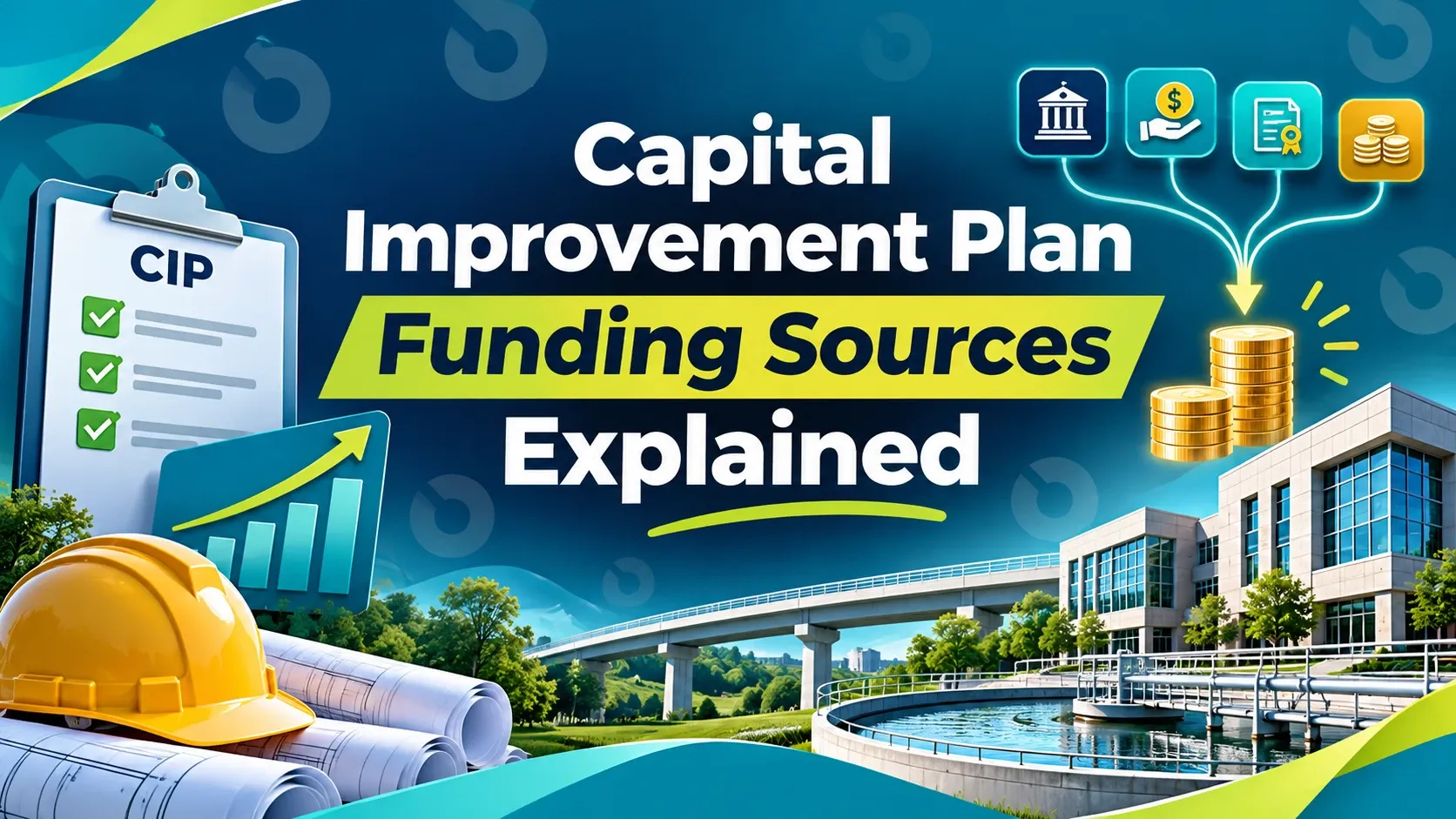
A capital improvement plan is usually funded from some combination of pay-as-you-go cash and reserves, general obligation bonds, revenue bonds, state and federal grants or formula funds, impact fees, special assessments, reimbursement programs like tax increment financing, and donor or referendum proceeds. Each source carries its own eligibility rules, spending window and reporting burden, and those rules — not the priority score — usually decide which year a project can start.
Why the funding source sets the start date
A scoring model ranks projects by condition, risk, mission fit and cost. It does not tell you when the money arrives. A roof replacement that scores first can sit in year three because the only eligible source is a bond issue scheduled for that year, while a lower-ranked parking deck starts in year one because an impact fee balance is already sitting in a restricted fund and the fee ordinance requires it to be spent within a fixed period.
That is the practical shape of most capital plans. The ranking produces a wish list; the funding sources produce the calendar. A plan built the other way around — scope and sequence first, funding reconciled later — fails the first time a grant award slips a quarter or a bond referendum is pulled from the ballot.
The working rule: build the plan fund by fund, then check the project sequence against it, then reforecast every time a source moves.
Pay-as-you-go cash and reserves
Pay-as-you-go funding uses current revenue, fund balance or a dedicated capital reserve to pay for projects as they are built. There is no interest cost, no issuance process, no debt covenant and no continuing disclosure. The money is available when the appropriation is, and it can usually be redirected between eligible projects with far less friction than restricted money.
The constraint is annual capacity. A reserve that generates a few million dollars a year can fund a steady program of roof, HVAC and paving work, but it cannot fund a new facility without either years of accumulation or a decision to drain the reserve and lose the cushion that protects the operating budget.
Pay-as-you-go also competes directly with operations every budget cycle. Deferred maintenance is the first thing cut when revenue softens, which is how a renewal backlog turns into an emergency replacement two years later at a higher cost.
General obligation bonds
A general obligation bond is backed by the issuer's full faith, credit and taxing power. It usually requires voter approval, and the ballot language becomes the eligibility rule: proceeds can only fund what the measure described. Scope changes that drift outside that language create a legal problem, not just a budget problem.
GO bonds suit projects with no user fee attached — schools, libraries, fire stations, parks, streets. They are the normal answer when the asset serves the whole tax base.
The timing consequences are specific:
- The project cannot be committed until the measure passes and the issue closes, which anchors the start to an election calendar and a market window.
- Proceeds generally must be spent within defined periods to avoid arbitrage rebate exposure, so an underspent bond is its own compliance issue.
- Debt service begins regardless of construction progress, so slippage costs carry while nothing is in the ground.
- Continuing disclosure obligations run for the life of the bonds, which means the project record has to stay retrievable long after closeout.
Revenue bonds
A revenue bond is repaid from a defined revenue stream — water and sewer charges, parking revenue, toll receipts, dormitory rents — rather than general taxes. Voter approval is often not required, which can make a revenue bond faster to the market than a GO issue.
The trade is the covenant. Most revenue issues require a coverage ratio: net revenue must exceed debt service by a stated multiple. That binds the capital plan to the rate structure. If the plan assumes a utility expansion funded by revenue bonds, it also assumes the rate increases that keep coverage intact, and the governing body has to approve those on a schedule that lines up with issuance.
Revenue bonds also restrict use tightly to the enterprise that generates the revenue. Water system proceeds pay for water system assets. A shared facility that serves both the utility and general government has to be cost-allocated before anyone signs a contract.
Grants and formula funds
Grant funding is the source most likely to break a schedule, because the grant sets the dates rather than accepting yours. An award has an execution date, an obligation deadline, a period of performance and a closeout deadline. Spending before the start date is usually unreimbursable. Spending after the end date is usually unreimbursable. The project has to fit inside the window.
Attached conditions typically include a local match, procurement standards that may differ from your own, prevailing wage requirements, environmental or historic review, and reporting on a cycle that does not match your fiscal year.
| Dimension | Pay-as-you-go | GO bond | Revenue bond | Grant |
|---|---|---|---|---|
| Approval path | Annual appropriation | Voter referendum, then issuance | Board action and covenant test | Application and award |
| Typical lead time to first dollar | Shortest | Longest | Medium | Medium to long, award-dependent |
| What constrains scope | Available balance | Ballot language | Enterprise purpose | Grant program rules |
| Spending window | Fiscal year, often reappropriated | Arbitrage-driven | Project fund drawdown | Fixed period of performance |
| Ongoing obligation | None | Debt service, continuing disclosure | Debt service, coverage ratio | Reporting, audit, clawback risk |
Impact fees, special assessments and exactions
Impact fees are collected from new development to pay for the capacity that development consumes. The money is restricted by nexus: a transportation impact fee funds transportation capacity in the benefit district where it was collected, not a community center across town. Many ordinances also require the funds to be spent or refunded within a set number of years, which pushes eligible projects forward in the plan whether or not they rank highly.
Special assessments charge a defined set of properties for an improvement that benefits them directly — a street, a sidewalk, a drainage improvement. The assessment roll has to be adopted before construction, and challenges to the roll stop the project, not just the financing.
Both sources are lumpy. Impact fee revenue follows development activity, so a slowdown in permits quietly removes funding capacity from year three of the plan while everything else looks unchanged.
Reimbursement programs and other sources
Reimbursement funding pays after you spend. Tax increment financing districts, FEMA public assistance, many state revolving loan funds and most federal transportation programs work this way. The plan needs interim cash — a line of credit, reserve draw or short-term note — to cover the period between payment and reimbursement, and that carrying cost belongs in the project budget rather than being absorbed invisibly by the general fund.
Other recurring sources worth naming in the plan: donor and philanthropic gifts, which often carry naming conditions and payment schedules that do not match the construction draw curve; public-private partnership contributions; developer agreements; and interfund transfers or internal service charges for facilities that serve multiple departments.
Building a capital plan fund by fund
Most plans fail on funding, not scoring. Five things make the difference.
- Hold the plan by source and year, not just by project. Each project line needs the source or sources funding it and the amount from each, in the year it will be spent. A single combined project budget cannot answer the question a board actually asks, which is what happens to the program if one source slips.
- Enforce eligibility before commitment. Record the restriction with the fund — what it can buy, which geography, which deadline — and check a commitment against it before the contract is signed rather than discovering the mismatch during the single audit.
- Allocate split-funded projects at the line-item level. When a project draws on three sources, a change order has to be allocated across all three, which may mean three different approval paths. Doing that at the cost code level is work; doing it retroactively is worse.
- Model at least two funding scenarios. One with the referendum passing and the grant awarded, one without. Knowing in advance which projects drop out and which can be accelerated into the space turns a bad funding month into a decision rather than a scramble.
- Reforecast on the funding calendar, not the construction calendar. Award notices, election dates, issuance windows and fee collection reports all change capacity. Each one should trigger a plan update.
This is where most capital planning software falls short: it tracks projects well and funds poorly. Keeping funding sources, eligibility rules, allocations and forecast spend in the same system as commitments and change orders is the point of capital planning software built for owners, and INGENIOUS.BUILD was designed so the funding view and the project cost view are the same record rather than two spreadsheets reconciled monthly. For the mechanics of keeping allocations current across sources, see how to streamline funding source tracking.
If you are assembling the broader program, the companion pieces here cover capital planning and construction budgets from request to delivery, where enterprise capital programs actually leak money, and, for agencies working with restricted and grant funding, public sector construction management software.
Frequently asked questions
What are the main funding sources for a capital improvement plan?
The common sources are pay-as-you-go cash and reserves, general obligation bonds, revenue bonds, state and federal grants or formula funds, impact fees, special assessments, reimbursement programs such as tax increment financing, and donor or referendum money. Most multi-year plans combine several, with each source carrying its own eligibility rules, spending window and reporting obligations.
What is the difference between pay-as-you-go and bond financing for capital projects?
Pay-as-you-go funds projects from current cash, reserves or annual appropriations, avoiding interest and debt covenants but limiting annual capacity to what the budget produces. Bond financing borrows the full project amount up front and repays over the asset's life, enabling large single projects but adding issuance timing, debt service, arbitrage rules and continuing disclosure obligations.
What is a general obligation bond and when is it used for capital projects?
A general obligation bond is debt backed by the issuer's full faith, credit and taxing power rather than a specific revenue stream. It typically requires voter approval and is used for projects with no direct user fee, such as schools, fire stations, parks and roads. Approved ballot language usually restricts what the proceeds may fund.
How do grants change a capital project schedule?
Grants set the schedule rather than following it. Award dates, obligation deadlines, expenditure windows, match requirements and procurement or prevailing-wage rules all come attached. A grant-funded project generally cannot start before the award is executed and cannot finish after the period of performance ends, so grant dates should drive the plan year, not the scoring rank.
Can one capital project be funded from multiple sources?
Yes, and most large projects are. The requirement is cost allocation at the line-item level so each dollar is tied to the source that paid it, with eligibility rules enforced before commitment rather than at audit. Split funding also means a change order has to be allocated across sources, which affects which approvals are needed.
What should a capital plan show when a funding source slips?
It should show which projects lose funding, how much, in which year, and what the alternatives are: deferral, scope reduction, substitution of another eligible source, or acceleration of a different project that fits the money still available. That requires funding tracked by source and year rather than one combined project budget.