Uncategorized
AI Training for Construction Project Managers: Certifications, Courses and Skills for 2026
Explore the best AI certifications, PMI AI training programs, construction AI courses and practical skills construction project managers need in 2026.
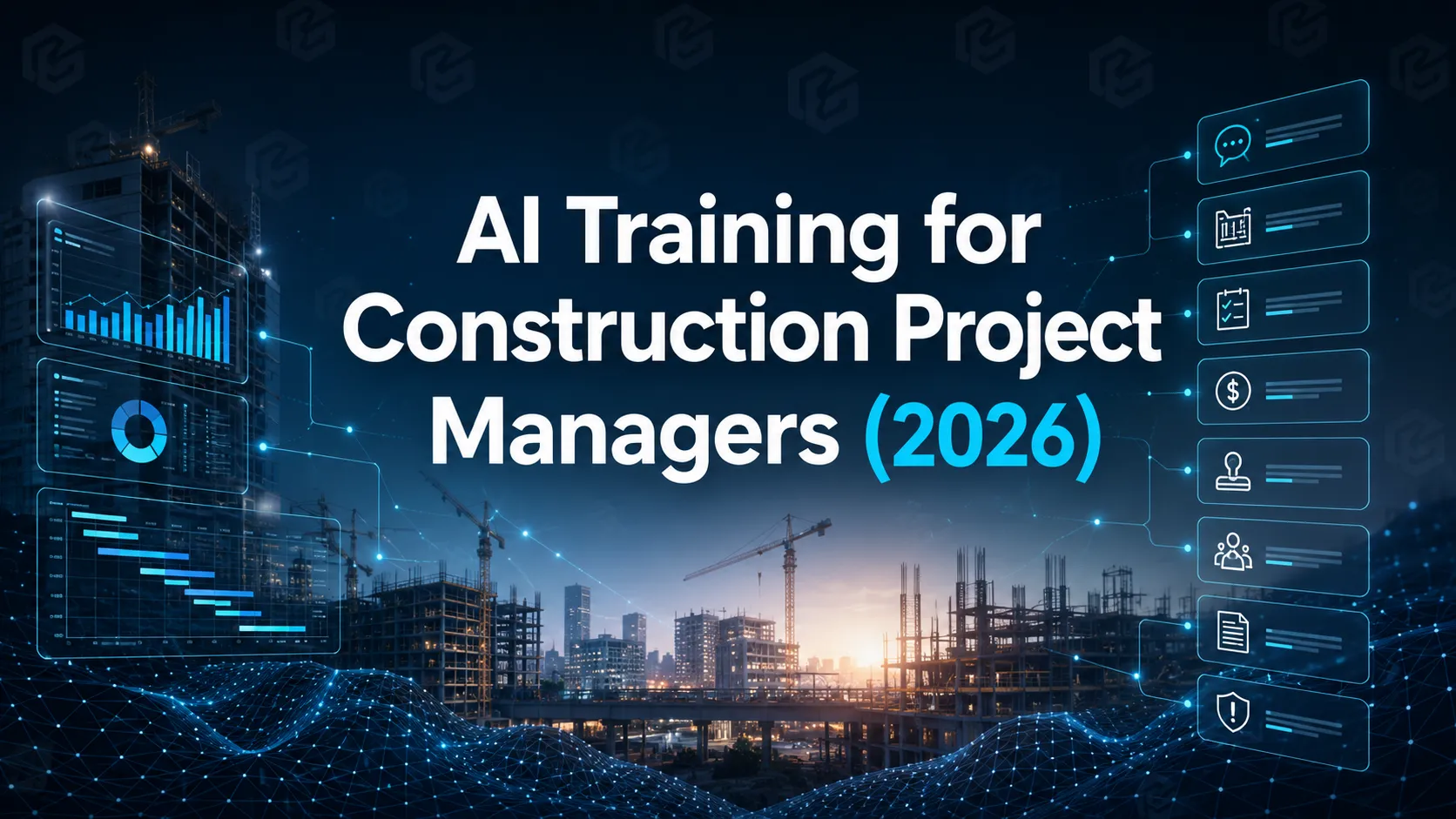
Artificial intelligence is quickly becoming one of the most important technology trends in construction.
From project reporting and document management to risk detection and portfolio visibility, AI is changing how construction projects are planned, managed and delivered.
As a result, many project managers are asking:
- Should I get an AI project management certification?
- Is PMI AI certification worth it?
- What AI training should construction project managers pursue?
- How can I actually use AI on real projects?
The good news is that construction professionals do not need to become data scientists to benefit from AI.
The most valuable skills are often practical: understanding where AI creates value, how to use it safely and how to integrate it into existing project workflows.
The best AI training for construction project managers focuses on practical applications such as project reporting, construction administration, document management, risk detection, scheduling and portfolio visibility. While certifications can help build foundational knowledge, the greatest value comes from learning how AI supports real construction workflows.
This guide explains the most relevant AI certifications, construction AI courses and skills project managers should focus on in 2026.
Why Construction Project Managers Need AI Skills
Construction projects generate enormous amounts of information.
Teams manage:
- RFIs
- submittals
- schedules
- budgets
- procurement workflows
- meeting minutes
- inspections
- change orders
- project documentation
A growing portion of a project manager's time is spent organizing and communicating information rather than managing project execution.
AI is helping reduce this administrative burden. Project managers who understand AI can often:
- generate reports faster
- improve project visibility
- organize documentation more efficiently
- identify risks earlier
- communicate more effectively with stakeholders
The goal is not replacing project management expertise. It is improving productivity and decision-making.
What Is an AI Project Management Certification?
An AI project management certification is a training program that teaches project managers how artificial intelligence can be applied to project planning, execution, reporting, communication and decision-making.
These programs typically cover:
- AI fundamentals
- generative AI tools
- workflow automation
- prompt engineering
- AI governance
- project management use cases
Some certifications are industry-agnostic, while others focus on construction, engineering or capital projects.
PMI AI Certification and PMI AI Training
The Project Management Institute (PMI) has increasingly incorporated AI into its training and professional development programs.
PMI's AI-related training generally focuses on:
- responsible AI use
- AI-enhanced project management
- workflow optimization
- leadership in AI-enabled organizations
For project managers already pursuing PMI credentials, these programs provide a strong foundation for understanding how AI is affecting the profession.
However, most PMI training remains industry-neutral.
Construction professionals often need additional training focused on real-world construction workflows.
Best AI Courses for Construction Project Managers
The most valuable AI education combines general AI knowledge with construction-specific applications.
Areas worth studying include:
AI for Construction Administration
Understanding how AI supports:
- RFIs
- submittals
- document control
- meeting management
- approvals
AI for Construction Reporting
Learning how to use AI to generate:
- owner reports
- executive updates
- progress summaries
- portfolio reporting
AI for Risk Management
Understanding how AI can help identify:
- schedule risks
- procurement bottlenecks
- budget concerns
- operational issues
AI for Document Management
Learning how AI improves:
- document retrieval
- information search
- project knowledge management
- construction documentation workflows
Best AI Certifications for Project Managers in 2026
If you're looking for formal AI training, these are among the most recognized options:
PMI AI Training
Best for:
- existing PMP holders
- project leaders
- PMO professionals
Focus:
- AI fundamentals
- AI governance
- project management workflows
Microsoft AI Skills Programs
Best for:
- operational teams
- business users
- project coordinators
Focus:
- Copilot
- AI productivity
- workflow automation
Construction-Specific AI Training
Best for:
- project managers
- owners' reps
- construction administrators
Focus:
- RFIs
- submittals
- reporting
- project controls
This captures:
- ai project management certification
- pmi ai certification
AI Skills Construction Project Managers Should Learn
Many project managers focus too heavily on tools.The more important skill is understanding workflows. The most valuable AI skills include:
Prompt Engineering
Learning how to ask AI systems effective questions.
Information Analysis
Using AI to identify trends and project risks.
Report Generation
Creating faster and more consistent project reporting.
Document Intelligence
Working with contracts, RFIs, submittals and project records.
AI Governance
Understanding where AI should and should not be used.
These skills often provide more value than any single certification.
AI Skills Roadmap for Construction Project Managers
The most valuable AI skills for construction project managers typically develop in stages.
Level 1: AI Productivity
Learn:
- prompting
- meeting summaries
- report generation
- document analysis
Level 2: Construction Administration
Learn:
- AI-assisted RFIs
- submittal workflows
- document retrieval
- approval tracking
Level 3: Project Controls
Learn:
- schedule risk analysis
- cost forecasting
- procurement monitoring
Level 4: Portfolio Visibility
Learn:
- executive reporting
- capital program oversight
- predictive risk management
AI Prompts Every Construction Project Manager Should Know
Weekly Project Report
"Create a weekly construction project report using the information below. Summarize schedule status, completed work, upcoming milestones, budget concerns, project risks and required decisions."
OAC Meeting Summary
"Summarize the following OAC meeting and identify action items, responsible stakeholders, deadlines and unresolved issues."
Construction Risk Review
"Review the project update below and identify potential schedule, procurement, budget and coordination risks."
Executive Project Update
"Create a one-page executive project update focused on project health, schedule status, budget performance, major risks and upcoming decisions."
Change Order Analysis
"Analyze the following change orders and summarize financial impacts, schedule impacts, approval status and potential risks."
Procurement Risk Prompt
"Review the procurement status below and identify long-lead items, delayed approvals, vendor risks and potential schedule impacts."
Owner Update Prompt
"Draft a weekly owner update highlighting completed work, budget status, schedule risks and upcoming milestones."
Construction Delay Analysis Prompt
"Analyze the following project update and identify the root causes of schedule delays and recommended mitigation actions."
The Biggest Limitation of AI Training
Many professionals assume that learning AI tools automatically creates business value. In reality, most AI initiatives fail because project information remains fragmented. AI performs best when it can access connected project data.
If:
- schedules live in one system
- budgets live elsewhere
- approvals happen through email
- documentation is fragmented
then AI can only see part of the project picture. This is why connected construction workflows are becoming increasingly important.
Where AI Still Struggles in Construction
AI can help analyze information, but it cannot:
- walk a jobsite
- negotiate with subcontractors
- manage stakeholder politics
- replace superintendent judgment
- resolve field conflicts
Construction remains a people-driven industry. AI works best as a decision-support tool rather than a replacement for experienced project professionals.
From AI Training to AI-Powered Project Management
Learning AI concepts is only the first step. The next challenge is applying AI to real projects.
The most successful construction teams are using AI to support:
- project reporting
- construction administration
- document management
- risk identification
- portfolio visibility
inside connected construction management environments. This is where AI moves from theory to operational value.
Why Connected Data Matters More Than AI Tools
Many organizations focus on finding the best AI tool. A more important question is whether project information is connected. The most advanced AI system cannot provide meaningful insights if project data is fragmented across multiple platforms or spreadsheets.
The strongest AI outcomes come from environments where:
- schedules
- budgets
- RFIs
- submittals
- approvals
- project documentation
are connected inside a shared operational workflow. This gives AI the context needed to generate useful insights and recommendations.
How INGENIOUS.BUILD Supports AI-Powered Construction Management
AI becomes most valuable when it operates within connected project data.INGENIOUS.BUILD centralizes:
- schedules
- budgets
- RFIs
- submittals
- meeting minutes
- approvals
- project documentation
- reporting workflows
inside one operational environment. This provides the foundation for AI-powered reporting, construction administration, project visibility and decision support. Rather than working across fragmented systems, teams can use AI within the context of actual project execution.
Final Thoughts
AI is becoming an increasingly important skill for construction project managers.
The most valuable professionals will not necessarily be those with the most certifications. They will be those who understand how to apply AI to real construction workflows.
Certifications and courses provide a useful foundation. But the greatest value comes from using AI to improve reporting, communication, documentation, risk management and project visibility across active projects. Book a demo to see INGENIOUS.BUILD in action!
FAQ
Is there an AI project management certification?
Yes. Several organizations offer AI project management certifications and training programs, including PMI and specialized AI education providers.
Is PMI AI certification worth it?
PMI AI training can provide valuable foundational knowledge about AI and project management. Construction professionals may also benefit from construction-specific AI education focused on operational workflows.
What is the best AI training for project managers?
The best training combines AI fundamentals with practical applications such as reporting, risk management, document analysis, workflow automation and stakeholder communication.
Are there AI courses specifically for construction?
Yes. A growing number of AI in construction courses focus on project management, construction administration, reporting, risk detection and document management.
What AI skills should construction project managers learn?
Prompt engineering, report generation, document intelligence, risk analysis and AI governance are among the most valuable skills for construction project managers today.
Can AI replace construction project managers?
No. AI supports reporting, documentation and information management, but construction projects still require human judgment, field expertise, stakeholder management and operational decision-making.