|

MENU


.svg)
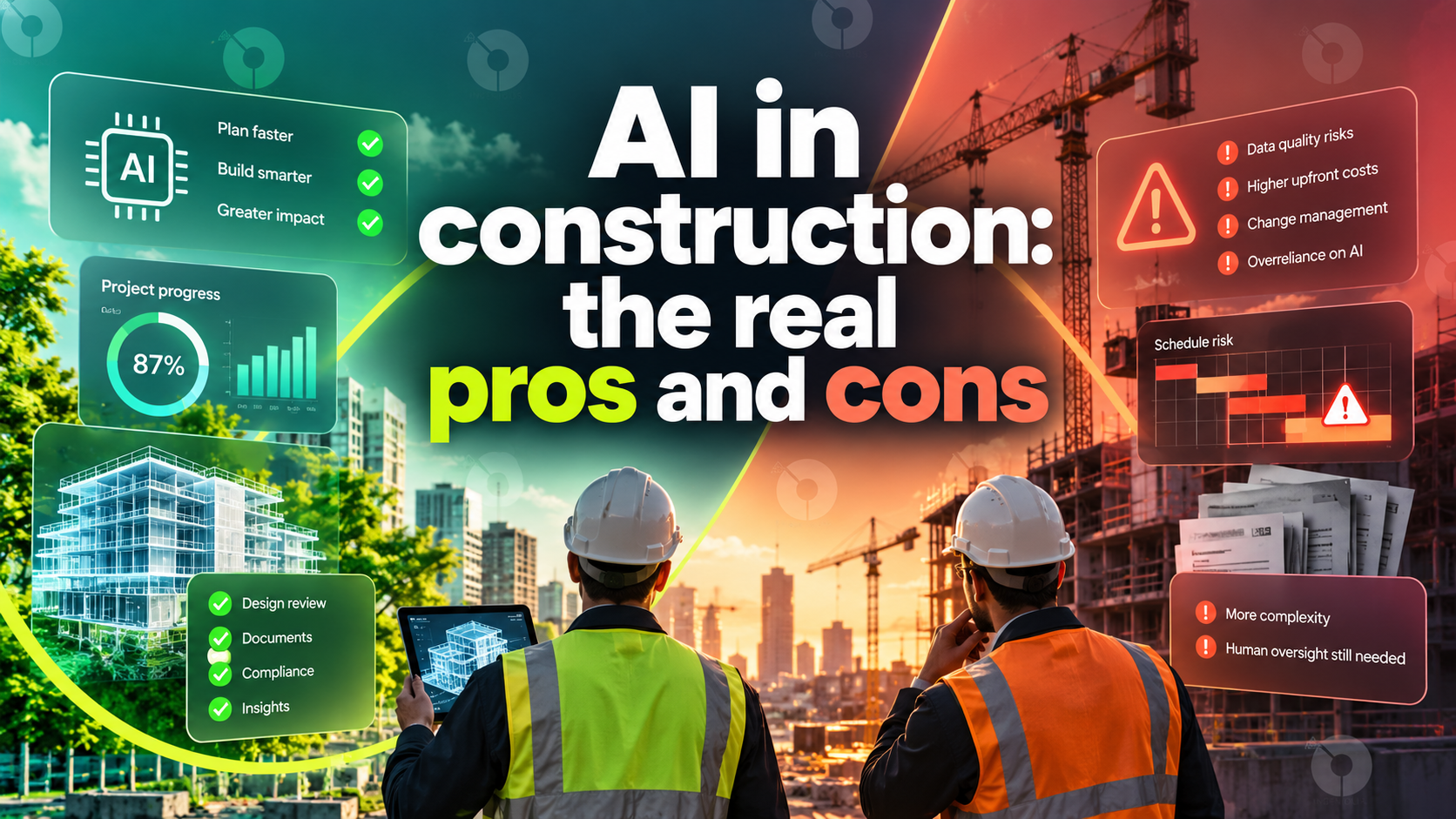
Few topics in construction generate more strong opinions with less agreement than AI — some treat it as an inevitable disruption to the workforce, others dismiss it as overhyped software marketing. The honest picture is more specific than either extreme: AI is being adopted quickly, for concrete reasons tied to a severe labor shortage, and it comes with real, well-documented risks that responsible teams need to manage rather than ignore. This guide covers what AI actually does in construction today, its genuine benefits and disadvantages, and a straight answer to the question everyone in the industry is asking about their own job.
AI applications in construction cluster around a handful of real, currently deployed use cases rather than a single "AI does everything" narrative:
AI in construction isn't a single technology arriving all at once; it's a decade-plus evolution from basic scheduling software toward genuinely predictive tools, accelerating sharply in the last two to three years as large language models made document-heavy tasks newly automatable.
Abstract risk is easy to dismiss; a concrete example is harder to. A project manager asks an AI tool to summarize a lengthy subcontract before a deadline. The summary is mostly accurate but omits a clause that shifts a specific risk onto the general contractor — not because the AI "hallucinated" anything dramatic, just an incomplete summary of a genuinely complex document. The PM, trusting the summary, misses the clause, misunderstands a payment obligation, and the company ends up bound to terms nobody actually reviewed in full.
Nothing exotic happened here — no rogue algorithm, no dramatic malfunction. Just a time-saving tool used as a substitute for review instead of a starting point for it, on a document where the stakes were higher than the task felt like in the moment. This is the realistic shape most AI risk takes in construction: not catastrophic failure, but a small, missed detail with real financial or legal consequences.
No, especially not in the way the question usually implies - the honest answer, consistent across labor economists, industry surveys, and legal analysis.The near-universal framing across current industry research is augmentation, not replacement — AI is filling a productivity gap created by a labor shortage, not eliminating the need for skilled trades.
That said, the effect isn't uniform across every role. Tasks that are repetitive, physical, and well-defined — certain material handling, some earthmoving, aspects of routine inspection — are more exposed to automation than tasks requiring judgment, adaptability, or complex physical skill. Some independent analyses attempt to score individual construction occupations by automation exposure, and while the specific numbers vary and shouldn't be treated as precise predictions, the general pattern they point to — routine and repetitive tasks shifting first — is consistent with what labor economists say about automation generally, not unique to construction.
The more useful framing for most construction professionals isn't "will my job disappear" but "which parts of my job will change". Project managers increasingly spend less time on administrative documentation and more on judgment calls and stakeholder coordination — a shift toward the parts of the job AI can't do well, not a shift out of the industry.
Based on the pattern consistent across current industry and labor research, tasks generally split into three tiers:
Most exposed to automation: repetitive material handling, routine document classification and data entry, standard quantity takeoff, basic scheduling updates, and predictable inspection checklist items.
Partially exposed — augmented, not replaced: cost forecasting and risk flagging (AI surfaces the signal, a person decides what to do about it), subcontractor performance tracking, and safety monitoring (AI detects, a person still responds and enforces).
Least exposed: skilled trade craftsmanship, on-site problem-solving when actual site conditions don't match the plan, client and stakeholder relationship management, and any judgment call involving contractual, safety, or design trade-offs.
The pattern holds across every task category: the more a task depends on physical dexterity, real-time judgment, or human relationships, the less exposed it currently is — regardless of which specific job title it falls under.
Not currently, and not by full autonomy — but it's worth being precise here, because construction robots aren't a future hypothetical. Several are already operating on real jobsites today, just in narrow, well-defined roles alongside human crews rather than replacing them.
Robots already deployed in construction today:
What every one of these has in common: each automates one narrow, repetitive, physically strenuous task — not an entire trade or job. A mason still supervises SAM100. Rebar crews still oversee TyBot. None of these systems plan a project, solve an unexpected site condition, or make a judgment call — that stays entirely human.
What's different about the next decade isn't whether these robots exist — they already do — it's whether they become affordable and common enough for a typical mid-size contractor to deploy routinely, rather than largely on flagship or well-capitalized projects. Industry workforce analysis generally places that broader, everyday adoption in the 2030–2035 window, which is a meaningfully longer and different question than "does construction robotics exist" — it already does, today, just not yet at the scale most firms will encounter it.
Given the gap between marketing language and real capability in this category, a few features are worth evaluating specifically rather than accepting "AI-powered" as a sufficient answer on its own:
We've covered this in more depth specifically for RFI and submittal workflows in our guide to AI for RFI and submittal management.
1. Define approved tools and tasks explicitly, in writing. A one-page policy naming which AI tools are approved, for which specific tasks, and which project data is off-limits for public AI tools prevents the shadow AI problem before it starts. Without this, individual employees make that call themselves, inconsistently, with no visibility into what's actually happening.
2. Keep human sign-off on anything liability- or safety-critical. AI-assisted first-pass checks are valuable — flagging a discrepancy, drafting a summary — but final approval on safety, structural, or contractual matters should require a named, qualified person's sign-off, not an AI recommendation accepted by default. A useful test: if you wouldn't accept "the software said it was fine" as a legal defense, a person needs to review it.
3. Audit your own data quality before trusting AI outputs heavily. Before evaluating any vendor's AI claims, check your own project data for the specific problems AI struggles with most — inconsistent cost coding, incomplete historical records, unstructured document naming. A model can't outperform the data it's given, regardless of how it's marketed.
4. Review vendor contracts specifically for AI liability allocation. Ask directly: if an AI-generated recommendation contributes to a costly decision, who bears responsibility — the vendor, your firm, or is it left ambiguous? Get this in writing before a dispute forces the question, not after.
5. Adopt a recognized risk framework rather than building governance from scratch. NIST's AI Risk Management Framework — built around four functions (Govern, Map, Measure, Manage) — wasn't written for construction specifically, but it's a well-established, publicly available starting point many firms adapt rather than reinventing their own governance structure from zero.
A meaningful share of the disadvantages described above — fragmented gray work, unclear data provenance, AI tools disconnected from where decisions actually get made — trace back to the same root cause: AI operating on disconnected or exported data rather than a live, connected project record. INGENIOUS.BUILD's AI capability is built on the Model Context Protocol (MCP), giving AI agents direct, real-time access to the full connected workspace — budgets, schedules, RFIs, and submittals together — rather than a periodic export from a single module.
That connectivity is also why teams using INGENIOUS.BUILD see 5x faster collaboration and 10x fewer change-order disputes — outcomes that depend on AI and human decision-making both working from the same current data, not a stale snapshot.
Book a personalized demo to see how a connected data foundation changes what AI can actually do on your projects.
AI in construction is neither the job-eliminating disruption some fear nor the frictionless solution some vendors imply — it's a genuinely useful set of tools for a genuinely under-resourced industry, with real risks that responsible teams manage rather than dismiss. The labor shortage driving adoption is well-documented and severe enough that the "will AI take our jobs" framing mostly misses what's actually happening on the ground. The more useful question for any construction professional or firm right now is narrower and more actionable: which tasks are worth automating first, and what data and governance do you need in place before you trust the output.
The most consistently cited disadvantages are poor data quality limiting AI's real-world accuracy, data privacy concerns with public AI tools, unclear liability when AI outputs are wrong, algorithmic bias in models trained on historical data, and "shadow AI" risk from employees using unapproved tools.
Not in the way the question usually implies. Current industry consensus, backed by severe labor shortage data, frames AI as filling a productivity gap rather than eliminating jobs — though routine, repetitive tasks are more exposed to automation than skilled, judgment-based work.
Not imminently. Physical robotics currently handles narrow, well-defined tasks under human oversight. Industry forecasts generally place more collaborative robotic labor — bricklaying, rebar tying — in the 2030–2035 window, a longer timeline than the broader AI conversation.
The clearest benefits are addressing labor shortages through productivity gains, reduced rework from catching issues earlier, reduced hazard exposure in specific automated tasks, and faster document-heavy administrative workflows like RFI and submittal processing.
By catching scope gaps, documentation errors, and quality issues earlier in processes like bid leveling and submittal review — rework caught early is consistently cheaper than rework discovered after installation.
Primarily in predictive scheduling, cost forecasting and anomaly detection, document classification and summarization, computer vision safety monitoring, and quantity takeoff support — repetitive, data-heavy tasks rather than skilled trade work.
The main risks are relying on inaccurate AI-generated contract or document summaries without verification, unclear liability when an AI recommendation contributes to a costly decision, and data privacy exposure when project information is processed by public AI tools.
Predictive cost and schedule forecasting based on your own project data, document summarization connected to live project records, anomaly detection that flags issues for human review, and clear data governance policies.
Shadow AI refers to employees using unapproved, consumer-grade AI tools for work tasks without company oversight — creating risks of data leakage, inconsistent outputs, and unverified guidance on things like code compliance.
Most AI risk isn't dramatic malfunction — it's more often a small, missed detail, like an incomplete contract summary that omits a risk-shifting clause, treated as a final answer instead of a starting point for human review.
Repetitive material handling, routine document classification, standard quantity takeoff, and predictable inspection checklist items are most exposed. Skilled trade craftsmanship, real-time site judgment, and stakeholder relationships remain least exposed.

INGENIOUS.BUILD
.svg)
.svg)



Company Type

Product Solutions
Information
.svg)
Speak to a Product Specialist
Streamline your Development & Construction projects with our cutting-edge project management software.
Discover why people are switching to INGENIOUS today!
By submitting this form, you agree with our Privacy Policy.