Informative
AI in Construction Project Management: Real Use Cases That Actually Save Time
Discover how AI is helping construction teams save time with smarter reporting, meeting summaries, RFIs, scheduling, and connected project management workflows.
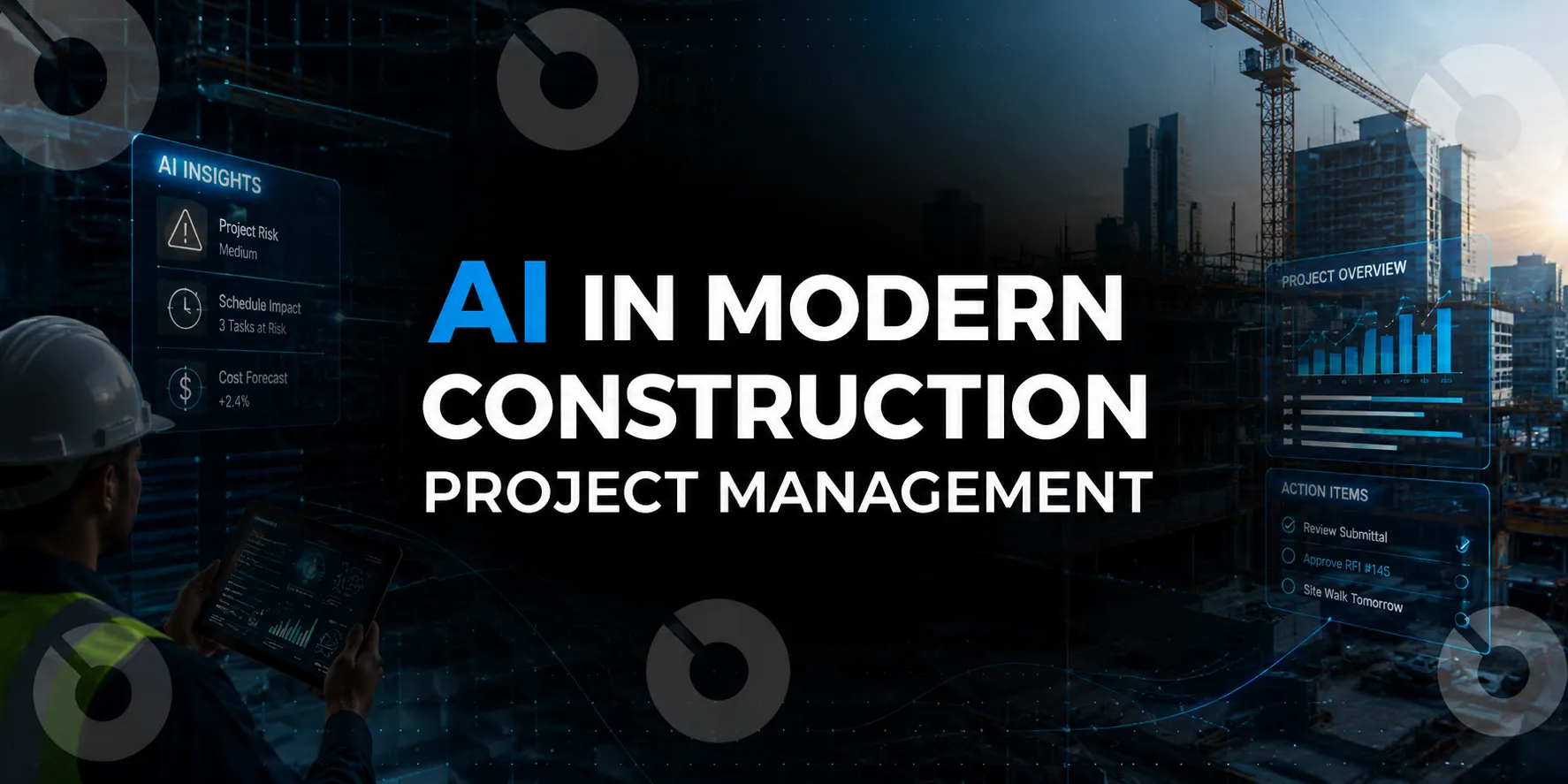
AI is rapidly becoming one of the most discussed topics in construction technology. But most conversations around AI in construction still stay too abstract.
Construction teams are not looking for futuristic concepts. They are looking for practical ways to:
- reduce administrative overhead
- improve project visibility
- speed up coordination
- reduce delays
- improve forecasting
- simplify reporting
- manage growing project complexity
That is where AI in construction project management is starting to create real operational value.
In 2026, the biggest shift is not AI replacing construction teams. It is AI helping project teams process information, coordinate workflows, and reduce operational friction across increasingly complex projects.
This article explains how AI is actually being used in construction project management today, where it creates the most value, and why connected construction data is becoming critical for AI-powered workflows.
What Is AI in Construction Project Management?
AI in construction project management refers to using artificial intelligence to improve project coordination, reporting, forecasting, document management and operational decision-making across construction workflows.
AI construction tools are increasingly being used to:
- summarize project updates
- identify project risks
- automate meeting documentation
- organize RFIs and submittals
- improve reporting visibility
- support schedule forecasting
- analyze project data
- reduce manual administrative work
The most important shift is that AI is moving from isolated automation toward connected operational workflows. Instead of simply generating text, modern AI construction systems increasingly help teams work with live project data across schedules, budgets, approvals, documentation and field updates.
Why AI Is Becoming Important in Construction
AI is becoming important in construction because modern projects generate more operational information than teams can realistically manage manually.
Every construction project produces continuous streams of data across:
- RFIs
- submittals
- schedules
- meeting minutes
- change orders
- procurement workflows
- field reports
- inspections
- approvals
- budgets
- contractor coordination
On many projects, this information is still fragmented across spreadsheets, PDFs, email threads, shared drives and numerous disconnected construction software tools.
This fragmentation creates operational inefficiency and limits project visibility.
Construction teams often spend hours:
- searching for the latest project information
- manually updating reports
- reconciling inconsistent data between systems
- tracking unresolved approvals and RFIs
- documenting meetings and follow-ups
- coordinating stakeholders across disconnected workflows
As projects scale, the amount of administrative coordination increases significantly. This is one of the main reasons AI adoption in construction project management is accelerating.
AI helps construction teams:
- organize project information faster
- surface operational risks earlier
- summarize large volumes of documentation
- improve reporting visibility
- reduce repetitive administrative work
- connect project context across workflows
- improve decision-making speed
The most important shift is that AI is moving construction teams from reactive information management toward connected operational visibility.
Instead of manually searching through fragmented systems, teams can work from centralized, contextual project data. This is especially valuable on:
- large commercial projects
- capital programs
- multi-stakeholder developments
- data center construction
- infrastructure projects
- owner-led portfolios
In practice, the biggest value of AI in construction is not replacing project teams. It is helping teams manage complexity, coordination, and project information more efficiently across the full construction lifecycle.
Real AI Use Cases in Construction Project Management
The most valuable AI construction workflows today are operational rather than futuristic. Here are the areas where AI is already helping construction teams save time and improve coordination.
AI for Construction Meeting Summaries and Action Items
Construction projects rely heavily on meetings to keep stakeholders aligned.
Teams regularly manage:
- OAC meetings
- construction coordination meetings
- subcontractor meetings
- procurement reviews
- executive status updates
- safety meetings
- site progress meetings
One of the biggest operational challenges is turning those conversations into clear, trackable follow-up actions.
This creates common problems such as:
- missed action items
- unclear responsibilities
- inconsistent meeting records
- unresolved follow-ups
- delayed decision-making
- poor visibility across stakeholders
AI construction tools help reduce this administrative burden by automatically:
- summarizing meeting discussions
- identifying action items and deadlines
- assigning responsibilities
- surfacing unresolved issues
- generating project updates
- organizing meeting records across workflows
Instead of manually reviewing long meeting notes or email threads, project teams can quickly identify critical decisions, upcoming risks, unresolved coordination issues, outstanding approvals and accountability gaps.
This improves operational visibility while reducing the amount of time spent on repetitive documentation work. For owners, contractors and project managers, AI-powered meeting workflows also improve accountability because decisions and follow-ups become easier to track across the project lifecycle.
AI for RFIs and Submittal Management
RFIs and submittals are some of the most operationally critical and documentation-heavy workflows in construction project management.
On complex projects, teams may manage:
- hundreds or thousands of RFIs
- multiple submittal revisions
- overlapping approval chains
- consultant responses
- procurement dependencies
- schedule-sensitive documentation workflows
When these processes are managed manually across spreadsheets, email threads, PDFs and disconnected systems, visibility quickly becomes difficult.
Common problems include:
- duplicate or repetitive RFIs
- delayed approvals
- unresolved documentation bottlenecks
- missing context between teams
- procurement delays tied to pending submittals
- difficulty tracking responsibility and status
AI construction workflows help reduce this operational friction by making project documentation easier to organize, analyze and retrieve.
AI can help teams:
- organize incoming RFIs and submittals automatically
- identify duplicate or related requests
- surface overdue approvals and unresolved issues
- summarize project impacts and dependencies
- improve document searchability across large datasets
- connect documentation to schedules, procurement, and project workflows
- identify patterns causing repeated coordination delays
As projects scale, these workflows become increasingly difficult to manage manually. AI improves visibility into large volumes of construction documentation that would otherwise remain fragmented across systems and stakeholders.
The biggest value is not simply automation. It is helping project teams identify bottlenecks, reduce approval delays and improve coordination across fast-moving construction workflows.
AI for Construction Reporting
Construction reporting is one of the most time-consuming administrative workflows in project management. Project teams constantly need to assemble information for:
- executive updates
- owner reports
- progress summaries
- budget reviews
- schedule tracking
- procurement status updates
- field progress reporting
- portfolio-level visibility
As a result, teams spend significant time:
- collecting updates from stakeholders
- reconciling inconsistent project data
- manually formatting reports
- searching for the latest information
- preparing executive summaries
AI-powered construction reporting helps reduce this operational overhead by generating real-time insights from centralized project data.
AI workflows can help create:
- project summaries
- executive status reports
- schedule snapshots
- budget and cost updates
- field progress summaries
- owner and stakeholder reports
- portfolio-level reporting views
Instead of manually assembling reports from fragmented systems, teams can work from connected project information that updates dynamically across workflows.
This improves:
- reporting speed
- operational visibility
- consistency across stakeholders
- executive decision-making
- portfolio oversight
The biggest advantage is not simply faster reporting. It is improving visibility into project conditions before small issues become larger operational problems.
AI for Construction Schedule Risk Detection
Construction schedules are constantly changing. Even well-planned projects face disruptions caused by:
- procurement delays
- approval bottlenecks
- subcontractor coordination issues
- labor shortages
- weather conditions
- inspection delays
- design revisions
- sequencing conflicts
- incomplete field information
On complex projects, these risks are often difficult to identify early because schedule dependencies are spread across multiple teams, workflows and systems.
AI-powered construction scheduling workflows help teams move from reactive schedule management toward earlier risk detection and operational visibility.
AI can help identify:
- emerging schedule risks
- delayed dependencies
- unresolved blockers affecting downstream work
- critical path concerns
- repetitive delay patterns across projects
- procurement impacts on milestones
- coordination gaps between trades
- approval bottlenecks affecting execution
Instead of manually reviewing large amounts of project information, AI helps surface issues that may otherwise remain hidden until delays become more serious.
The biggest value is not simply automating schedules. It is helping project teams identify operational risks earlier, improve forecasting visibility and make faster decisions before schedule problems cascade across the project.
AI for Construction Document Management
Construction projects generate enormous amounts of documentation across every phase of the project lifecycle.
Teams manage:
- drawings and revisions
- RFIs and submittals
- meeting minutes
- contracts and procurement records
- inspection reports
- permits and compliance documents
- field photos and site reports
- approvals and change orders
As documentation volume grows, teams often struggle with:
- outdated file versions
- fragmented document storage
- inconsistent naming conventions
- limited approval visibility
- difficulty locating historical decisions
- disconnected project context between documents and workflows
These issues create operational risk because project teams lose time searching for information instead of acting on it. AI-powered construction document management helps solve this by making project information easier to organize, retrieve and understand across connected workflows.
AI can help improve:
- document searchability across large project datasets
- organization of drawings and project records
- workflow visibility tied to approvals and revisions
- document summaries and contextual insights
- retrieval of historical project decisions
- identification of related RFIs, submittals, and schedule impacts
- visibility into unresolved documentation bottlenecks
Instead of manually navigating thousands of files and email chains, teams can access contextual project information much faster.
The biggest advantage of AI in construction document management is not simply storing files more efficiently. It is improving operational visibility across complex project information that would otherwise remain fragmented and difficult to manage at scale.
AI Construction Software vs Traditional Construction Management Tools
Traditional construction software typically focuses on storing and managing project information. AI-enabled construction platforms increasingly help teams interact with project information more intelligently.
For example:
- traditional systems store meeting minutes
- AI systems summarize and surface key decisions
- traditional systems track RFIs
- AI systems identify unresolved bottlenecks and related risks
- traditional systems store schedules
- AI systems help identify emerging coordination problems
The biggest operational difference is visibility. AI becomes most valuable when it helps teams reduce complexity and make project information easier to act on.
Why Connected Construction Data Matters for AI
AI in construction only works well when project information is connected across workflows. That is becoming one of the biggest challenges in construction AI adoption today.
Many construction teams still manage schedules, budgets, RFIs, approvals, field updates and documentation across disconnected systems. As a result, project data becomes fragmented and difficult to analyze in context.
This limits what AI can actually do.
If project information is scattered across spreadsheets, email threads, PDFs, and separate software tools, AI struggles to surface reliable insights, identify risks accurately or connect issues across workflows.
For example, a schedule update may not reflect procurement delays, unresolved RFIs or pending approvals happening elsewhere in the project.
That is why connected construction management platforms are becoming increasingly important for AI-powered workflows. The more centralized and connected the project data is, the more useful AI becomes for reporting, coordination, forecasting, and operational visibility.
Why Fragmented Construction Workflows Break AI
AI systems depend on context.
If project information is spread across disconnected systems, AI workflows become:
- incomplete
- inconsistent
- difficult to trust
- operationally limited
For example:
- schedule data may not reflect procurement risks
- meeting notes may not connect to RFIs
- approvals may remain buried in email chains
- budget exposure may lack real-time visibility
This limits AI’s ability to provide meaningful operational insights.
Construction companies increasingly need centralized operational environments where project data remains connected across workflows.
AI in Construction Administration
Construction administration is one of the areas where AI can create immediate value.
Administrative workflows consume enormous amounts of time through:
- meeting documentation
- approval tracking
- reporting
- RFIs
- submittals
- document coordination
- follow-up communication
AI helps reduce repetitive administrative work while improving visibility into operational workflows.
This allows project teams to spend more time managing execution and less time manually organizing information.
AI for Construction Owners and Developers
Owners and developers are increasingly interested in AI because of visibility challenges.
Large capital projects generate:
- huge volumes of reporting
- multiple stakeholder layers
- complex approval structures
- fragmented operational updates
AI-powered construction workflows can help owners:
- summarize project status faster
- identify unresolved risks
- improve portfolio visibility
- streamline reporting
- improve auditability
As projects become more complex, operational visibility becomes increasingly valuable.
What AI Cannot Replace in Construction
AI can significantly improve construction workflows by reducing administrative overhead, improving reporting visibility and helping teams process project information faster.
But construction still depends heavily on human expertise.
Projects require:
- field experience
- operational judgment
- relationship management
- site coordination
- technical decision-making
- real-world problem solving
AI cannot replace the practical knowledge required to manage subcontractors, respond to changing site conditions, navigate stakeholder dynamics or make critical project decisions under pressure.
Instead, AI works best as a support layer for construction teams.
Its role is not replacing project managers, superintendents or coordinators. It is helping them manage increasingly complex, data-heavy projects more efficiently by improving visibility, coordination and access to information.
The Future of AI in Construction Project Management
The future of AI in construction project management is shifting away from isolated automation tools and toward connected operational systems.
Construction teams increasingly need:
- centralized project visibility
- connected workflows across stakeholders
- real-time reporting and forecasting
- contextual project data
- portfolio-level operational insights
AI becomes significantly more valuable when it can work across the full construction workflow instead of isolated datasets or disconnected software tools.
For example, the real value of AI is not simply generating summaries or automating tasks. It is helping teams connect schedules, budgets, RFIs, approvals, procurement, and field updates inside one operational environment.
As projects become more complex and data-heavy, construction companies are realizing that fragmented systems limit what AI can actually deliver. That is why connected construction workflows are becoming a major focus across the industry.
The future of AI in construction is not just smarter automation. It is smarter operational visibility across the entire project lifecycle.
How INGENIOUS.BUILD Supports AI-Powered Construction Workflows
INGENIOUS.BUILD is designed around connected construction operations.
The platform centralizes:
- schedules
- budgets
- RFIs
- approvals
- meeting minutes
- procurement workflows
- action items
- reporting
- document management
inside one operational environment.
This connected structure creates stronger visibility across project workflows while supporting AI-powered coordination, reporting, and operational insights.
Instead of working across fragmented systems, teams can manage project information inside connected workflows tied directly to execution.
Final Thoughts
AI in construction project management is no longer just a future concept. It is increasingly becoming an operational tool for reducing administrative burden, improving project visibility, and helping teams coordinate more effectively across complex projects.
The biggest opportunity is not replacing construction professionals. It is helping project teams spend less time managing fragmented information and more time managing projects.
As construction becomes more data-heavy, connected operational visibility will become increasingly important for successful AI adoption.
INGENIOUS.BUILD helps construction teams centralize workflows, improve operational visibility, and support smarter project coordination across stakeholders and project phases.
Book a demo to see how connected construction workflows support modern AI-powered project management.
FAQ
How is AI used in construction project management?
AI is used in construction project management to improve reporting, document management, meeting summaries, schedule visibility, RFI coordination, forecasting and operational workflows.
What are the benefits of AI in construction?
AI helps reduce administrative work, improve project visibility, organize large volumes of information, identify risks earlier and improve coordination across stakeholders.
Can AI replace construction project managers?
No. AI supports project teams by improving information management and workflow visibility, but construction still requires human judgment, field expertise and operational decision-making.
Why does connected project data matter for AI?
AI systems depend on accurate and connected information. Fragmented construction workflows limit AI effectiveness because project context becomes incomplete or inconsistent.
What are the best AI use cases in construction today?
Common AI construction use cases include meeting summaries, reporting automation, RFI organization, document search, schedule risk detection and operational visibility improvements.
How does AI improve construction administration?
AI helps automate repetitive administrative workflows such as documentation, reporting, follow-up tracking, approvals and project coordination tasks.