|

MENU


.svg)
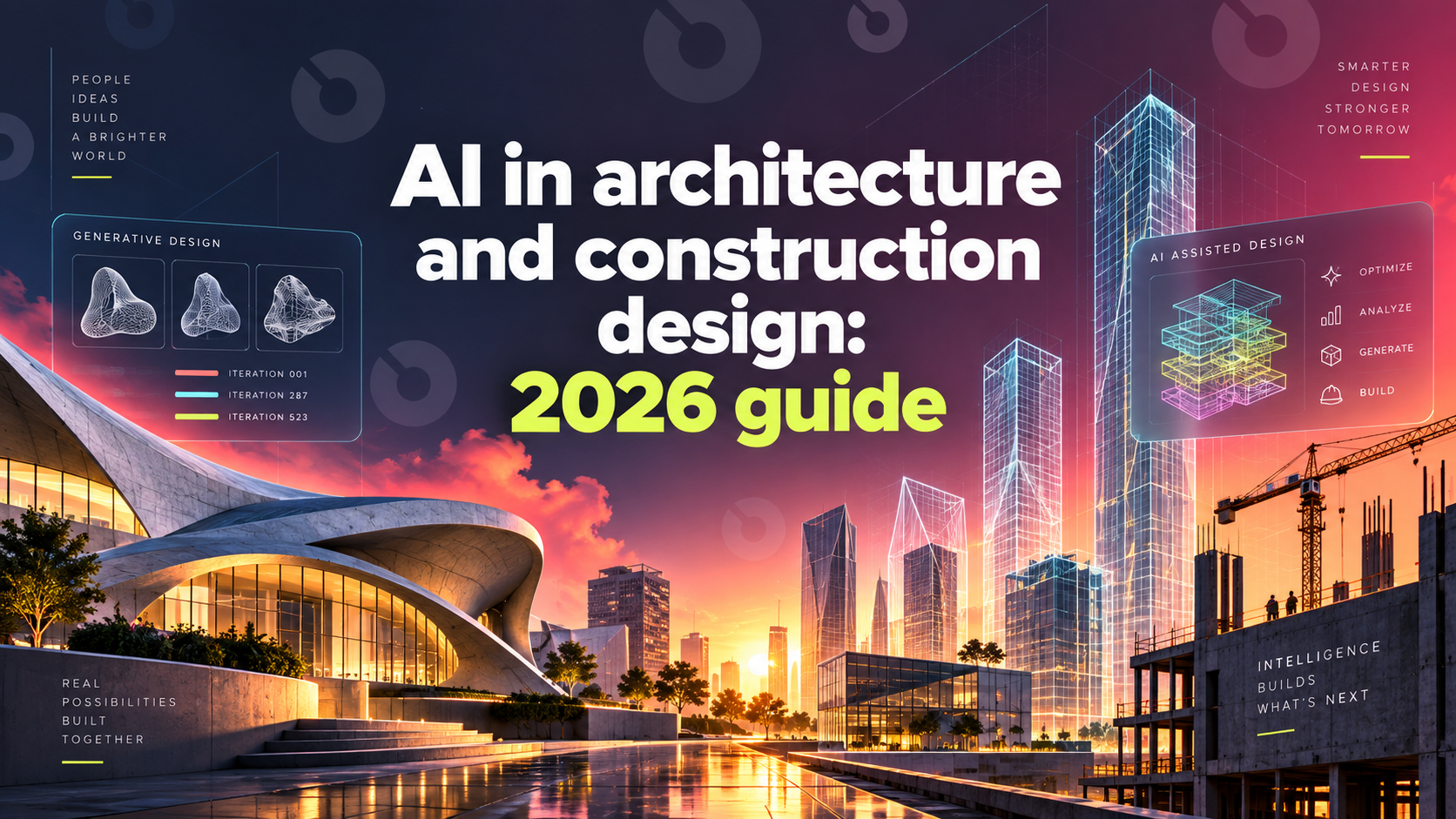
Ask two different industry surveys how many architecture firms actually use AI, and you'll get two different answers: one puts it at 27%, another at 46%. That gap says more about how loosely "AI adoption" gets measured than it does about the technology itself — and it's a useful starting point for a guide that tries to be specific about what AI actually does in architectural and construction design today, rather than repeating the same vague "AI is transforming design" claim everyone else makes.
AI applications in this space cluster into several distinct categories, each at a different level of maturity:
This is genuinely hard to pin down precisely, and the disagreement between sources is itself informative. One global survey of over 1,000 AEC professionals found only 27% of firms currently use AI in their operations — though 94% of those adopters plan to increase investment this year, suggesting the ones who've started are convinced it's working. A separate survey of 1,227 architecture professionals put current usage at 46%, with another 24% planning to start soon.
The likely explanation for the gap: firm size, digital maturity, and — most importantly — what counts as "using AI" vary enormously between studies. A firm using AI-assisted rendering might not count itself as an "AI adopter" the same way a firm running generative design workflows would, even though both are technically true. The practical takeaway isn't the exact percentage — it's that adoption is real, growing, and highly uneven across the industry, which matches the broader pattern seen across construction technology generally.
A quick reference for which tools handle which job, based on current 2026 coverage:
This list will shift quickly — this is a fast-moving category — but the categories themselves (feasibility, performance, coordination, visualization, modeling) are a more durable way to think about the space than any specific product name.
Generative design tools are strongest exactly where the problem is well-defined and rule-based: solving for thousands of layout iterations against hard constraints like height limits and setbacks, then exporting the optimized geometry into Revit or another BIM platform for further development. For architects working with developers who need a fast, defensible feasibility answer, this is a genuinely mature, reliable application today.
The same tools are weakest exactly where design work is least rule-based: because the geometry these platforms produce is strictly logic-driven, they're a poor fit for bespoke or sculptural architectural forms where the value is precisely in departing from a rule-optimized solution. The most useful framing, echoed across current architecture research, is that generative design works best as bounded option generation — helping a team define goals and constraints and then explore many viable options quickly — rather than as autonomous authorship that replaces architectural judgment about what's actually worth building.
Clash detection is one of the more mature, lower-risk AI applications in this category, largely because of how it's structured: it flags a potential conflict for a human coordinator to review, rather than resolving the conflict itself. In older workflows, catching a conflict between, say, ductwork and structural framing meant manual, discipline-by-discipline coordination review — tedious and easy to miss on a complex model. AI-assisted clash detection can study patterns from earlier projects and increasingly flag likely conflicts even before a model is fully built out, catching issues earlier in the design process rather than after significant modeling work is already done.
This matters beyond just saving coordination time: a clash caught during design costs a redraw. The same clash caught during construction costs a change order, a schedule delay, or both — which is exactly the kind of downstream cost the rework and change order research we've covered elsewhere consistently points to.
Here's what that difference actually looks like. A structural beam and a mechanical duct run are routed through the same ceiling space. Caught during BIM coordination: the clash detection flag appears during model review, an engineer adjusts the duct routing in the model, and the fix costs an afternoon of redesign work before anything is fabricated. Caught during construction: the conflict surfaces when the crew tries to install the ductwork and the beam is already in place, triggering a field RFI, a redesign under time pressure, possible demolition and rework of installed work, and a change order to cover the added cost and schedule impact — often 10 to 20 times the cost of the same fix caught on the model.
The underlying design mistake is identical in both cases. The only variable is which phase caught it — and it's a widely cited rule of thumb in construction that the cost of fixing an error grows substantially at each later phase, which is the core argument for treating clash detection as a design-phase investment rather than a nice-to-have.
This is arguably the lowest-risk, fastest-adopted category of AI in the entire design workflow, because the output is presentation material rather than a structural or contractual decision. Current tools can convert a rough sketch or a BIM screenshot into a photorealistic render, maintain accurate, consistent material representation without manual mapping, and let a user make targeted edits — swapping a material or lighting condition — without re-rendering an entire scene from scratch.
The practical value here is speed in client communication and design iteration, not a structural or code decision, which is part of why this category faces less scrutiny and skepticism than generative design or documentation AI.
A consistent theme across current tools and research: the more a task depends on structural plausibility, buildability, or genuine design originality, the less reliable AI is at replacing human judgment, rather than assisting it.
A few direct questions tend to separate genuine capability from marketing language in this category:
That last question matters more than it might seem — a design tool that can't clearly answer how its output reaches construction is a signal the tool was built for the design phase in isolation, without much thought for what happens next.
Design-phase AI tools and construction delivery software solve genuinely different problems, and it's worth being clear about that boundary rather than implying one category of tool covers both. Generative design, clash detection, and visualization tools operate before and during the design phase, helping architects and engineers arrive at a buildable design faster. Once that design moves into procurement and construction, a different set of questions takes over: does the budget still reflect what's actually being built, are RFIs about design intent getting resolved quickly, and is everyone — owner, architect, GC, subs — working from the same current version of the design.
That handoff is where a lot of the value created during design can quietly leak away if the systems don't connect. A clash caught brilliantly during BIM coordination still needs to translate into an accurate budget line and a clear submittal review process once construction starts — which is a construction administration and project financials problem, not a design tool problem. We've covered the AI side of that specific handoff — RFIs and submittals — in more detail in our guide to AI for RFI and submittal management.
INGENIOUS.BUILD isn't a generative design or BIM authoring tool — those are a genuinely different category, covered throughout this guide. Where INGENIOUS.BUILD fits is the moment design intent needs to become a buildable, budgeted, trackable project: connecting the RFIs, submittals, budgets, and schedules that translate a finished design into an actual building, with owners, architects, GCs, and subs all working from the same current data.
Teams using INGENIOUS.BUILD see 5x faster collaboration and 10x fewer change-order disputes — outcomes that depend directly on design decisions and their cost and schedule implications staying connected, rather than getting lost in the handoff between design tools and construction execution.
Book a personalized demo to see how INGENIOUS.BUILD keeps design intent connected through construction delivery.
AI in architecture and construction design is genuinely useful today, but unevenly so — mature and reliable for generative feasibility, clash detection, and visualization; still requiring real human oversight for documentation, structural judgment, and anything genuinely creative. The adoption numbers vary so much between surveys precisely because the category itself is uneven, not because anyone's measuring it wrong. The more useful question for any firm isn't "are we using AI" in the abstract — it's which specific, well-bounded tasks in your design workflow are mature enough to trust today, and which still need a person checking the last 10%.
Primarily for generative feasibility and massing studies, automated code and zoning compliance checks, BIM clash detection, building performance analysis, and visualization/rendering — each at a different level of reliability.
Estimates vary widely — one survey puts current adoption at 27% of AEC firms, another at 46% of architecture professionals specifically — largely because studies define "using AI" differently.
Generative design uses AI to produce and evaluate many layout options against defined constraints like height and setbacks. It's strongest for rule-based feasibility work and weakest for bespoke or highly creative design, since the output is inherently logic-driven.
Current guidance treats AI-generated geometry as accurate enough to rely on, but AI-assisted documentation still requires human review before it's used for construction — a common target is AI handling roughly 90% of the work with a human verifying the rest.
Not entirely — it flags likely conflicts based on patterns from past projects, which speeds up review significantly, but a human coordinator still confirms and resolves the actual conflict.
No. Current tools generate and filter options within constraints an architect defines; deciding what's actually worth building — structurally, aesthetically, and functionally — remains a human judgment call.
It doesn't automatically — design tools and construction delivery software solve different problems. The handoff between a finished design and an accurate budget, schedule, and RFI process is where the two need to connect, which is a construction administration function, not a design tool feature.
Common categories include generative feasibility tools like TestFit and ARCHITEChTURES, building performance analysis like Cove.tool, visualization tools like Rendair AI and Chaos AI Enhancer, and concept modeling tools like Kaedim — the specific products shift quickly, but these categories are fairly stable.
It's a widely cited industry rule of thumb that fixing an error costs substantially more the later it's caught — a clash found in BIM coordination typically means a same-day model fix, while the same clash found in the field can trigger an RFI, rework, and a change order.
Ask specifically whether generative outputs are filtered for structural plausibility (not just code compliance), what percentage of output realistically needs human review, and how the tool's output connects to construction documentation and delivery.

INGENIOUS.BUILD
.svg)
.svg)



Company Type

Product Solutions
Information
.svg)
Speak to a Product Specialist
Streamline your Development & Construction projects with our cutting-edge project management software.
Discover why people are switching to INGENIOUS today!
By submitting this form, you agree with our Privacy Policy.