|

MENU


.svg)
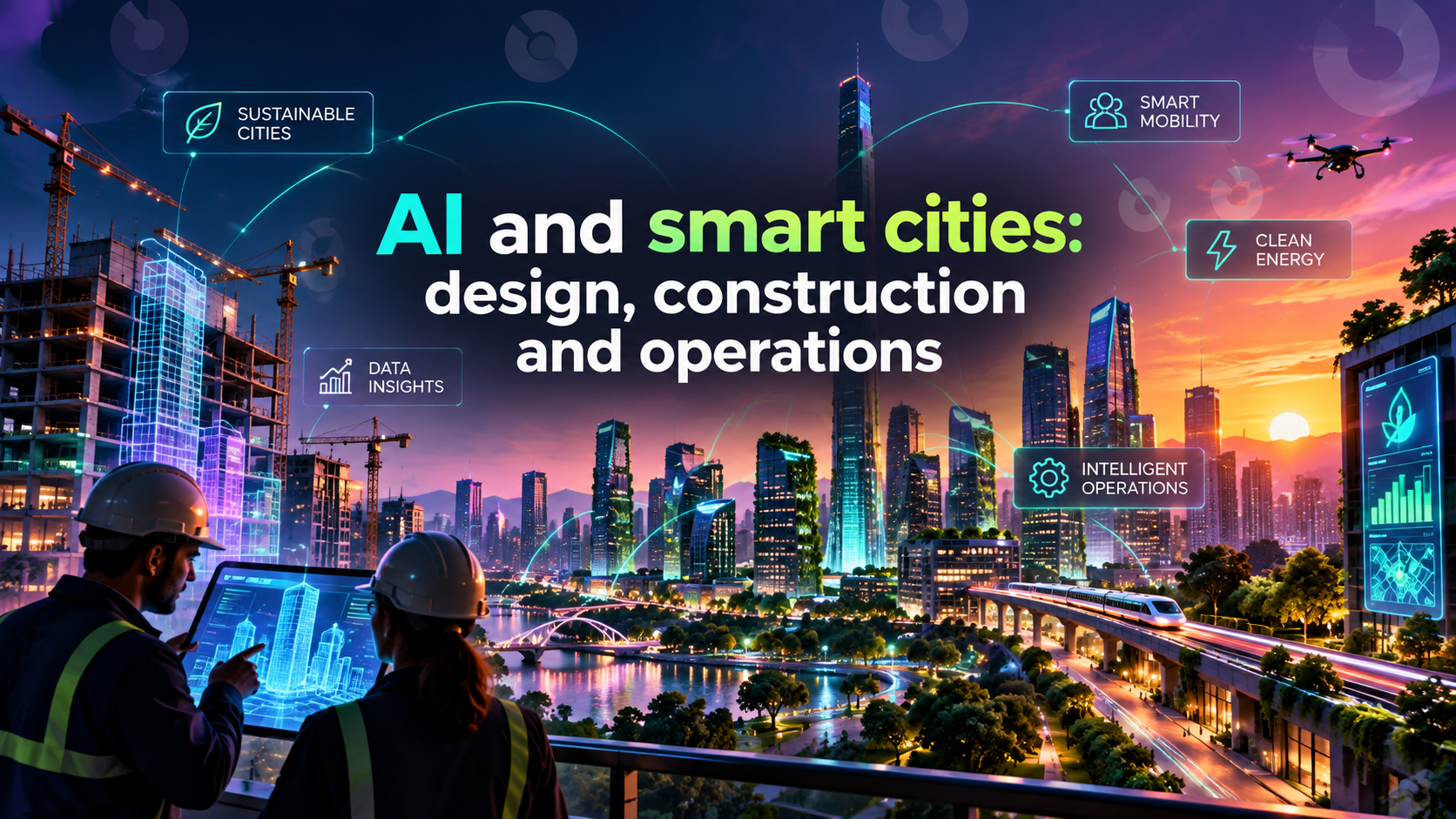
"AI and smart cities" gets used as if it's one topic, but it's really three distinct ones happening at different points in a project's life: AI that helps design and plan a smart city, AI that helps actually build it, and AI that runs it once it's finished. Most coverage of this topic blurs those three together, which makes it hard to tell what's actually relevant to your project versus what's a different category of tool entirely. This guide keeps them separate.
A smart city is an urban area that integrates connected sensors, data platforms, and digital infrastructure into how it manages services — traffic flow, energy and water use, waste management, and public safety — with the goal of running more efficiently and responsively than a traditional city relying on manual oversight. Some smart cities are built from scratch on greenfield sites (like NEOM in Saudi Arabia); far more commonly, "smart city" work means retrofitting AI and connected infrastructure into existing urban areas incrementally.
This is the most visible and most discussed layer of the AI-and-smart-cities conversation, and it's genuinely active today rather than theoretical.
Generative urban design tools now let planners generate multiple layout options for a neighborhood or district based on defined constraints — density targets, sunlight access, walkability — and evaluate the tradeoffs quickly rather than manually drafting each option. Autodesk's Spacemaker has been used in Norway to design denser developments without the cramped feel density usually implies, and Daiwa House in Japan uses generative design tools to solve high-density housing challenges within strict material and regulatory constraints.
Automated zoning and code compliance is one of the fastest-moving applications. Some city planning departments, including Los Angeles, are piloting AI tools that read submitted development plans and automatically check them against zoning rules and building codes, flagging issues before a human reviewer even opens the file — reducing administrative review time for more routine applications and freeing staff to focus on complex cases.
Traffic, water, and waste flow modeling during the planning phase increasingly uses AI to simulate how infrastructure decisions will perform before anything is built, rather than relying solely on historical rules of thumb.
This is the phase that gets the least attention in most "AI and smart cities" coverage, despite being where the actual execution risk concentrates. A smart city plan can be brilliantly designed and still fail to materialize on time or on budget if the delivery process — coordinating dozens of stakeholders across public and private interests — breaks down.
A few applications are emerging specifically in this phase. AI tools that analyze predevelopment and construction data can feed directly into budgeting, design refinement, and procurement decisions, which matters most in public-private partnerships and affordable housing components of smart city developments, where more reliable cost and scheduling estimates reduce risk for both the government and private development partners involved. Structural health monitoring, using sensors and AI analysis during construction itself, is increasingly used to catch potential structural issues early on complex, large-scale infrastructure builds. And because smart city projects routinely involve multiple government agencies, utility providers, and private developers simultaneously, AI-assisted document processing and RFI/submittal management — the kind we've covered in detail in our guide to AI for RFI and submittal management — becomes more valuable, not less, given how many parties are generating and needing to track that documentation at once.
This is a genuinely different category of tool from anything used in design or construction, worth not conflating with the earlier two phases. Once a smart city district or building is complete, a separate class of platforms manages its day-to-day operation: aggregating data from HVAC, lighting, security, and energy systems into unified dashboards, and using machine learning to optimize energy consumption based on occupancy patterns, weather, and utility rates. Some platforms in this category report energy consumption reductions in the range of 20–30% compared to conventional building controls.
If you're evaluating tools specifically for running a completed smart city district or portfolio of connected buildings, that's a distinct buying decision from tools used to design or deliver the project in the first place — worth knowing before assuming one platform covers all three phases.
NEOM, the large-scale greenfield development in Saudi Arabia, is among the most frequently cited real-world examples spanning multiple AI applications — from generative planning of its urban zones to sensor-driven infrastructure monitoring. It's also the clearest illustration of the point this guide keeps returning to. NEOM's original announced budget was roughly $500 billion, but a 2024 internal audit reported by the Wall Street Journal projected the full build-out cost at approximately $8.8 trillion — nearly 17 times the original figure, and roughly nine times Saudi Arabia's annual GDP. Around $50 billion has reportedly been spent to date, spanning a footprint of roughly 26,500 square kilometers. Some components, like the Sindalah resort island, have visibly progressed, while others, including the widely publicized "The Line," have been scaled back or redesigned.
None of that reflects a failure of AI planning or design — NEOM's AI-assisted urban planning and sensor infrastructure are genuinely sophisticated. It reflects what happens to budget and scope on any capital project of sufficient scale and complexity when delivery execution — not the underlying design vision — becomes the binding constraint. Even a smart city built with cutting-edge AI planning and operations tools still has to be physically constructed, on a schedule, on a budget, coordinating an enormous number of stakeholders — and that delivery challenge doesn't shrink just because the plan was AI-generated.
Strip away the "smart city" framing for a moment, and the underlying project is still a capital project — usually an unusually large and complex one, involving a municipality or public agency, one or more private developers, multiple utility providers, a general contractor, and dozens of subcontractors and design firms, often across several concurrent phases or districts.
That combination — many stakeholders, public and private money often mixed together, and infrastructure that needs to integrate cleanly with systems multiple different parties own — is exactly the profile where delivery risk concentrates on any large capital project, smart city or not. Budget assumptions made during planning need to survive contact with real bids. Change orders on a project this size and complexity are common, not exceptional. And documentation needs to be clean enough to support the compliance, reporting, and audit requirements that public-private capital projects almost always carry.
INGENIOUS.BUILD isn't a generative design tool or a post-construction building operations platform — those are genuinely different categories of software, covered above. Where INGENIOUS.BUILD fits is the delivery phase: its Project Financials module includes capital planning alongside budgets, bid packages, and contracts, built for exactly the kind of large, multi-stakeholder capital project a smart city development represents — connecting owners, agencies, GCs, subs, and design teams in one system rather than leaving that coordination to email and spreadsheets across a dozen different organizations.
Teams using INGENIOUS.BUILD see 5x faster collaboration and 10x fewer change-order disputes — outcomes that matter as much, if not more, on a large public-private infrastructure project as on any single building.
Book a personalized demo to see how INGENIOUS.BUILD supports complex, multi-stakeholder capital project delivery.
A quick recap of the concrete figures covered in this guide:
The gap between the tidy market-size percentages and NEOM's real, audited cost overrun is itself the point: forecasts and market sizing are estimates; a capital project's actual delivery outcome is what determines whether the plan survives contact with reality.
AI's role in smart cities is real across design, construction, and operations — but it's three different roles, not one, and conflating them makes it harder to evaluate what's actually relevant to a given project. The design and operations layers get most of the attention because they're the most visible and most novel. The construction delivery layer gets the least attention and carries the most execution risk, because at its core, a smart city is still a massive capital project that has to be built, on budget, by coordinating far more stakeholders than a typical development ever involves.
AI is used for generative urban design — producing multiple layout options based on density, sunlight, and walkability constraints — and for automated zoning and building code compliance checks during the planning and permitting process.
Primarily through AI-assisted analysis of predevelopment and construction data feeding into budgeting and procurement decisions, structural health monitoring during the build, and AI-assisted document processing for the high volume of RFIs and approvals multi-stakeholder projects generate.
Design software (like generative urban design tools) is used before construction to plan layouts and check compliance. Operations software is used after construction to manage a completed building or district's energy, HVAC, and security systems — they're different categories of tools for different project phases.
Los Angeles City Planning is piloting automated zoning and code compliance review, Autodesk's Spacemaker has been used for generative design in Norway, and NEOM in Saudi Arabia is a widely cited example — though its budget growing from an original $500 billion estimate to a reported $8.8 trillion full build-out projection also illustrates the real delivery risk behind any project this scale.
At its core, yes — a smart city development still has to be designed, budgeted, and physically built by coordinating a public agency, private developers, utilities, and contractors, which is fundamentally a large-scale capital project delivery challenge regardless of how much AI is layered on top.
Post-construction city and building operations software aggregates data from HVAC, energy, security, and lighting systems into unified dashboards, using machine learning to optimize consumption — a distinct category from design or construction delivery software.
Estimates vary enormously by source, ranging from roughly $420 billion to over $870 billion for 2026 depending on methodology and scope — a wide enough spread that any single figure should be treated with some skepticism.

INGENIOUS.BUILD
.svg)
.svg)



Company Type

Product Solutions
Information
.svg)
Speak to a Product Specialist
Streamline your Development & Construction projects with our cutting-edge project management software.
Discover why people are switching to INGENIOUS today!
By submitting this form, you agree with our Privacy Policy.