Informative
AI Agents for Construction: What They Are and Why They Matter
Learn how AI agents can automate construction workflows, improve project visibility, reduce admin work, and support faster decisions.
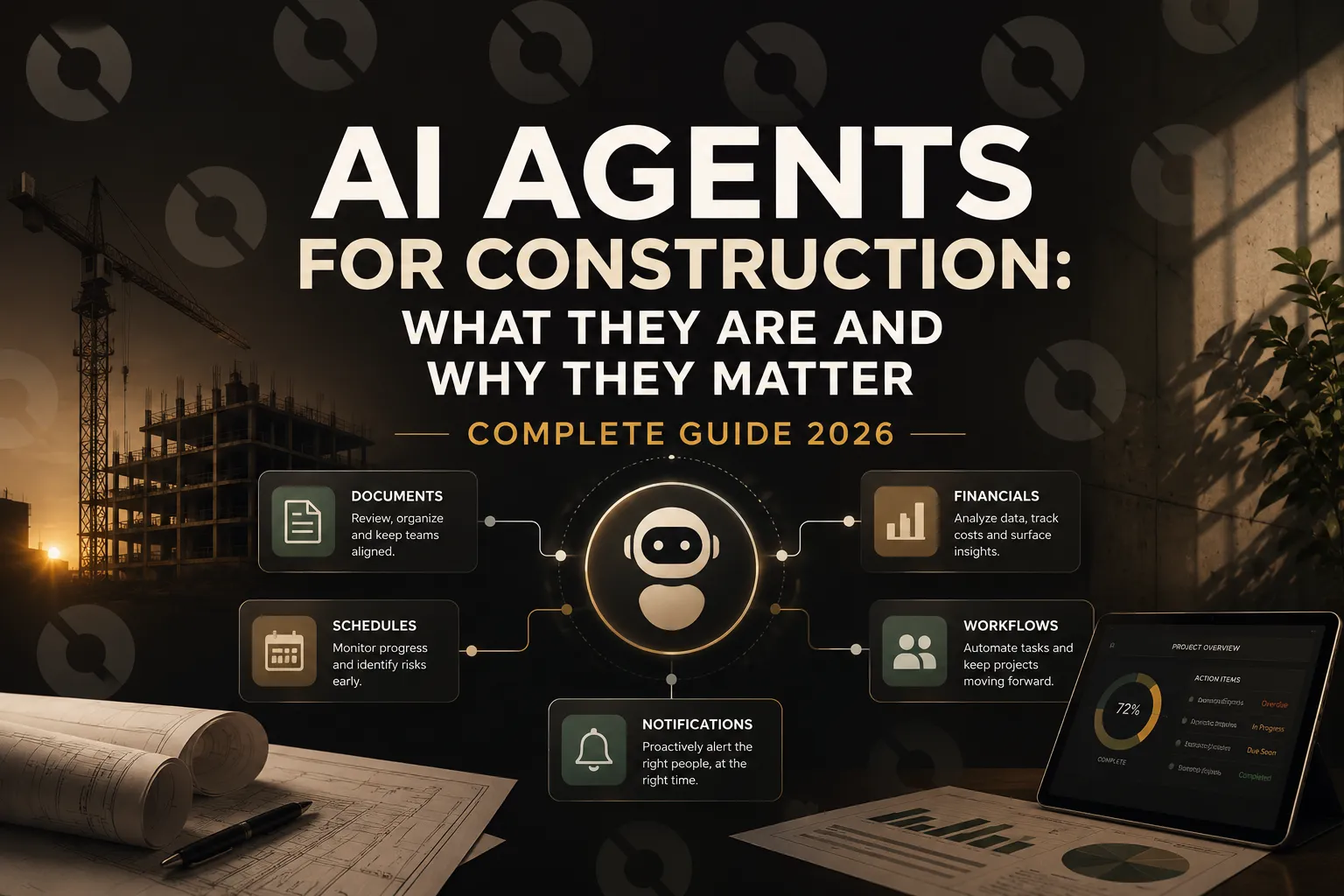
Artificial intelligence is already changing how construction teams manage reports, documents, schedules and project data. The next evolution is agentic AI: AI systems that can not only analyze information but also take actions, complete workflow and proactively support project teams.
While many construction organizations are still experimenting with AI chatbots and reporting tools, AI agents are emerging as a potentially more powerful way to automate repetitive processes, improve project visibility and reduce administrative burden.
From construction project management and financial reporting to document control and risk monitoring, AI agents have the potential to support a wide range of construction workflows.
This guide explains what AI agents are, how they differ from traditional AI tools and where they may create the most value for construction companies.
What Are AI Agents?
An AI agent is an AI-powered system that can perform tasks on behalf of a user with limited human intervention.
Unlike traditional software, which typically requires users to initiate every action, AI agents can:
- gather information
- analyze data
- make recommendations
- complete workflows
- monitor changes
- trigger actions
- communicate updates
In construction, an AI agent might automatically review project data, identify risks, generate reports, notify stakeholders and track unresolved issues without requiring manual oversight at every step.
What Is Agentic AI in Construction?
Agentic AI refers to AI systems that can reason through workflows and perform multi-step tasks rather than simply answering questions.
For example:
A traditional AI assistant may answer: "What RFIs are overdue?".
An AI agent may:
- identify overdue RFIs
- summarize project impacts
- notify responsible stakeholders
- generate a status report
- track whether the issue is resolved
The difference is that agentic AI moves from information retrieval to workflow execution.
This concept is becoming increasingly relevant for construction organizations managing complex projects and large volumes of operational data.
Why Construction Is a Good Fit for AI Agents
Construction is an information-heavy industry. Every project generates a constant stream of RFIs, submittals, schedules, budgets, meeting notes, change orders, procurement updates, approvals and project communications.
Managing this information has traditionally required significant manual effort. Project teams often spend hours searching for documents, tracking outstanding items, following up on approvals, preparing reports and coordinating stakeholders across multiple systems.
AI agents are particularly well-suited to these environments because they can continuously monitor project information, identify important changes, track workflows and proactively surface issues that need attention. As construction projects become more complex and data-intensive, AI agents can help organizations improve project visibility, reduce administrative burden and support faster decision-making.
AI Agents for Construction Project Management
Project management is one of the most promising applications for AI agents in construction.
Construction project managers spend significant time:
- preparing reports
- tracking action items
- monitoring project status
- following up on approvals
- coordinating stakeholders
AI agents can help automate portions of these workflows.
Potential use cases include:
Project Reporting Agents
Automatically generate:
- executive reports
- owner updates
- weekly project summaries
- portfolio reports
- meeting recaps
Action Item Tracking Agents
Monitor project communications and track:
- outstanding decisions
- overdue tasks
- unresolved issues
- upcoming deadlines
Schedule Monitoring Agents
Review project schedules and identify:
- delayed milestones
- emerging risks
- critical path concerns
- dependency conflicts
The goal is not to replace project managers but to reduce administrative effort and improve visibility.
AI Agents for Construction Administration
Construction administration involves some of the most documentation-intensive workflows in the industry.
AI agents can help manage:
- RFIs
- submittals
- meeting minutes
- document control
- approvals
- project correspondence
For example, an AI agent could automatically identify overdue submittals, notify responsible parties and summarize potential project impacts.
This creates a more proactive approach to project administration.
AI Agents for Construction Finance
Financial visibility remains one of the biggest challenges in construction.
AI agents may help finance teams:
- monitor project budgets
- identify cost variances
- analyze commitments
- track invoice approvals
- support forecasting
- generate financial reports
As project financial data becomes increasingly connected, AI agents can help surface issues that might otherwise go unnoticed.
For owners, developers and capital program managers, this creates opportunities for better portfolio-level decision-making.
AI Agents for Owners and Developers
Owners and developers often manage multiple projects simultaneously.
AI agents can help by:
- monitoring portfolio performance
- identifying high-risk projects
- generating executive dashboards
- tracking capital allocation
- summarizing project status
Instead of manually reviewing dozens of reports, leaders can receive proactive updates focused on issues requiring attention.
AI Voice Agents for Construction
Voice-based AI agents are another emerging area.
Potential applications include:
- answering project questions
- retrieving project information
- documenting field observations
- generating reports from verbal updates
- supporting field teams on mobile devices
While still evolving, AI voice agents could improve access to project information for field personnel who spend limited time behind a computer.
Examples of AI Agents in Construction
Several types of AI agents are beginning to emerge across the construction industry.
Reporting Agents
Generate project updates and executive summaries automatically.
Document Management Agents
Organize files, summarize documents and improve information retrieval.
Risk Monitoring Agents
Identify potential schedule, budget, procurement or compliance issues.
Financial Analysis Agents
Monitor project financial performance and surface anomalies.
Workflow Agents
Track approvals, action items and project communications.
While most construction organizations are still in the early stages of adoption, these use cases are expected to expand significantly in the coming years.
Benefits of AI Agents for Construction Companies
The primary benefits of AI agents include:
Reduced Administrative Work
Many repetitive workflows can be automated or partially automated.
Faster Decision-Making
AI agents can surface important information more quickly.
Improved Project Visibility
Teams gain better insight into project performance and risks.
Better Communication
Stakeholders receive timely updates and notifications.
Scalable Operations
Organizations can manage larger project portfolios without proportionally increasing administrative workload.
Challenges and Limitations of AI Agents
Despite their potential, AI agents are not a complete solution.
Data Quality Matters
AI agents depend on accurate and connected project information.
Human Oversight Remains Essential
Construction decisions still require professional judgment.
Workflow Integration Can Be Complex
Organizations often need to standardize processes before deploying AI agents effectively.
Security and Governance Matter
Project information must be managed securely and responsibly.
Successful adoption depends as much on operational maturity as technology.
Why Many Construction Companies Struggle with AI Agents
The biggest barrier to successful AI adoption is often not the AI itself, it's the underlying project data.
Many construction organizations still manage schedules, budgets, RFIs, submittals, meeting minutes, approvals and project documents across multiple disconnected systems. Critical information may be spread across project management software, accounting platforms, email threads, spreadsheets, shared drives and field reporting tools.
This fragmentation makes it difficult for AI agents to understand the full context of a project. An AI agent may be able to access schedule information but not budget data or review RFIs without visibility into related change orders and approvals. As a result, insights can be incomplete and workflows become harder to automate.
Organizations that achieve the greatest success with agentic AI typically start by creating connected project environments where operational, financial and project information is centralized. The more complete the project context, the more effectively AI agents can identify risks, monitor workflows, generate insights and support decision-making.
AI Agents vs AI Assistants in Construction
Many people use the terms AI assistant and AI agent interchangeably, but they are not the same.
An AI assistant typically responds to questions and requests. For example, a project manager may ask an AI assistant to summarize meeting notes or generate a project update.
An AI agent goes a step further. It can monitor project information, identify issues, initiate workflows, notify stakeholders and track outcomes with minimal human intervention.
For example:
- An AI assistant can summarize overdue RFIs.
- An AI agent can identify overdue RFIs, notify responsible parties, generate a report and track whether the issue gets resolved.
This shift from answering questions to completing workflows is what makes agentic AI particularly interesting for construction.
FAQ
What are AI agents in construction?
AI agents are AI-powered systems that can monitor information, analyze data, complete tasks and support workflows with limited human intervention.
What is agentic AI in construction?
Agentic AI refers to AI systems capable of executing multi-step workflows rather than simply responding to questions or generating content.
How can AI agents be used in construction project management?
AI agents can help with reporting, schedule monitoring, action item tracking, risk identification, document management and stakeholder communication.
Can AI agents replace construction project managers?
No. AI agents can automate administrative work and improve visibility, but project management still requires leadership, communication, negotiation and professional judgment.
What is the biggest challenge for AI agents in construction?
The biggest challenge is often fragmented project data. AI agents perform best when project information is connected across schedules, budgets, documents and workflows.
Final Thoughts
AI agents represent one of the most significant emerging trends in construction technology.
While the industry is still early in its adoption journey, the potential applications across project management, construction administration, finance and portfolio oversight are substantial.
The key is not simply adding AI. It is creating connected project environments where AI agents can access the information they need to support better decisions, reduce administrative work and improve project outcomes.
For construction organizations evaluating AI-powered platforms, the most valuable solutions will likely be those that combine operational workflows, centralized project data and practical AI capabilities within a single environment. Book a demo to see how INGENIOUS.BUILD does it!