Informative
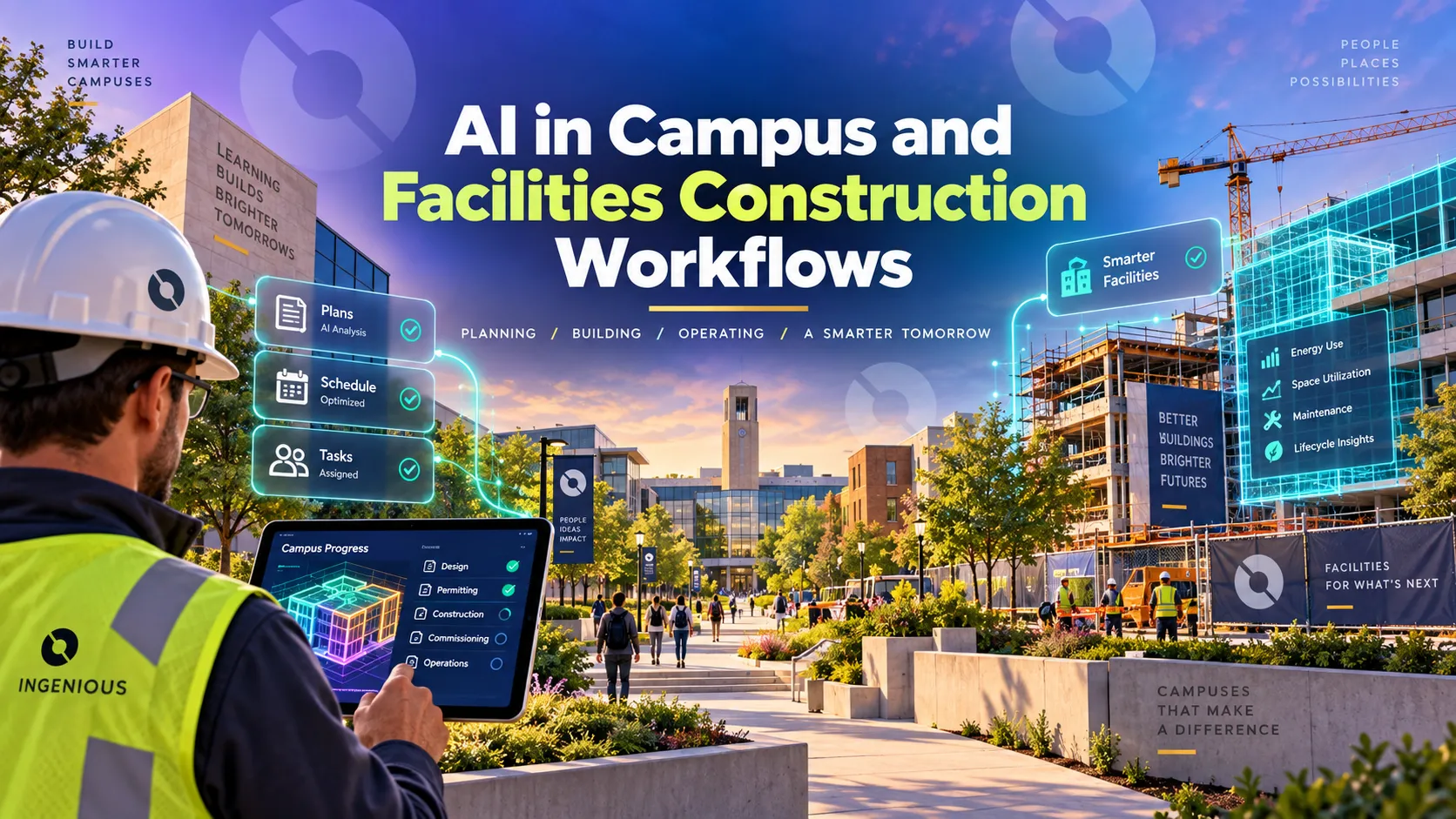
AI in Campus and Facilities Construction Workflows
See how AI improves campus and facilities construction workflows—from capital planning and phasing to document processing, standards compliance, and asset handoff.
Every campus renovation ends the same way. A contractor hands over a closeout package, someone from facilities receives it, and a few hundred pieces of equipment quietly enter a maintenance obligation that will run for the next twenty to forty years.
What happens to that package determines a lot. If the asset data gets into the maintenance system with model numbers, warranty dates and locations intact, the facilities team can plan. If it sits in a folder, they find out the air handler exists when it fails.
That gap is where AI has the most to offer campus construction right now, and it's the part almost nobody writes about. Most coverage of AI and campuses is about smart buildings, meaning sensors and energy optimization after the project is done. The construction workflows that feed those systems get skipped.
This guide covers where AI actually helps in campus and facilities construction, what has to be true before it works, and where it doesn't help at all.
The pressure institutional owners are under
Gordian's 2026 State of Facilities in Higher Education report puts deferred capital renewal at $156 per gross square foot, an 8% increase year over year and roughly double where it sat in 2007. Institutions are funding about 73.5% of what's required just to keep the backlog from growing, while operating budgets run 18.5% below target.
Worth knowing that Gordian is a facilities and construction cost data provider and the report draws on its own database, covering what it describes as 43,000 campus buildings across North America. Vendor-sourced doesn't mean wrong, and it's the most widely used benchmark in the sector, but it's the kind of provenance worth naming.
The practical situation those numbers describe: campus facilities teams are choosing which buildings to renew with less money than the math requires, every year, permanently. That changes what "efficiency" means. It isn't about building faster. It's about making better decisions about what to build at all, and not losing information between projects.
Why campus construction is its own problem
Institutional construction differs from commercial development in ways that shape where technology helps.
- You build on an occupied site. Students are in class, patients are in beds, researchers have experiments running. There's no shutting down for eighteen months. Phasing constraints drive everything.
- It's a continuous program, not a series of projects. A university with 200 buildings always has renewal work underway. The unit of management is the multi-year capital plan, not the individual job.
- The owner keeps the building forever. A developer sells or leases and moves on. A university operates that chiller for its full service life. Decisions made during construction become operating costs for decades, which changes how tradeoffs should be evaluated and rarely does.
- Design standards apply across buildings. Most campuses have standards specifying acceptable equipment, materials and systems, so facilities isn't stocking parts for forty different door hardware types. Enforcing those standards across concurrent projects with different design teams is a real coordination problem.
- Governance is formal and slow. Board approvals, state system requirements, bond covenants, public procurement rules. Timelines reflect that regardless of urgency.
Where AI actually helps
Deciding what to renew
The hardest decision in campus facilities isn't how to execute a project. It's which of forty candidate projects to fund this year.
Facility condition assessments produce the raw input, generating FCI scores per building. FCI, developed by APPA in 1991, is the ratio of deferred maintenance cost to current replacement value, so lower is better. It's the common language across higher ed and K-12 facilities.
Where AI adds something is in the analysis on top of it. Condition data, work order history, energy consumption and asset age together can identify which buildings consume disproportionate maintenance spend relative to their square footage, project how costs move under different deferral scenarios, and flag systems approaching end of life before they announce themselves.
The value isn't a better FCI number. It's converting a maintenance backlog into a capital argument a board will fund, which is a communication problem as much as an analytical one.
Phasing around occupancy
Academic calendars are unforgiving. Summer windows are short, and a project that overruns into September doesn't just cost money, it displaces classes.
Schedule optimization tools can model phasing scenarios against occupancy constraints faster than doing it manually, and flag when a sequence puts a milestone at risk of missing a hard calendar date. On healthcare campuses the equivalent constraint is clinical operations, with infection control requirements adding another layer.
This is genuinely useful and also genuinely bounded. The model doesn't know that the dean will not accept losing that lecture hall, or that the department chair has already been promised a move date. Those constraints live in people's heads and negotiations, not in the schedule file.
Standards compliance across concurrent projects
If your campus standard specifies particular equipment and a submittal comes in with something else, someone has to catch it. Across a dozen concurrent projects with different design teams and contractors, that's a lot of review load falling on a small facilities staff.
AI-assisted submittal review can compare submissions against a documented standard and flag deviations for a human to confirm. It's a first-pass check rather than an approval, and it works only if your standards are documented in a form something can actually read. Many campus standards live in a PDF last updated in 2019, which is its own problem.
Document load across a portfolio
A single mid-size project generates hundreds of RFIs and submittals. A campus running fifteen concurrent projects generates thousands, reviewed by a facilities and capital projects team that hasn't grown proportionally.
Classification, routing and summarization are the mature applications here. Routing an RFI to the right reviewer based on content, flagging items aging past their review window, summarizing a long thread into a decision and rationale. None of it makes the technical judgment; it removes the search-and-sort work around it.
The construction-to-operations handoff
This is the one with the most upside and the least attention.
Every closeout package contains structured information that a maintenance system needs: equipment identifiers, model and serial numbers, installation dates, warranty terms, service intervals, spatial location. Traditionally somebody extracts that by hand from submittals and O&M manuals, or nobody does and the data is lost.
Document extraction is exactly the kind of task current AI handles well. Pulling asset attributes from submittals and O&M documentation into a structured format the CMMS can ingest is a bounded, repetitive, high-volume problem with a checkable output.
The payoff compounds. A campus building typically contains a few hundred maintainable assets. Multiply across a renewal program and the difference between capturing that data at handover and reconstructing it later is the difference between planning replacements and discovering them.
It's also the workflow where the failure is most invisible. Nobody notices missing asset data at closeout. They notice it eight years later when a roof needs replacing and nobody knows when it was installed.
Where AI doesn't help
- Deciding what the institution should prioritize. Analysis can tell you Building 7 consumes disproportionate maintenance spend. Whether renewing it matters more than a new research facility is a strategic judgment involving enrollment, donors and mission.
- Navigating governance. Board cycles, state approvals and bond covenants move at their own pace.
- Constraints that live in relationships. The commitments made to a department chair, the political history of a building, the donor whose name is on it. None of that is in the data.
- Anything code or life-safety critical without review. Automated checks are triage. A qualified person signs off.
- Producing good output from bad data. Which is the real constraint on most campuses.
What has to be true first
The prerequisites matter more than the tooling, and this is where most institutional AI efforts stall.
Your space and asset inventory needs to be reasonably current. A CMMS with assets that were decommissioned in 2018 still listed will produce confident, wrong analysis.
Your design standards need to exist in a readable, current form. A document from six years ago that everyone quietly ignores can't be enforced by anything.
Your condition assessment data needs to be recent enough to mean something. Assessments age, and a five-year-old FCI is a historical artifact.
Your closeout requirements need to specify structured asset data as a deliverable, in the contract. If contractors aren't required to provide it in a usable format, extraction is archaeology rather than processing.
That last one is the highest-leverage change available to most institutions, and it costs nothing but a specification update. It's also the least technological item on the list, which is usually how these things go.
A reasonable starting sequence
Start with the handoff. Asset data extraction from closeout documentation has a clear input, a checkable output and a compounding benefit. It's also the easiest to evaluate honestly, since you can verify whether the extracted data is correct.
Then document processing across concurrent projects, since the volume is already there and the workflows are repetitive.
Then standards compliance checking, once your standards are in a form worth checking against.
Save condition-based capital prioritization for after your assessment and asset data are trustworthy, because that's the application most sensitive to input quality and the one where a wrong answer is most expensive.
Update your closeout specification regardless of where you start. It's the cheapest improvement on the list.
Where INGENIOUS.BUILD fits
INGENIOUS.BUILD isn't a CMMS or an IWMS. Once a building is in operation, the maintenance and work order systems named throughout this topic handle that layer.
Where it sits is the construction side: capital planning, budgets, funding source tracking across the bond funds, state allocations and grants an institution draws on, and the construction administration workflows that generate the documentation feeding everything downstream. RFIs, submittals, inspections and closeout run in the same system as the financial data, with owners, design teams and contractors working from the same current information.
For campus programs specifically, funding source attribution and closeout documentation are the two areas that matter most, because one determines whether you can report to the sources funding the work and the other determines whether the facilities team inherits usable information.
If you're evaluating platforms for an institutional capital program more broadly, our guide to capital program management software for education covers that decision.
Book a demo to see how it handles a multi-project campus program.
The short version
The campus AI conversation is mostly about buildings that are already finished. The larger opportunity is upstream, in the construction workflows that decide what gets renewed and what information survives into operations.
None of it works on bad data, and most institutions have some. The unglamorous work of getting the asset inventory current and specifying structured closeout data in contracts does more than any tool will, and it has to happen first regardless.
FAQ
How is AI used in campus construction workflows?
Primarily in four areas: analyzing facility condition and work order data to prioritize capital renewal, optimizing project phasing around occupancy constraints, classifying and routing the document load across concurrent projects, and extracting structured asset data from closeout documentation into maintenance systems.
What is FCI and how is it used in campus capital planning?
Facility Condition Index is the ratio of a building's deferred maintenance cost to its current replacement value, expressed as a percentage or decimal where lower is better. Developed by APPA in 1991, it's the standard metric for comparing building condition across a campus portfolio and prioritizing renewal funding.
How large is the deferred maintenance backlog in higher education?
Gordian's 2026 State of Facilities in Higher Education report puts deferred capital renewal at $156 per gross square foot, an 8% year-over-year increase and roughly double 2007 levels. The report draws on Gordian's own facilities database.
What makes campus construction different from commercial construction?
Work happens on occupied sites with no shutdown option, projects run as a continuous multi-year renewal program rather than discrete jobs, the owner operates the building for its full service life, campus-wide design standards apply across projects, and institutional governance adds formal approval requirements.
What is the construction-to-operations data handoff?
The transfer of asset information, including equipment identifiers, model numbers, installation dates, warranty terms and locations, from construction closeout documentation into the maintenance system that will manage those assets for decades. It's frequently incomplete, and the cost surfaces years later during replacement planning.
Can AI extract asset data from closeout documents?
Yes, and it's one of the better-suited applications, since submittals and O&M manuals are structured, repetitive and high-volume. The output should be verified rather than trusted outright, and it works far better when contracts specify structured closeout data as a deliverable.
What do we need in place before using AI for facilities capital planning?
A current space and asset inventory, design standards documented in a readable and current form, condition assessment data recent enough to be meaningful, and closeout specifications requiring structured asset data. Analysis built on stale inventory produces confident wrong answers.
Where does AI not help in campus facilities work?
Strategic prioritization between competing institutional goals, governance and approval timelines, constraints that exist in relationships and commitments rather than data, anything code or life-safety critical without human sign-off, and any analysis where the underlying data isn't reliable.