Informative
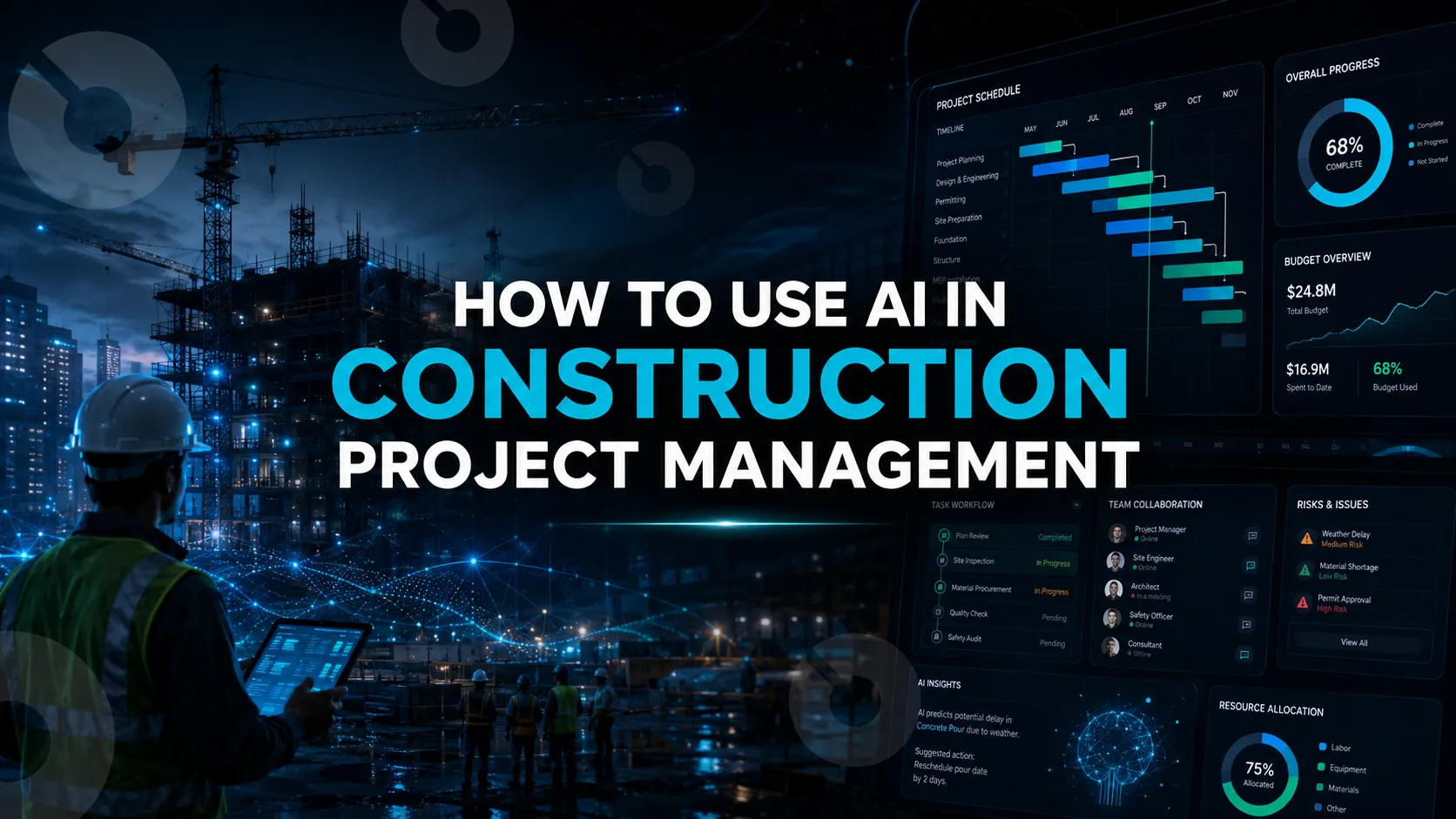
How to Use AI in Construction Project Management
Learn practical ways AI helps construction teams summarize meetings, manage RFIs, create reports, reduce admin work, and improve project visibility.
AI is quickly becoming one of the most talked-about technologies in construction.
Yet many construction professionals are still asking the same question - How do you actually use AI in construction project management?
The answer is not replacing project managers, superintendents, estimators or coordinators.
The most successful construction teams are using AI to reduce administrative work, improve project visibility and make faster decisions across the project lifecycle.
In practice, AI is helping teams:
- summarize meetings
- generate project reports
- analyze project documentation
- track RFIs and approvals
- identify schedule risks
- improve communication
- surface operational insights
This guide explains how AI is used in construction today, practical workflows you can implement immediately and the best AI prompts for construction project managers.
How Is AI Used in Construction?
AI in construction is primarily used to help teams process information faster and reduce manual coordination work. Construction projects generate large amounts of operational data across:
- schedules
- budgets
- RFIs
- submittals
- meeting minutes
- inspections
- change orders
- procurement workflows
- field reports
Traditionally, project teams spend hours collecting, organizing and reporting on this information.
AI helps automate portions of those workflows while improving visibility across projects.
The biggest value of AI in construction is not automation alone.
It is helping teams manage growing project complexity without increasing administrative burden.
Top AI Use Cases in Construction Project Management
In 2026, the most common uses of AI in construction include:
- Meeting summaries and action item tracking
- Construction reporting and executive updates
- RFI analysis and management
- Submittal review workflows
- Schedule risk detection
- Construction document search and retrieval
- Change order analysis
- Procurement tracking
- Budget forecasting and cost control
- Portfolio-level project visibility
How to Use AI in Construction Project Management
AI in construction project management is most commonly used to automate reporting, summarize meetings, organize project documentation, analyze RFIs and submittals, identify schedule risks and improve project visibility. The most successful construction teams use AI to reduce administrative work and improve decision-making rather than replace project managers or field teams.
Generate Meeting Summaries and Action Items
Construction projects involve constant coordination meetings.
These include:
- OAC meetings
- subcontractor meetings
- weekly progress meetings
- safety meetings
- executive reviews
AI can quickly transform meeting notes or transcripts into:
- concise summaries
- action item lists
- assigned responsibilities
- follow-up reminders
- stakeholder updates
This reduces documentation time while improving accountability.
Create Project Reports Faster
Many project managers spend significant time building reports.
AI can help generate:
- executive updates
- owner reports
- project status summaries
- schedule updates
- field progress reports
- risk summaries
Instead of manually assembling information from emails and spreadsheets, AI can organize updates into a clear report format.
Analyze RFIs and Submittals
RFIs and submittals often become difficult to track as projects grow.
AI can help:
- summarize responses
- identify overdue items
- group related RFIs
- surface approval bottlenecks
- improve document searchability
This helps teams identify issues before they affect schedule or procurement.
Review Construction Documentation
Construction projects create thousands of documents.
AI can help teams:
- locate information faster
- summarize lengthy documents
- identify missing information
- compare document revisions
- retrieve historical decisions
This becomes particularly valuable on large projects with multiple stakeholders.
Improve Stakeholder Communication
Project managers spend significant time responding to emails and preparing updates.
AI can draft:
- owner updates
- subcontractor communications
- meeting recaps
- project summaries
- issue escalation messages
This allows teams to communicate more consistently while spending less time writing.
AI Across the Construction Project Lifecycle
AI can support nearly every stage of the construction project lifecycle.
Preconstruction
During planning and preconstruction, AI can assist with:
- meeting summaries
- document review
- proposal analysis
- risk identification
- schedule planning
Design and Procurement
During design and procurement phases, AI can help:
- organize submittals
- review specifications
- summarize design discussions
- identify procurement risks
- track approvals
Construction Execution
During active construction, AI is commonly used for:
- progress reporting
- meeting documentation
- field communication
- schedule analysis
- issue tracking
Closeout and Handover
During project closeout, AI can support:
- document organization
- punch list reporting
- turnover package preparation
- project summaries
- lessons learned documentation
Best AI Prompts for Construction Project Management
Many construction teams struggle because they use generic prompts.
The best results come from construction-specific instructions.
Project Status Update Prompt
"Act as a construction project manager. Using the information below, create a concise weekly project status report for an owner. Include schedule status, completed work, upcoming milestones, risks, budget concerns and required decisions."
Meeting Summary Prompt
"Summarize the following construction meeting. Identify key decisions, action items, responsible stakeholders, deadlines, unresolved issues and potential project risks."
RFI Analysis Prompt
"Review these RFIs and identify recurring themes, unresolved issues, overdue responses and any items that could impact schedule, procurement or budget."
Executive Report Prompt
"Create a one-page executive project update for senior leadership. Focus on overall project health, budget status, schedule risks, major decisions and critical issues requiring attention."
Schedule Risk Prompt
"Review the project update below and identify potential schedule risks, delayed dependencies, critical path concerns and activities requiring immediate attention."
Change Order Review Prompt
"Analyze the following change orders and summarize cost impacts, schedule impacts, approval status and potential project risks."
Common Mistakes When Using AI in Construction
Many teams expect AI to solve operational problems automatically. The reality is more nuanced.
Common mistakes include:
Using AI Without Project Context
AI performs best when it has access to relevant project information. Generic prompts produce generic outputs.
Treating AI as a Replacement for Expertise
Construction still requires human judgment. AI supports decision-making but should not replace experienced project professionals.
Working With Fragmented Data
AI struggles when schedules, budgets, RFIs, approvals and documentation live in disconnected systems. The quality of AI insights depends heavily on the quality and accessibility of project data.
Automating Bad Processes
AI improves workflows. It does not automatically fix broken workflows.
Organizations should focus on improving operational processes before trying to automate them.
Why Connected Construction Data Matters
The effectiveness of AI depends heavily on project visibility.
Many construction companies still operate across:
- spreadsheets
- email threads
- shared drives
- disconnected software platforms
This fragmentation limits what AI can do.
If project information is disconnected, AI cannot fully understand project context or identify relationships between schedules, budgets, RFIs, approvals and field activities.
That is why connected construction management platforms are becoming increasingly important.
The more centralized the project data, the more useful AI becomes.
What AI Cannot Replace in Construction
AI can dramatically improve reporting, documentation and information management.
However, construction still depends on:
- field expertise
- operational judgment
- stakeholder management
- technical problem-solving
- project leadership
- site coordination
AI is not replacing project managers. It is helping them spend less time managing information and more time managing projects.
Despite rapid advances, AI still struggles with:
- interpreting site conditions firsthand
- managing subcontractor relationships
- resolving field conflicts
- making contractual decisions
- replacing superintendent experience
- understanding project-specific politics
Construction remains a people-driven industry. AI works best as a decision-support tool rather than a replacement for experienced professionals.
The Future of AI in Construction Project Management
The future of AI in construction is moving beyond standalone tools and chatbots.
The next generation of AI will increasingly operate inside connected construction management platforms where it can access:
- schedules
- budgets
- RFIs
- submittals
- meeting records
- procurement workflows
- project documentation
This creates richer project context and more useful insights.
The future is not simply AI-generated content. It is AI-powered operational visibility.
AI Adoption Roadmap for Construction Teams
Most construction companies adopt AI in stages:
- Stage 1: Content and Communication
Using AI for emails, meeting notes and report drafts. - Stage 2: Project Administration
Using AI for RFIs, submittals, documentation and reporting. - Stage 3: Operational Visibility
Using AI to identify risks, track approvals and surface project insights. - Stage 4: Predictive Project Management
Using AI to forecast schedule delays, budget risks and portfolio performance.
Most companies today are operating between stages 1 and 2.
How INGENIOUS.BUILD Supports AI-Powered Construction Workflows
AI is most effective when it can work across connected project data.
INGENIOUS.BUILD centralizes:
- schedules
- budgets
- RFIs
- submittals
- meeting minutes
- approvals
- reporting workflows
- project documentation
inside a single operational environment.
This creates the foundation for AI-powered reporting, project budget visibility, construction administration and stakeholder coordination.
Rather than working across fragmented systems, teams can leverage AI within the context of actual project execution.
Final Thoughts
The best way to use AI in construction project management is not to replace people.
It is to eliminate repetitive administrative work and improve visibility across increasingly complex projects.
Construction teams are already using AI to:
- create reports
- summarize meetings
- organize documentation
- analyze RFIs
- identify schedule risks
- improve communication
As AI continues to evolve, the companies that gain the most value will be those with connected workflows and centralized project data.
AI is becoming a powerful tool for construction project management, but its true value comes from helping teams make better decisions, faster. Book a demo to see INGENIOUS.BUILD in action!
FAQ
How can AI be used in construction?
AI can be used for project reporting, meeting summaries, document management, RFI analysis, schedule risk detection, communication and operational visibility.
How do construction project managers use AI?
Construction project managers commonly use AI to generate reports, summarize meetings, analyze project documentation, identify risks and improve stakeholder communication.
What are the best AI prompts for construction project management?
Useful prompts include project status reports, meeting summaries, RFI analysis, executive reporting, schedule risk reviews and change order evaluations.
Can AI manage a construction project?
No. AI can support project management workflows, but construction projects still require human expertise, field coordination and operational decision-making.
What is AI project lifecycle management in construction?
AI project lifecycle management refers to using AI across planning, design, procurement, construction and closeout phases to improve visibility, coordination, reporting and decision-making.
What is the biggest benefit of AI in construction?
The biggest benefit is reducing administrative work while improving project visibility and decision-making across complex construction workflows.