|

MENU


.svg)
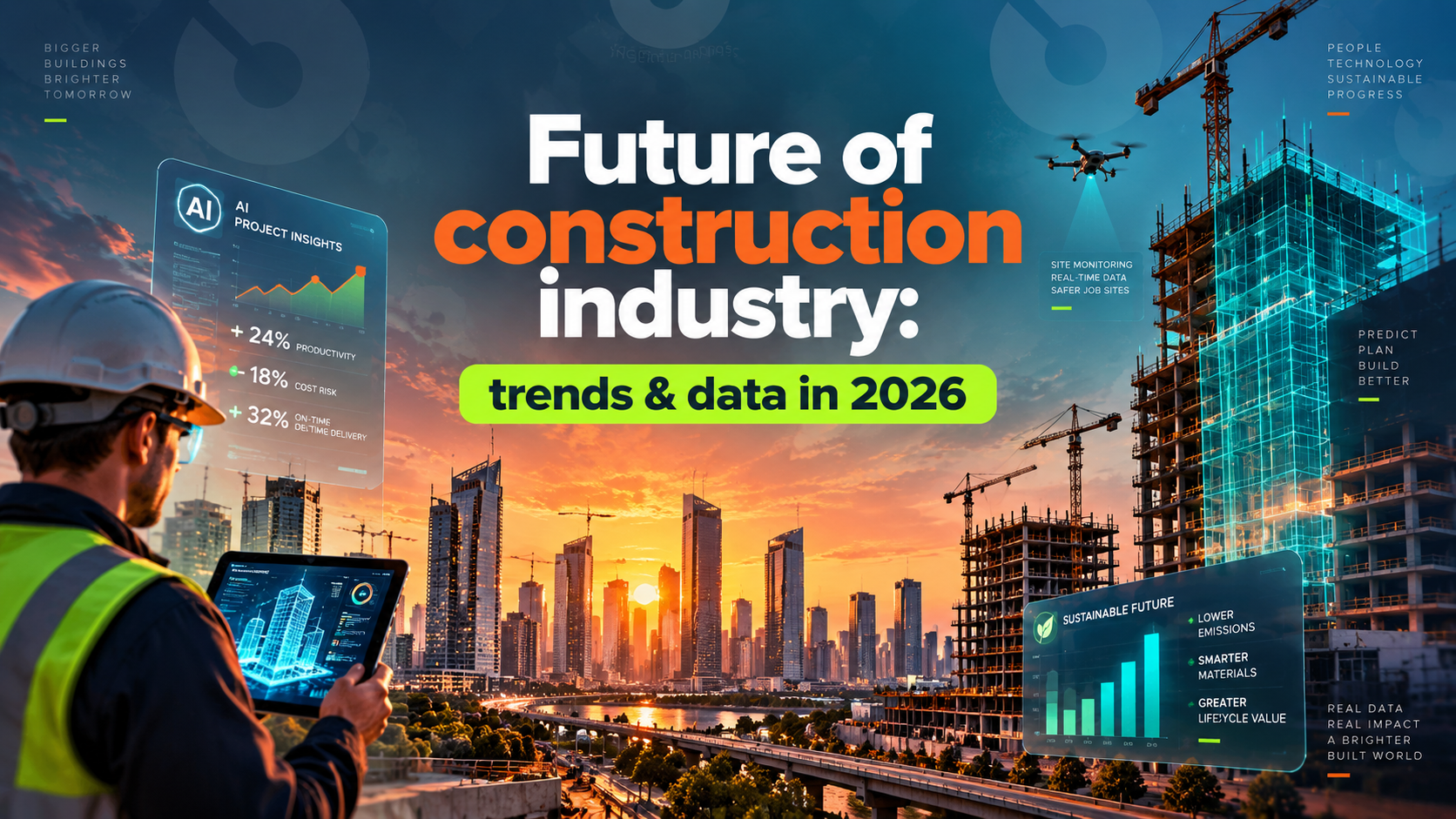
"Are we in a construction boom?" is one of those questions where a simple yes or no would be misleading either way. Overall U.S. construction spending is barely growing — forecasters put 2026 growth at somewhere between 1% and 1.8%, essentially flat. But underneath that flat headline number, a handful of segments are booming hard enough to reshape where contractors, developers, and investors are putting their attention. This guide covers what's actually happening in construction right now, where the real growth is concentrated, and what it means for how owners, developers, and GCs should be thinking about the next few years.
Construction is the process of designing, planning, and physically building structures — buildings, infrastructure, and industrial facilities — from initial site work through completion. It spans several distinct segments with very different economics: residential (homes and multifamily), commercial and institutional (offices, retail, healthcare, education), industrial (manufacturing and data centers), and infrastructure (roads, utilities, and public works).
Those segments don't move together, which is exactly why a single "is construction growing" answer misses most of what's actually happening in the industry right now.
Not uniformly, and treating it as one question obscures more than it reveals. FMI Corporation's 2026 industry outlook forecasts total U.S. construction spending growth of just 1% for the year, following a roughly 1% decline in 2025. Deloitte's 2026 outlook similarly projects investment in structures pivoting from a 2025 decline to modest growth near 1.8%. By almost any measure, that's not a boom at the aggregate level.
But look at individual segments and the picture changes entirely. Data center construction spending is projected to grow somewhere between 17% and 35% in 2026 depending on the source and methodology — a genuine boom by any definition. Healthcare construction is forecast to grow around 4.3%, institutional construction around 3.8%, and hotel construction around 6%, all comfortably outpacing the overall market. Meanwhile, speculative office, traditional retail, and several manufacturing subsectors are flat or declining.
The honest answer: the U.S. isn't in a construction boom. Specific segments — data centers most dramatically — are.
Where it's notably not booming: speculative office space (still weighed down by high vacancy and remote work), traditional retail (continued e-commerce pressure), and residential construction, which remains highly sensitive to mortgage rates and affordability constraints.
A quick recap of where each major segment stands, based on current industry forecasts:
Here's what this uneven growth actually looks like for two hypothetical firms. Firm A does mostly speculative office and traditional retail build-outs. Going into 2026, their pipeline is thinning, bids are more competitive for a shrinking pool of projects, and margin pressure is real — even though "the construction industry" as a headline is barely down.
Firm B has pivoted toward data center and healthcare work over the past two years. Their backlog is full, they're fielding more RFPs than they can staff, and their biggest constraint isn't finding work — it's finding enough skilled labor and subcontractor capacity to deliver it on the timelines clients want.
Both firms are reading the same "construction industry" headlines. Neither headline — "growth is flat" or "the industry is booming" — describes either firm's actual 2026 accurately on its own.
Not exactly — and the more accurate framing has shifted in the last few years. BIM (Building Information Modeling) isn't really a standalone "future trend" anymore; it's increasingly the foundational data layer that other emerging technologies depend on. AI-assisted scheduling, digital twins, and robotics-guided layout work all function better, and in many cases only function at all, when they have structured BIM data to work from.
That said, BIM adoption itself is still actively expanding, not fully mature everywhere. Government mandates are pushing adoption in markets where it wasn't previously standard — Poland's BIM policy programs and Hong Kong's procurement thresholds are two current examples — and BIM continues to hold the largest share of the broader construction technology market by most estimates. The more useful way to think about BIM's role going forward: less "is it the future" and more "it's the prerequisite most other future technology in construction depends on."
Every serious estimate agrees the ConTech market is growing quickly — but the specific size figures vary so widely across sources that citing one as definitive would be misleading. Depending on the research firm and how "construction technology" is scoped, 2026 market size estimates range from roughly $6 billion to well over $100 billion, with projected annual growth rates commonly cited between 8% and 15%. That's a wide enough spread to suggest these figures depend heavily on methodology and market definition, not just genuine disagreement about growth — treat any single number you see cited elsewhere with some skepticism.
What's more reliably consistent across sources: BIM holds the largest share of ConTech spending currently, AI and robotics are the fastest-growing subsegments, and North America remains the most mature ConTech market globally, driven by strong software adoption, venture investment, and sustained productivity pressure from ongoing labor shortages.
Sector-specific strategy matters more than industry-wide strategy right now. A firm heavily exposed to speculative office or traditional retail faces a very different 2026 than one positioned in data centers, healthcare, or institutional work. Generic "the industry is growing" or "the industry is struggling" framing obscures decisions that should really be made at the segment level.
Flexible, connected platforms matter more in an uneven market. When growth is concentrated rather than uniform, teams often need to pivot between project types faster than in a stable, predictable cycle — which makes locking into rigid, single-purpose tools riskier than it would be in a more stable environment.
Labor shortages make productivity tools less optional. With labor supply tightening further and demand from booming segments like data centers competing for the same skilled workforce, the cost of manual, disconnected workflows is higher now than it was a few years ago — not because the tools changed, but because the labor buffer that used to absorb inefficiency has shrunk.
Capital discipline matters more when growth is selective. In a genuinely broad boom, mistakes are easier to absorb. In a market where growth is concentrated in specific segments and overall spending is nearly flat, cost overruns and change order disputes eat into margin that isn't being replenished by rising volume elsewhere.
A construction market defined by uneven, sector-specific growth rewards teams that can move quickly between project types without re-platforming every time their pipeline shifts. INGENIOUS.BUILD connects owners, GCs, subs, and architects in one system across budgets, schedules, RFIs, and submittals — the same connected foundation whether a team is scaling into data center work, holding steady in healthcare, or navigating softness in office and retail.
Teams using INGENIOUS.BUILD see 5x faster collaboration and 10x fewer change-order disputes — outcomes that matter more, not less, in a market where margin isn't being cushioned by broad-based growth.
Book a personalized demo to see how a connected platform adapts as your project mix shifts.
The future of the construction industry isn't a single story — it's several different stories happening at once, depending on which segment you're in. Data centers are booming at a pace few sectors ever see; office and traditional retail remain under real pressure; healthcare, institutional, and hotel work sit somewhere comfortably in between. BIM has quietly shifted from "emerging trend" to foundational infrastructure that other technologies depend on. The practical takeaway for owners, developers, and GCs isn't a single industry-wide prediction — it's understanding specifically where your own pipeline sits in this uneven landscape, and building the operational flexibility to move with it.
Not uniformly. Overall U.S. construction spending growth is forecast at roughly 1–1.8% for 2026, essentially flat, but specific segments — especially data centers, growing 17–35% — are booming even as others like office and retail remain soft.
Data centers are the clearest boom, followed by healthcare, institutional and public buildings, advanced manufacturing tied to reshoring, and a recovering hotel sector.
Increasingly segment-specific growth rather than a uniform cycle, continued labor shortages, growing adoption of AI and offsite construction, and BIM functioning as foundational infrastructure for other emerging technologies rather than a standalone trend.
Not on its own — BIM has become the foundational data layer that AI, digital twins, and robotics-guided construction depend on, rather than a standalone emerging trend itself.
Estimates vary enormously by source and methodology, ranging from roughly $6 billion to well over $100 billion for 2026, with commonly cited growth rates between 8% and 15% annually — treat any single figure with some skepticism given the wide spread.
Construction is the process of designing, planning, and physically building structures, spanning residential, commercial and institutional, industrial, and infrastructure segments with distinct economics and growth patterns.
Firms exposed to booming segments like data centers or healthcare face very different planning and staffing needs than those exposed to soft segments like office or retail — sector-specific strategy matters more than industry-wide assumptions right now.
ConTech, short for construction technology, refers to the broad category of software, hardware, and digital tools — including BIM, AI, robotics, and IoT sensors — used to plan, build, and operate construction projects.
Data centers are growing fastest, forecast at 17–35% depending on the source, followed by hotels (+6%), healthcare (+4.3%), and institutional/public buildings (+3.8%). Office, retail, and residential remain soft by comparison.
Neither framing is accurate on its own. Overall spending is roughly flat, but that average hides sharp differences — some segments like data centers are genuinely booming while others like speculative office remain under real pressure.

INGENIOUS.BUILD
.svg)
.svg)



Company Type

Product Solutions
Information
.svg)
Speak to a Product Specialist
Streamline your Development & Construction projects with our cutting-edge project management software.
Discover why people are switching to INGENIOUS today!
By submitting this form, you agree with our Privacy Policy.