Construction Punch List Template: What to Include
Learn what to include in a construction punch list template, from architectural and MEP items to life safety, site work, closeout documents, and owner requirements.
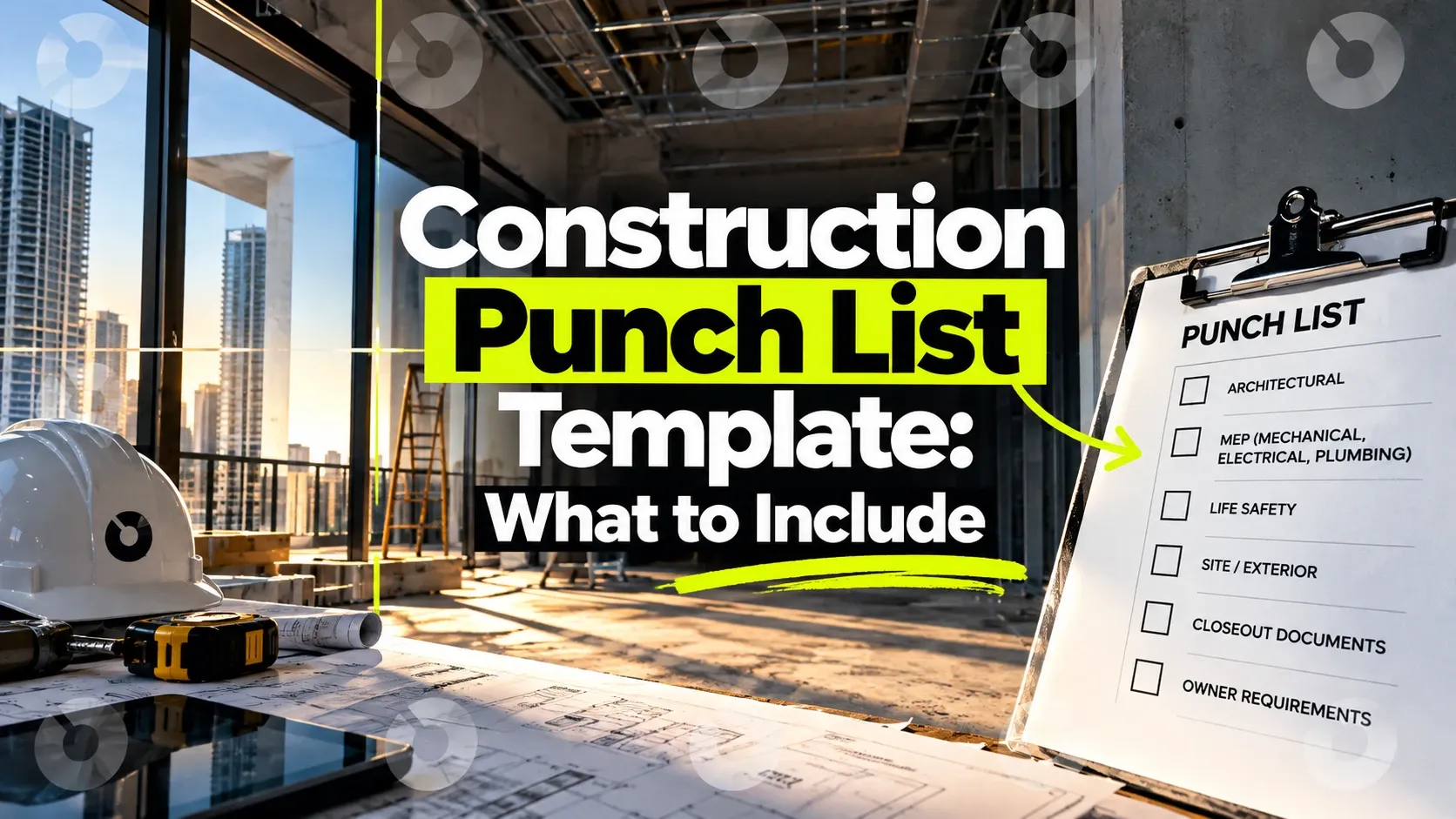
A construction punch list template works only if every item carries four fields: exact location, the responsible subcontractor, measurable acceptance criteria, and the date the item entered the list. Those four decide who pays and when retainage releases. Everything else on the form — item number, photo, status, verifier — is useful, but those four are the ones argued over in a final payment dispute.
What to include in a construction punch list template
Use one row per item, one defect per row. Combining "paint touch-ups throughout Level 3" into a single line is the most common reason punch lists stall: nobody can close it, because nobody can prove it is done.
| Field | What goes in it | Why it matters |
|---|---|---|
| Item number | Sequential, never reused | The reference used in correspondence and on the pay application |
| Location | Building, level, room number, grid or wall elevation | Determines access, trade routing, and whether the item is in a turned-over area |
| Trade / responsible sub | The firm holding the commitment, not "drywall" | Drives the backcharge if it is not corrected |
| Description | The observed condition, factually stated | Avoids arguing about intent later |
| Acceptance criteria | What "done" looks like, measurably | The sub cannot dispute a criterion they agreed to |
| Date added | The date observed | Separates punch work from warranty work |
| Due date | Contract or schedule-driven | Supports the backcharge notice if missed |
| Status | Open / Corrected / Verified / Rejected | Rejected is a status, not a re-entry |
| Verified by + date | Name, role, date | The signature chain behind sign-off |
| Photo reference | Before and after | Removes "I was there, it was fine" |
| Cost to complete | Estimate per open item | Drives the retainage hold calculation |
Two fields people leave off and regret. First, cost to complete per item — without it you cannot justify the retainage number when the owner asks. Second, rejected count — an item corrected three times and rejected three times is a performance signal worth capturing, not an administrative annoyance. It belongs in your contractor performance monitoring record for the next bid.
How to write a punch list item a subcontractor cannot argue
A punch item is a mini-specification. Write it so a foreman who was not on the walk can send a crew and know when to stop.
Weak: Level 2 corridor — door doesn't close right.
Workable: Item 214. Level 2, Corridor C2-04, door 2-118. Door binds on strike at upper hinge; does not latch under self-closing action. Acceptance: door latches fully from 30-degree open position without manual pressure; hardware set per spec 08 71 00; no gouges to frame paint. Responsible: Ace Doors & Hardware. Added 03/14. Due 03/21.
The second version does three things the first does not. It names the standard being enforced, so the argument is about the spec rather than about opinion. It states a test the verifier can perform in ten seconds. And it closes the door on repair damage, which is where touch-up disputes usually start.
Three rules for the field:
- Quote the spec section or the approved submittal where one exists. "Per approved submittal, finish shall be semi-gloss" ends an argument that "it looks fine" does not.
- Write the test, not the fix. You own the result; the sub owns the means. Telling a sub how to repair it invites a claim that your method caused the damage.
- Photograph before the sub arrives. A photo taken after a partial repair proves nothing about the original condition.
Punch list vs snag list: the same process, different region
A punch list and a snag list are the same document. Punch list is the US term and appears in AIA contract language; snag list, or snagging list, is standard in the UK, Ireland, Australia and much of the Commonwealth. If you are a US GC working for an overseas owner or under an international form of contract, expect the owner's team to call it snagging and to expect a snagging report at practical completion, which maps to your substantial completion inspection.
One difference worth planning around: on many international projects the "de-snagging" period is contractually defined with its own duration and its own retention release trigger. On US work, the punch period is often governed loosely by "promptly" language, which is exactly why you want due dates on each line of your own template rather than relying on the contract to supply them.
Who creates the punch list in construction
Three parties touch it, and confusing their roles is how lists get issued twice with different item numbers.
- The general contractor runs the pre-punch. Superintendents walk the work with each foreman ahead of the formal inspection and clear the obvious items. A pre-punch that catches 80 items before the architect sees them is cheaper than defending 80 items on the owner's list.
- The architect or engineer of record issues the formal punch list after the substantial completion walkthrough. On most AIA-based contracts, their list is the one attached to the certificate of substantial completion.
- The owner or owner's representative adds items, frequently in areas they care about commercially — lobbies, model units, tenant-facing finishes. Owner's reps ask sharper questions than the design team does on these walks; the five questions owners should be asking on a punch walkthrough are a good preview of what to pre-punch for.
Consultants and commissioning agents generate their own lists for MEP systems. Decide before the walk whether those merge into the master list or run as a separate commissioning log. Merging gives you one closeout number; separating keeps systems issues from blocking a certificate over a finish item.
Punch list categories: three things that look alike and are not
This is where margin leaks. Items get accepted onto the punch list that were never punch work, and the GC absorbs the cost of someone else's scope.
True punch work. A defect or minor incomplete finish, observable at inspection, in work that is otherwise complete and usable. Goes on the list, gets corrected before final payment, costs the responsible sub.
Warranty work. A failure appearing after acceptance, during the warranty period. A compressor that fails in month four is not a punch item, regardless of what the owner's facilities manager calls it. The date-added field is the evidence that separates the two, and it is why the field is non-negotiable.
Incomplete scope. Work never performed. Four of twelve light fixtures hung is not a punch item; it is eight fixtures unbilled. This belongs on a pay application deduction or a backcharge, not on the punch list. Putting it on the punch list converts a billing adjustment you control into a completion obligation with no money attached.
A fourth bucket shows up on every project: owner-directed changes discovered at walkthrough. The owner wants the outlet moved. That is a change order, priced and executed, not a punch item — handle it through your normal change order process so it does not get absorbed into closeout.
Sort items into these four at the moment they are logged. Re-sorting a 400-line list two weeks before final payment is a week of a PM's time and a conversation with the owner you would rather not have.
The substantial completion punch list process, in sequence
- Pre-punch, 2 to 4 weeks out. GC and each sub walk their own scope. Clear what you can, log what you cannot.
- Readiness check. Permanent power, life safety sign-offs, elevator certificates. An inspection called before these are in place produces a list the owner will not sign against.
- Substantial completion walkthrough. Architect, owner or owner's rep, GC, key trades. Record items live, with location and photo, as you walk.
- Issue and assign within 48 hours. Every item routed to a responsible sub with a due date. The delay between walking and issuing is where items lose their context.
- Certificate of substantial completion. Signed with the punch list attached, listing the owner's and contractor's responsibilities, the date occupancy transfers, and the retainage held against remaining work.
- Correction and verification. Sub corrects, GC verifies, architect accepts. Rejected items return to the sub with a reason, not a silent re-add.
- Final completion and sign-off. Zero open items, lien waivers, closeout documents handed over, final payment and retainage released.
Insurance and utilities transfer at step 5, not step 7. Confirm the date in writing, because an owner who believes they took the building on a different date than you did will dispute the first month of operating costs.
Punch list sign-off requirements
Sign-off is not one signature. It is a chain, and a gap anywhere in it is a gap in your final payment position.
- Per-item verification. Who corrected it, who checked it, on what date, with a photo. Signed off in the field, not reconstructed from memory at month end.
- Architect's acceptance of the completed list, typically a written statement that the punch list items have been completed.
- Owner's acknowledgment, especially on occupied floors where the owner's own moves may have caused damage after your verification. Date-stamped photos settle this instantly.
- Final lien waivers from each sub whose punch work is closed, conditioned on final payment.
- Retainage release documentation showing the calculation: items closed, cost-to-complete zeroed, hold released.
Most disputes at this stage are not about whether work was done. They are about whether anyone can prove when it was done and who accepted it. A list that lives in a spreadsheet emailed between a superintendent, a PM and an architect produces three versions and no record — the same failure mode that shows up when a firm outgrows Excel on cost tracking.
Running the punch list in the same system that holds the commitments, the pay applications and the retainage schedule removes the reconciliation entirely: an item closed in the field updates the cost-to-complete, which updates the hold, which releases on sign-off. That is the connection INGENIOUS.BUILD is built around, and it is also what turns a closeout from four weeks of a PM chasing signatures into a process that finishes itself. Admin hours at closeout are margin, and closeout is where a GC spends the most of them with the least to show for it.
Frequently asked questions
What should a construction punch list template include?
At minimum: item number, building/floor/room location, trade and responsible subcontractor, a description of the defect, measurable acceptance criteria, the date the item was added, the contractual due date, status, verifying party, and the date and photo of the accepted fix. Location, responsible party, acceptance criteria and date added are the four fields that decide who pays.
Who creates the punch list in construction?
The general contractor usually compiles the working punch list from its own pre-punch walk, then the architect or engineer of record issues the formal list after the substantial completion walkthrough, often with the owner or owner's representative adding items. The GC assigns each item to the responsible subcontractor and verifies the correction before the design team accepts it.
What is the difference between a punch list and a snag list?
They are the same thing under different regional names. Punch list is the United States term, used in AIA documents and most US contracts; snag list or snagging list is standard in the UK, Ireland and much of the Commonwealth. The process is identical: inspect near completion, log defects, correct, re-inspect, sign off.
Does the punch list have to be complete before substantial completion?
No. Substantial completion means the owner can occupy and use the work for its intended purpose, and remaining punch items are by definition minor work that does not prevent that use. Items large enough to block beneficial occupancy are incomplete scope, not punch items, and must be finished before the certificate is issued.
How much retainage can an owner hold against a punch list?
Most US contracts allow the owner to retain a multiple of the estimated cost to complete the remaining punch work, commonly 150 to 200 percent, with the rest of retainage released at substantial completion. The exact multiplier and release mechanics are in the contract, so price the open items before the certificate is issued.
What counts as punch work versus warranty work?
Punch work is a defect that existed and was observable at the time of the substantial completion inspection and is corrected before final payment. Warranty work is a failure that appears after acceptance during the warranty period. The dividing line is the date the item was first observed, which is why every punch item needs a date-added field.