|

MENU


.svg)
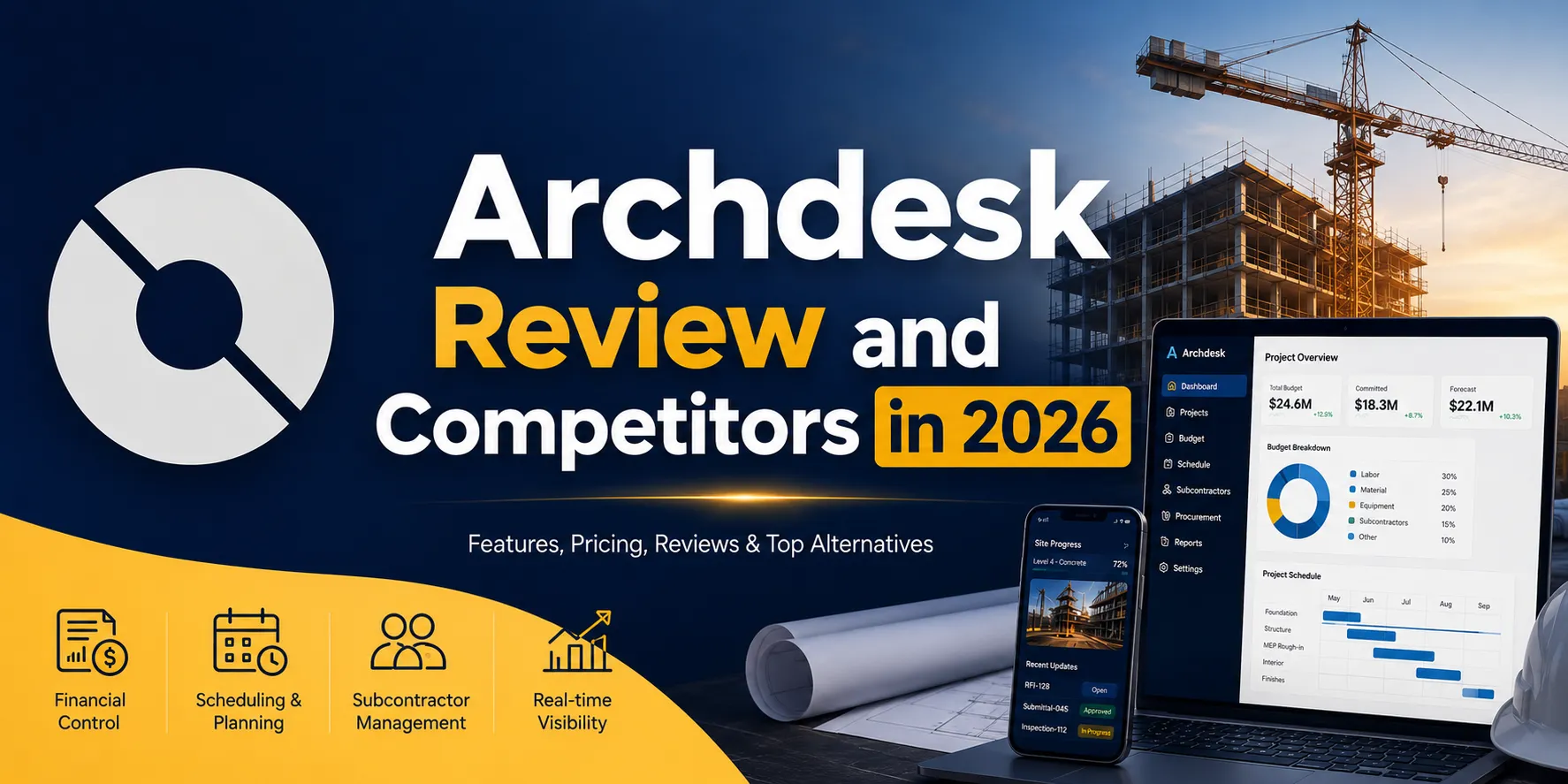
Archdesk positions itself as an all-in-one construction ERP and project management platform designed to connect financials, operations, scheduling and field execution inside one system.
For many growing construction businesses, that promise is appealing.
Instead of juggling separate tools for project management, cost tracking, subcontractors and reporting, Archdesk aims to centralize everything into a single platform.
But as construction teams scale, the real questions become more practical:
This guide breaks down Archdesk software in detail - including features, pricing considerations, reviews, integrations, pros and cons and the best alternatives in 2026.
Archdesk is a construction ERP and project management platform that combines project workflows, financial management, scheduling, subcontractor coordination and reporting inside one system.
Unlike lightweight construction management tools, Archdesk focuses heavily on operational and financial control.
Its platform includes:
In practice, Archdesk is designed for construction businesses that want deeper operational oversight than basic project management software provides.
Archdesk is generally best suited for:
It is less ideal for:
One of the biggest reasons companies consider Archdesk is the breadth of functionality.
Archdesk includes detailed financial tracking features designed to improve visibility into:
This is especially valuable for firms trying to reduce spreadsheet dependency.
Archdesk supports project scheduling and resource planning across multiple projects.
The platform is built for more operationally structured teams rather than lightweight task management.
The system helps contractors monitor subcontractor activity, progress, and reporting across active jobs.
Unlike many construction PM tools, Archdesk positions itself partly as a construction ERP platform.
This includes:
Archdesk supports API integration with third-party software, which is important for firms connecting accounting systems, external reporting tools, or BIM environments.
Archdesk also supports integration with Autodesk BIM 360 workflows, improving coordination between project execution and design/document management environments.
Archdesk pricing is not publicly transparent.
Like many ERP-style construction platforms, pricing is typically customized based on:
This means costs can vary significantly depending on complexity and deployment needs.
For growing contractors, it’s important to evaluate not only software pricing, but also:
Archdesk reviews are generally positive among companies that need structured operational control.
Users often highlight:
However, common challenges include:
This is a common tradeoff with ERP-oriented construction software: deeper control often comes with more complexity.
Scalability is one of Archdesk’s stronger positioning points.
The platform is designed to support:
For companies transitioning from spreadsheets or lightweight PM tools, Archdesk can provide significantly more structure.
The challenge is ensuring the organization is operationally ready for a more process-heavy platform.
This is one of the most common comparisons.
While both platforms support construction management workflows, they approach the problem differently.
Stronger ERP and operational management orientation.
Focuses heavily on:
Often attractive to companies looking for deeper operational integration.
More collaboration and field-execution focused.
Strong in:
Often preferred by large contractor-led teams managing complex commercial projects.
The better choice depends on what problem your company is trying to solve.
Choose Archdesk if:
Choose Procore if:
Some firms find Procore easier for field teams to adopt, while Archdesk appeals more to operations-heavy organizations.
Best for connected project visibility without ERP-heavy complexity
INGENIOUS.BUILD combines:
inside one construction-focused platform.
Compared to Archdesk, it offers a more streamlined collaboration and execution experience while still maintaining strong operational visibility.
Best for:
owners, developers, architects, and contractors needing connected workflows without excessive administrative overhead
Best for large contractor-led collaboration
Strong for:
Best for BIM-heavy and technical projects
Strong in:
Best for enterprise construction ERP
Deep ERP functionality with extensive operational controls.
More complex and enterprise-oriented.
Best for residential contractors
Simpler and more residential-focused than Archdesk.
Archdesk can be a strong fit if:
Companies often explore Archdesk competitors when they want:
This is especially true for teams that prioritize visibility and coordination over ERP depth.
Archdesk is a serious construction ERP and project management platform designed for companies that want strong operational and financial control.
For the right organization, it can provide significantly more structure than lightweight construction PM tools.
But construction software is not just about feature depth - it’s about usability, adoption and how efficiently teams can execute projects day to day.
The best platform is the one that improves visibility and coordination without creating unnecessary operational friction.
If your team wants strong project control with a more connected and collaboration-focused experience, platforms like INGENIOUS.BUILD offer a modern alternative built around real construction workflows.
Book a demo to compare how different construction management systems handle visibility, coordination and execution in practice.
Archdesk is a construction ERP and project management platform designed to manage financials, operations, scheduling, subcontractors and project workflows.
Yes. Archdesk includes ERP-style operational and financial management functionality alongside construction project management tools.
Archdesk pricing is customized based on company size, modules, and implementation requirements. Public pricing is not currently available.
Top alternatives include INGENIOUS.BUILD, Procore, Autodesk Construction Cloud, CMiC, and Buildertrend depending on project complexity and operational needs.
Archdesk focuses more heavily on ERP functionality and operational controls, while Procore is generally stronger in collaboration and field execution workflows.

INGENIOUS.BUILD
.svg)
.svg)

Company Type

Product Solutions
Information
.svg)
Speak to a Product Specialist
Streamline your Development & Construction projects with our cutting-edge project management software.
Discover why people are switching to INGENIOUS today!
By submitting this form, you agree with our Privacy Policy.