Informative
How AI is changing RFI and submittal management
See how AI is improving RFI and submittal management through smarter routing, faster reviews, automated checks, and real-time project context.
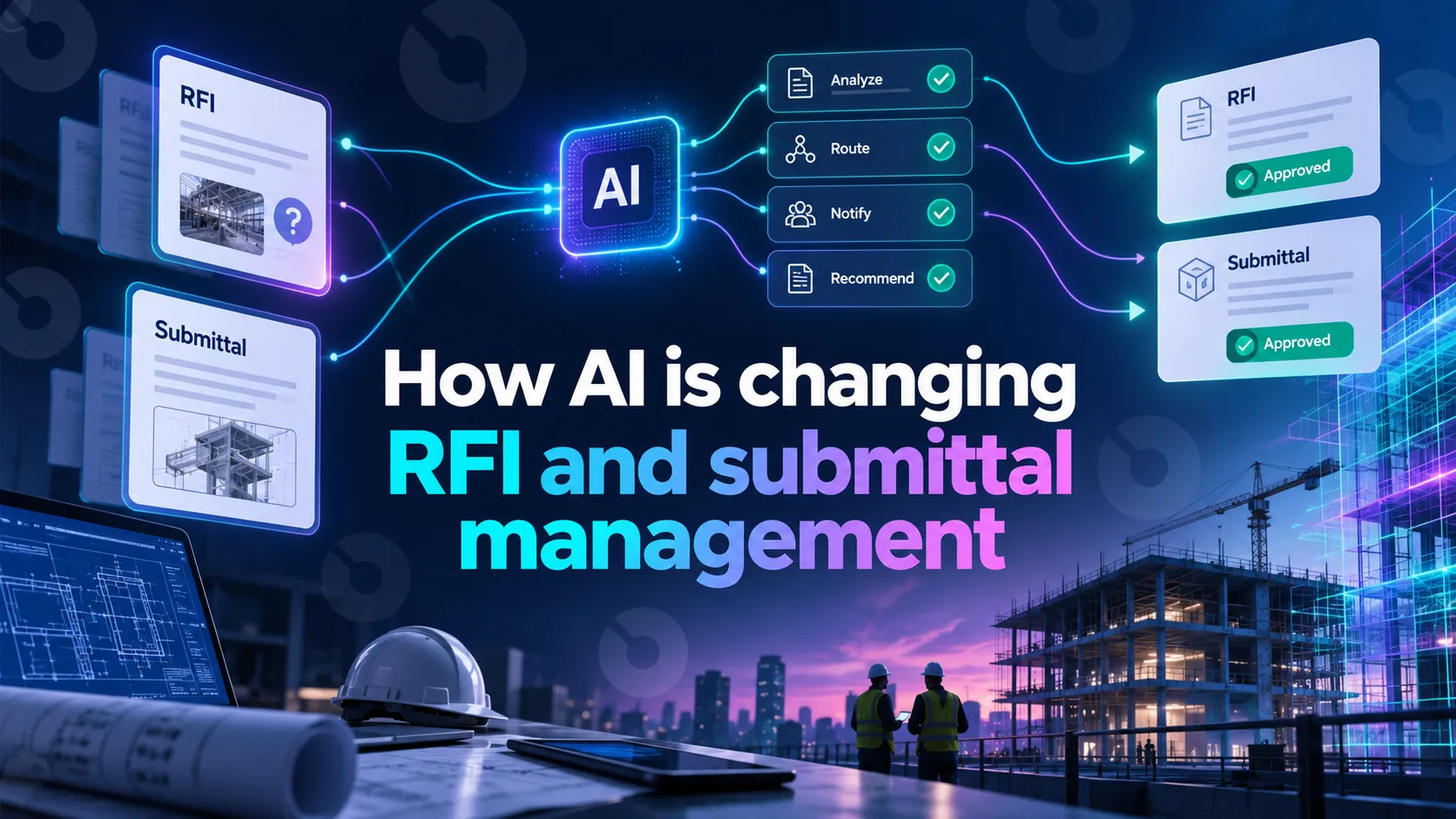
RFIs and submittals are two of the most document-heavy, repetitive workflows in construction — which also makes them one of the clearest places AI is actually delivering value right now, rather than just appearing on a features page. This guide covers what AI genuinely does for RFI and submittal management today, what it still can't reliably do, and how to evaluate a vendor's claims without getting caught up in the hype.
We've covered the operational cost of slow RFI and submittal turnaround in detail elsewhere — this piece focuses specifically on where AI fits into fixing that problem, not the cost of the problem itself.
Key takeaways
- RFI and submittal management is a strong fit for AI because both workflows are high-volume, repetitive, and document-heavy — exactly the conditions where pattern-matching and classification add real value.
- The most reliable AI applications today are classification, routing, summarization, and deadline flagging — not final technical judgment or contractual decisions.
- AI can meaningfully speed up submittal review by automatically checking submissions against spec requirements, but it doesn't replace the reviewer confirming the match is actually correct.
- The gap between "AI-powered" marketing and real functionality is wide in this category specifically — ask vendors exactly what data the AI uses and what a user sees differently as a result.
- AI delivers the most value when it has direct access to live project data across RFIs, submittals, drawings, and specs simultaneously, not when it's a separate tool working from static exports.
Why RFI and submittal management is a natural fit for AI
Both workflows share characteristics that make them well suited to AI assistance. They're high-volume — a mid-size commercial project can generate hundreds of RFIs and submittals. They're repetitive in structure — most RFIs follow a similar format, and most submittals reference the same spec sections repeatedly across a project. And they're time-sensitive in a way that compounds — a slow RFI response doesn't just delay one task, it can hold up everything downstream of it.
That combination — high volume, repeatable structure, and real cost to delay — is exactly the profile where pattern-matching and automation tend to add genuine value, rather than where "AI" gets bolted on as a marketing label without much underlying substance.
What the data says about AI's impact here
Independent industry sources converge on a consistent range, even though the exact figures vary by source: AI-assisted document processing commonly reduces RFI and submittal handling time by somewhere between 50% and 80%, with RFI response times frequently dropping from a multi-day cycle to same-day or hours in straightforward cases. These figures come primarily from vendor and industry analyses rather than independent academic research, so treat the specific percentage with some skepticism — but the direction and rough magnitude are consistent across multiple, unrelated sources, which is a reasonable signal that the underlying effect is real even if the exact number varies by project type and starting point.
What AI actually does for RFI management today
- Drafting response suggestions from similar past RFIs. If a project has answered similar questions before, AI can surface those past responses as a starting point, reducing the time a reviewer spends starting from a blank page.
- Auto-routing RFIs to the right reviewer. Based on the content and trade involved, AI can direct an RFI to the person best positioned to answer it, instead of it sitting in a general queue waiting for someone to triage it manually.
- Flagging overdue or at-risk RFIs before they become a problem. Rather than waiting for someone to notice an RFI has been open too long, AI-assisted tracking can flag it proactively based on typical response times for that type of question.
- Summarizing long RFI threads. A question that generated multiple rounds of back-and-forth can be summarized into a clear final answer and rationale, so anyone reviewing it later doesn't have to read the entire thread to understand the outcome.
- Cross-referencing against drawings and specs automatically. AI can pull the relevant drawing sheet or spec section related to an RFI's subject matter, saving the manual step of tracking down the right reference document.
What AI actually does for submittal management today
- Extracting relevant spec sections automatically. Instead of a reviewer manually finding which spec section a submittal relates to, AI can identify and surface it directly alongside the submission.
- Checking submittals against spec requirements. AI can compare a submitted product data sheet against the spec's stated requirements and flag discrepancies for a human reviewer to confirm — a first-pass check, not a final approval.
- Flagging missing attachments or incomplete submissions. A submittal missing a required data sheet or certification can be flagged automatically before it enters a review queue, rather than a reviewer discovering the gap partway through.
- Predicting likely bottlenecks based on revision history. If a particular trade or submittal type has a pattern of multiple rejection rounds, AI can flag that pattern early, giving the team a chance to address it before it repeats on a similar item.
What AI still can't reliably do
- Make the final technical judgment call. AI can flag that a submittal doesn't match a spec section, but confirming whether that mismatch actually matters — whether it's a genuine problem or an acceptable substitution — still requires a qualified reviewer's judgment.
- Interpret contractual or legal implications. Whether an RFI response creates a change order obligation, or whether a submittal deviation triggers a contractual issue, is a judgment call involving contract language and project-specific context that AI isn't positioned to make.
- Fully replace review for anything safety- or code-critical. Automated first-pass checks are useful triage, but life-safety and code-compliance items warrant full human review regardless of how confident an automated check appears.
A reasonable framing: AI handles the volume and pattern-recognition work well. Humans still own the judgment calls, and that division is unlikely to change soon regardless of what a features page claims.
- Predicting likely bottlenecks based on revision history. If a particular trade or submittal type has a pattern of multiple rejection rounds, AI can flag that pattern early, giving the team a chance to address it before it repeats on a similar item.
A concrete example: an RFI before and after AI assistance
Without AI assistance: A field question about a conduit routing conflict gets emailed to the PM, who forwards it to the electrical engineer. The engineer has to search through the project's drawing set and spec sections manually to check code requirements, then drafts a response from scratch. Total time from question to formal answer: often 20–30 minutes of focused work for a moderately complex question, longer if the engineer is juggling other priorities and the request sits before it gets attention.
With AI assistance: The RFI is automatically routed to the electrical engineer based on its content, with the relevant drawing sheet and spec section already surfaced alongside it. AI drafts a first-pass response referencing the applicable code sections, which the engineer reviews, adjusts if needed, and issues. The same question often takes 5–10 minutes of the engineer's actual attention — the time saved comes almost entirely from skipping the manual search and drafting-from-scratch steps, not from skipping the engineer's judgment.
How to evaluate AI RFI and submittal claims from vendors
A few direct questions tend to separate real capability from marketing language:
- "What data does the AI use to generate a response suggestion or flag a discrepancy — our own project history, or a generic model?"
- "Does this work across our existing RFI and submittal history, or only on data going forward from today?"
- "Is this summarizing and flagging for a human to review, or making an actual routing or approval decision on its own?"
- "Can you show me a real example, not a curated demo, of the AI catching something a reviewer would have otherwise missed?"
Vague answers to the first two questions specifically are worth treating as a signal — those are the two areas where "AI-powered" claims most often turn out to mean less than they imply.
Getting started: how to pilot AI for RFIs and submittals
Teams that adopt this well tend to follow a similar, low-risk sequence rather than rolling out everything at once:
- Start with one project or project type — ideally something repetitive, like a multifamily or commercial office build, where patterns from past RFIs and submittals are most likely to transfer.
- Begin with RFIs specifically — they're typically the fastest to show measurable improvement and the easiest to evaluate, since response time is straightforward to track before and after.
- Expand to submittals once the team is comfortable — the workflow and review habits built on RFIs carry over, but submittal review involves more structured comparison against specs, so it's worth treating as a distinct second step.
- Scale across projects as confidence builds — rather than deploying firm-wide immediately, which makes it harder to isolate what's actually working.
Set a measurable goal before starting — a specific target like reducing average submittal turnaround by a defined percentage — rather than a vague sense that things should be faster. That makes it possible to tell afterward whether the pilot actually worked.
How INGENIOUS.BUILD approaches AI for RFIs and submittals
INGENIOUS.BUILD's AI capability is built on the Model Context Protocol (MCP), which gives AI agents direct, real-time access to the full connected project workspace — RFIs, submittals, drawings, budgets, and schedules together — rather than working from a static export or a single module in isolation. That matters specifically for RFI and submittal management, because the most useful AI applications in this category — cross-referencing against current drawings, flagging patterns across a project's full submittal history, routing based on real project context — depend on the AI having live access to connected data, not a snapshot. Book a demo to see for yourself!
Wrap-up
RFI and submittal management is one of the categories where AI's practical value is easiest to demonstrate, precisely because the workflows are repetitive and document-heavy enough for pattern-matching to genuinely help. The realistic split is straightforward: AI is good at classification, routing, summarization, and flagging; people still own the technical and contractual judgment calls. Evaluating a vendor's AI claims against that split — rather than against the word "AI-powered" alone — is the fastest way to tell real capability from a features page.
FAQ
Can AI actually answer an RFI in construction?
Not reliably on its own. AI can draft a response suggestion based on similar past RFIs, but a qualified reviewer still needs to confirm the answer is technically and contractually correct.
How does AI help with submittal review?
AI can extract the relevant spec section, compare a submittal against stated requirements, and flag discrepancies or missing attachments — functioning as a first-pass check that speeds up, but doesn't replace, human review.
What should I ask a vendor about their AI RFI and submittal features?
Ask specifically what data the AI uses, whether it works on existing project history or only new data, and whether it's flagging issues for a human or making decisions on its own.
Does AI reduce RFI and submittal delays?
It can, primarily by speeding up routing, drafting, and first-pass review — though the underlying documentation and workflow structure still matter as much as the AI layer itself.
Is AI reliable for safety- or code-related submittal items?
No — automated checks are useful for triage, but life-safety and code-compliance items should always receive full human review regardless of what an automated first pass flags.
What's the difference between AI-assisted RFI routing and full automation?
AI-assisted routing directs a request to the right person based on content and trade. Full automation would imply the AI resolves the request itself — which isn't a reliable capability yet for anything beyond the most routine, low-stakes questions.
How much time does AI actually save on RFIs and submittals?
Industry sources commonly report 50–80% reductions in processing time, with RFI response times often dropping from days to hours for straightforward requests — though these figures come mainly from vendor and industry data rather than independent studies.
How should a construction team start using AI for RFIs and submittals?
Start with one project or project type, begin with RFIs specifically since results are easiest to measure, expand to submittals once the workflow feels comfortable, and set a measurable goal before piloting rather than rolling out firm-wide immediately.