|

MENU


.svg)
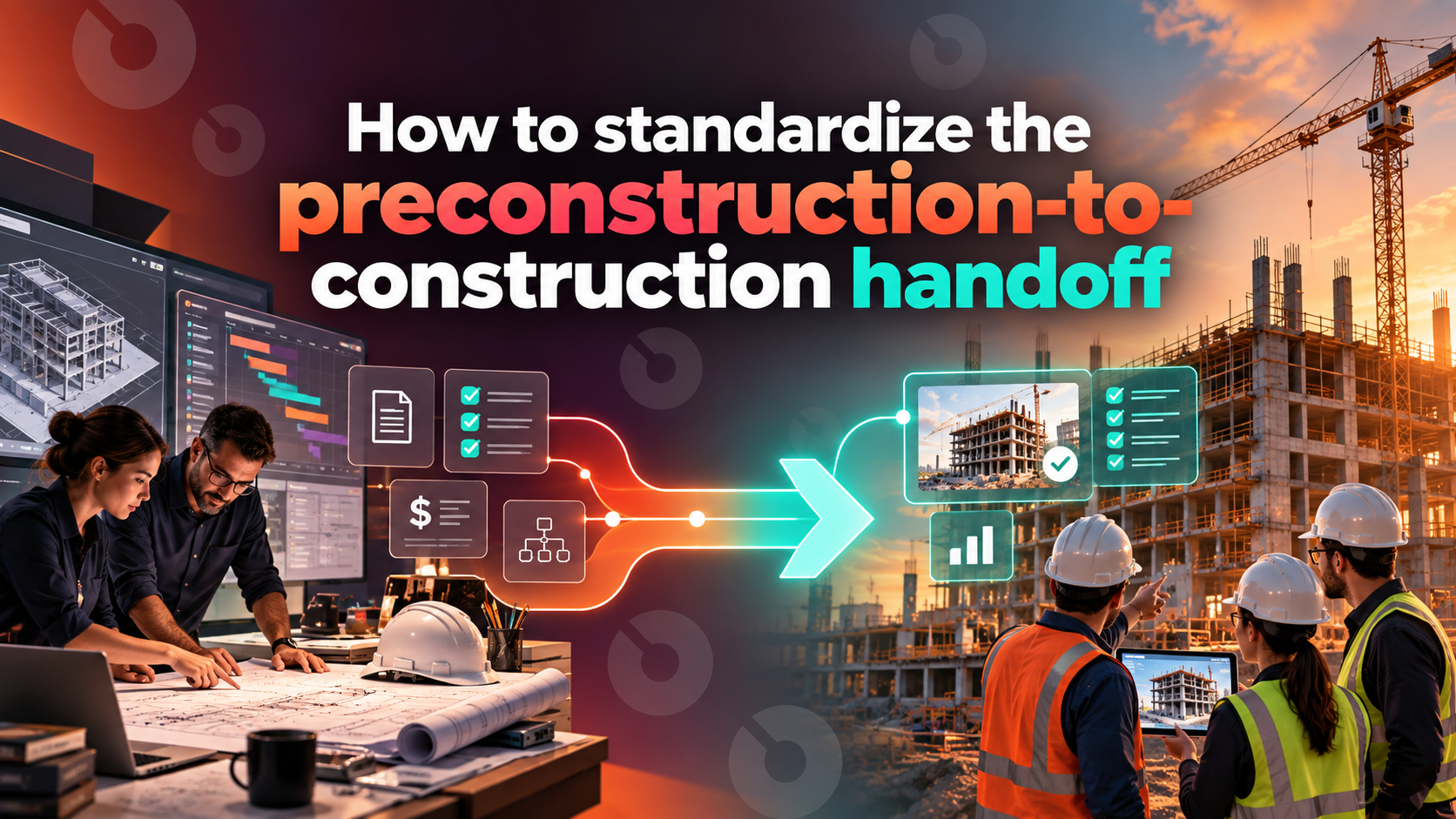
The preconstruction-to-construction handoff is where a lot of projects quietly lose information that nobody notices missing until it causes a problem. The estimator who built the budget isn't the PM running the job. The assumptions behind a bid line item live in someone's head, not in a document. By the time the field team is three weeks into the schedule, they're working from a version of the project that's already drifted from what preconstruction actually planned. This guide covers what a proper handoff should include, how to run one well, and how to make it consistent across every project instead of reinventing it each time.
A project handoff meeting is the formal transition point where the preconstruction team — estimators, preconstruction managers, sometimes the design team — transfers a project's plan, budget, and documentation to the team that will execute it: the project manager, superintendent, and field staff. It's distinct from a construction handover, which refers to the later handoff of a finished building from the contractor to the owner at closeout — same word family, different point in the project entirely.
Done well, a handoff meeting isn't a single conversation. It's a structured transfer of a specific set of documents and context, confirmed complete before the preconstruction team fully disengages from the project.
A few patterns show up repeatedly across projects where the handoff goes poorly:
A typical disconnected handoff: The precon team holds a one-hour walkthrough meeting in week one, covering the budget and schedule at a high level. No written checklist, no documented Q&A. By week three, the PM discovers a budget line that doesn't match what a sub was told during bidding. The estimator has moved to a new project and takes two days to respond. By week five, a scope question surfaces that was "covered" verbally in the handoff meeting, but nobody wrote down the answer, so it gets re-litigated with the owner from scratch.
The same handoff, standardized: The precon team completes a written checklist before the meeting, including budget assumptions and known risks. The one-hour meeting confirms understanding and answers questions in real time, with answers documented on the spot. By week three, the PM references the documented assumptions directly instead of tracking down the estimator. By week five, the scope question that would have been re-litigated is already answered in the risk log from week one.
The meeting length barely changes. What changes is whether the information from that meeting is still accessible three or five weeks later, or has to be reconstructed from memory.
A complete handoff should transfer more than documents — it should transfer the reasoning behind them. At minimum, include:
A structured one-hour agenda that covers the essentials without running long:
For a single project, a good meeting and a thorough checklist solve most of the problem. For a team running multiple projects, the bigger risk is inconsistency — one project gets a thorough handoff, another gets a rushed one, and there's no way to compare or improve the process across a portfolio without a consistent starting point.
Standardizing means using the same checklist and document set on every project, regardless of who's running the handoff that day, and storing the results somewhere every future handoff can reference — not starting from a blank template each time. This matters for the same reason standardized documentation matters at the program level generally: consistency is what makes it possible to spot patterns, like a specific type of information that keeps getting missed across multiple projects, and fix the process itself rather than just the individual instance.
A handful of avoidable mistakes account for most of the downstream problems traced back to a poor handoff:
Because INGENIOUS.BUILD keeps bid packages, contracts, and budgets in the same connected system used for schedules, RFIs, and submittals, the handoff from preconstruction to construction doesn't require re-entering data into a separate execution tool. The budget, contract terms, and bid documentation the precon team built are already where the field team needs them, visible to owners, GCs, subs, and architects from day one.
That connectivity is a big part of why teams using INGENIOUS.BUILD see 5x faster collaboration — the handoff isn't a separate event that depends on someone remembering to transfer everything correctly, because the data was never siloed to begin with.
Book a personalized demo to see preconstruction and construction data connected in one system.
The preconstruction-to-construction handoff fails quietly more often than it fails obviously — a missing assumption here, a verbal commitment that never got written down there, and a few weeks into the job the field team is reconstructing context that should have transferred cleanly. A documented checklist, the right people in the room, and a consistent process across every project close most of that gap. The teams that get this right treat the handoff as a real transfer of information, not a formality standing between preconstruction and the work actually starting.
FAQ
It's the formal transition point where the preconstruction team transfers a project's budget, contract, scope, and documentation to the team that will execute construction — distinct from a construction handover, which happens at closeout when the finished building transfers to the owner.
A project handoff happens at the start of construction, transferring preconstruction planning to the execution team. A construction handover happens at the end, transferring the finished building from the contractor to the owner.
The final budget with key assumptions, the executed contract and bid documents, current drawings, the subcontractor scope list, the baseline schedule, permit status, a risk log, and owner communication expectations.
The estimator or preconstruction lead, the incoming project manager, the superintendent, and ideally a representative from the owner's side, since scope, budget, and expectations affect all of them differently.
Use the same checklist and document set on every project regardless of who's running the handoff, and store the results consistently so future handoffs — and any process improvements — have a comparable starting point.
Missing context more often than missing documents — the reasoning behind a budget assumption or scope decision that was never written down, rather than a document that failed to transfer.

INGENIOUS.BUILD
.svg)
.svg)



Company Type

Product Solutions
Information
.svg)
Speak to a Product Specialist
Streamline your Development & Construction projects with our cutting-edge project management software.
Discover why people are switching to INGENIOUS today!
By submitting this form, you agree with our Privacy Policy.