Informative
MCP vs. Native AI Integrations in Construction Software: What Is the Difference?
Learn how Model Context Protocol (MCP) differs from native AI, why the architecture matters, and how it impacts construction teams, project data, and decision-making.
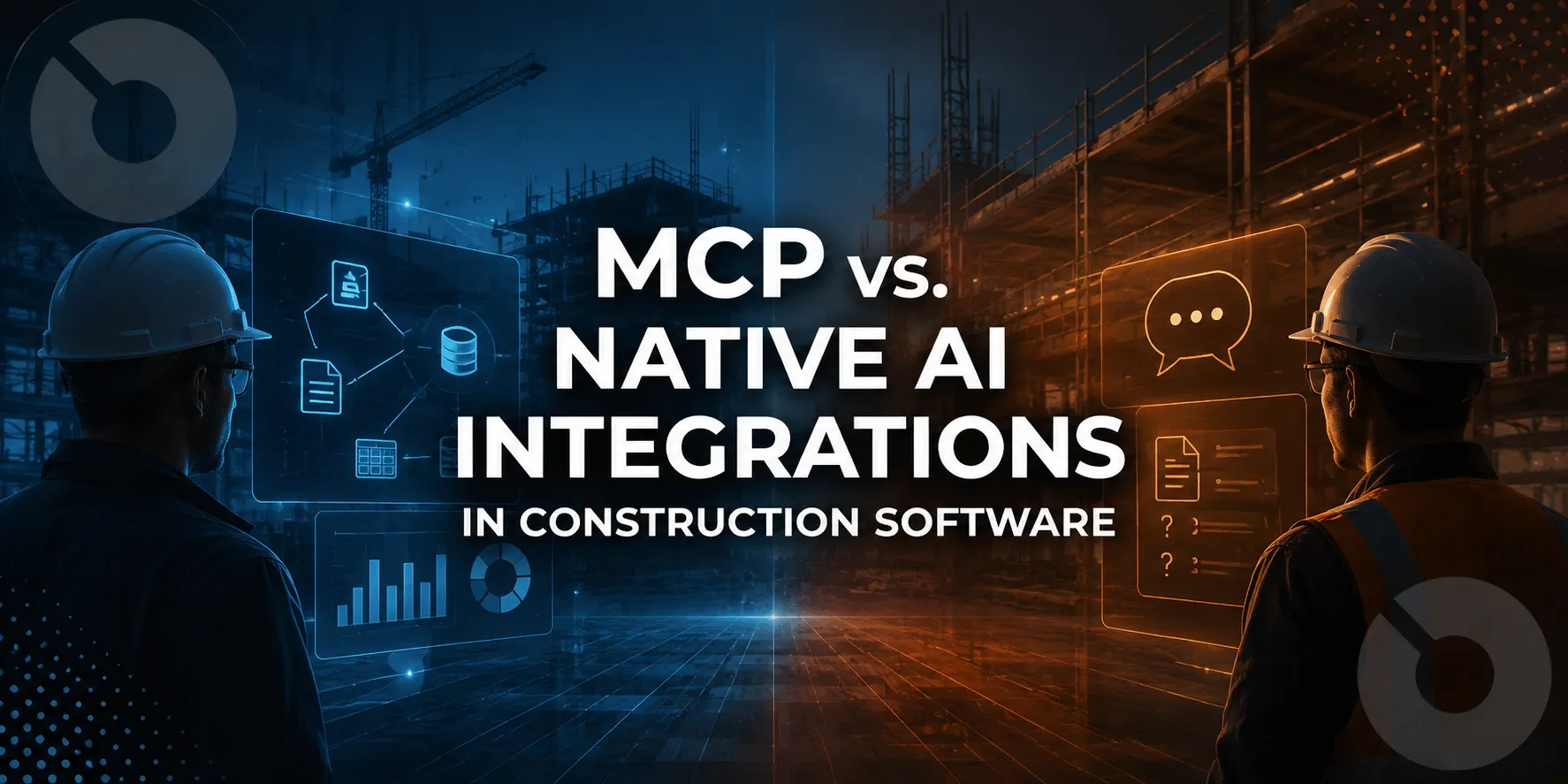
Every major construction software vendor in the United States now claims their platform is powered by AI. The claims look similar in a product brochure. The underlying architecture is not.
There is a meaningful divide between software that connects AI to live project data through the Model Context Protocol and software that has layered a chatbot on top without changing the data architecture beneath it. For owners, developers, general contractors, and owner's reps managing capital projects across the US, where a single change order dispute can cost six figures and a missed budget signal can derail a draw schedule, that divide has direct financial consequences.
AI construction management software has matured quickly, but not all integrations are equal. This article explains what MCP is, how native AI integrations work in construction platforms, where the two approaches diverge, and what that difference means for your projects, your team, and your technology decisions.
What Is the Model Context Protocol?
The Model Context Protocol (MCP) is an open standard introduced by Anthropic in late 2024. Its purpose is to give AI models a standardized, secure way to connect to external data sources, tools and applications. Rather than requiring custom integrations between every AI system and every data source, MCP establishes a common interface that any large language model can use to access live, structured, real-world data at runtime.
A useful analogy is a USB-C port. Before USB-C, connecting devices required matching proprietary cables. USB-C standardized the connection so any compliant device could communicate with any compliant peripheral. MCP does the same thing for AI and data systems. An AI agent that supports MCP does not need a custom connector built for each application it touches. The protocol handles the handshake, the authentication, and the data transfer through a consistent interface.
In practical terms, this means an AI model can read current project budget data, pull live RFI logs, check schedule status, or query committed cost reports in real time, without a developer pre-coding every query. The AI discovers what data is available, requests what it needs based on what the user asks, and responds with answers grounded in actual project state rather than static snapshots or training data.
By early 2026, MCP had been adopted by OpenAI, Microsoft and Google DeepMind as a foundational standard for agentic AI development. In the AEC industry, it represents the first credible path to AI that is actually aware of your specific project, not just construction in general.
What Is a Native AI Integration in Construction Software?
Native AI integrations are features built directly into a software platform by the vendor. They do not rely on an external protocol. Instead, the vendor has connected their own AI model to a selected subset of the data their platform holds, using their own proprietary logic.
Common examples include AI-generated summaries of meeting notes, automatic categorization of invoices, suggested responses to RFIs, or natural language search within a document library. These features are useful when they work well. They are faster to deploy, require no technical setup and deliver value immediately for the specific tasks they were designed for.
The important distinction is scope. Native integrations are designed to do a defined set of things with a defined set of data. The vendor chooses what the AI can see and what it can respond to. The integration is optimized for those specific use cases and often performs them reliably. Outside those defined paths, the AI has no access, no context and no answers.
Most construction software AI in the market today falls into this category. A well-known platform might surface AI budget variance alerts because the vendor pre-built that connection. Ask the same AI a question that falls outside the pre-built scope, such as a cross-module query combining RFI status with budget impact and schedule float, and it either cannot respond or produces an answer that is not grounded in your actual project data.
The Core Architectural Difference
The difference is not about which AI model is better. It is about how deeply the AI is connected to data.
Native integrations are designed at build time. A developer at the software vendor decides in advance which data points the AI can access, writes the logic to retrieve that data and publishes the feature. The connection is fixed. When you ask the AI a question, it can only draw on what the vendor pre-wired it to access.
MCP integrations are resolved at runtime. When you ask an AI model a question through an MCP connection, the model queries the available tools and data sources, determines which ones are relevant, pulls the information it needs and constructs an answer from live data. The model is not limited to pre-defined query paths. It can reason across the full scope of whatever data the MCP server exposes.
For construction teams, this distinction has direct operational consequences. A project where budgets, change orders, RFIs, submittals, schedule milestones and stakeholder communications all live in one platform, connected by a single MCP server, gives AI agents something no fixed native integration can match: full situational awareness of the project as it actually stands, right now.
Ask a native AI integration what your current budget exposure is on a contract if two pending change orders are approved. It may not be able to answer, because the connection between pending change orders and budget forecasting was not something the vendor pre-wired.
Ask an AI with MCP access to a unified project workspace the same question and it can reason across the change order module, the budget module and the contract log in a single response, because all three are accessible through the same protocol.
Why Fragmented Data Makes AI Unreliable in Construction
Construction projects generate data across a wide range of systems. Budgets live in one place. RFIs live in another. Submittals somewhere else. Schedule data in a separate tool. Contracts and change orders in yet another platform. Field reports in email threads.
This fragmentation is the single biggest reason AI in construction underperforms expectations. AI outputs are only as accurate as the data the model can access. When that data is split across disconnected tools, the AI sees fragments. It fills gaps with inferences. In construction, where the cost of an incorrect inference is a disputed change order, a missed commitment or a failed audit, AI that guesses is not a productivity tool. It is a liability.
Research from academic journals studying AI in construction project management identifies AI hallucinations and unauthorized AI access as among the most critical concerns for construction teams adopting AI. Both problems share a common root: the AI does not have reliable, complete, current access to the actual project data it needs to give accurate answers.
MCP addresses this at the architecture level. By giving AI agents a secure, standardized connection to a single, unified project workspace, the protocol removes the data fragmentation that causes unreliable outputs. The AI is not guessing. It is reading from the same source of truth that the project team uses every day.
How AI Agents Operate Through MCP
It helps to walk through what actually happens when an AI agent uses an MCP integration in practice.
A project manager asks: "What is my current committed cost exposure against the approved budget, and which line items have the highest variance?"
Without MCP access, a native AI integration can answer this only if the vendor pre-built that specific query path into the product. If they did not, the user gets a generic response, an error or an answer drawn from the last time that data was pushed into a static report.
With MCP access to a unified project workspace, the sequence looks different. The AI receives the question. It queries the MCP server to discover what data is available: budget line items, committed contracts, approved change orders, pending change orders, invoice records. It pulls the current state of each relevant data set. It calculates the variance. It returns an answer that reflects the project as it stands at that moment, not as it stood at the last reporting cycle.
This is what it means for AI to be architecture-level infrastructure rather than a feature. The value does not come from the AI itself. It comes from the AI having genuine, real-time access to project reality.
What This Means for AEC Teams Evaluating Software
When you evaluate construction software that claims AI capabilities, the right questions are about data access, not model quality.
The first question is what data the AI can actually see. Can it read across your project financials, project management and construction administration data at the same time? Or is it limited to a specific module?
The second question is whether the AI operates on live data or on exports and snapshots. Many platforms generate AI summaries by running the AI over a periodic data export. That is not real-time project intelligence. That is a delayed report with an AI wrapper.
The third question is how the AI is connected. Is the connection pre-defined and vendor-managed, meaning it can only answer questions the vendor anticipated? Or does it use a standardized protocol that lets the AI reason across the full data model?
The fourth question is whether the platform is built around a single source of truth. AI agents are most valuable when the data they access is clean, current, and trusted. A platform where every stakeholder, from owners and developers to GCs, specialty trades and architects, works in the same shared workspace produces data that AI can actually use. A fragmented stack of point solutions produces noise.
MCP in the Context of Construction Project Lifecycle
The AEC industry runs projects from pre-construction through closeout. Each phase generates different data types, involves different stakeholders and carries different decision-making risks. An AI that can only see one module or one phase cannot provide meaningful cross-project intelligence.
In project financials, the high-value questions involve cost exposure, budget variance, change order impact and invoice accuracy. These require access to contracts, budgets, committed costs, and change logs simultaneously. Native AI integrations designed for one of those areas cannot answer cross-domain questions.
In project management, the questions involve schedule adherence, document status, action item completion, and resource allocation. Useful AI in this context needs to understand what was committed versus what was delivered, who is responsible, and what the downstream schedule implications are.
In construction administration, the questions involve RFI resolution timelines, submittal review cycles, punch list completion, and closeout documentation. These connect back to budget impacts and schedule floats that live in other modules.
A project where all three modules share a common data architecture and where an AI agent can move freely across all three through MCP, gives project teams intelligence that no single-module native integration can provide. The AI can answer questions that cross module boundaries, which are almost always the most important questions on a complex project.
The Real Competitive Question for Construction Software Vendors
For construction technology vendors, MCP represents a strategic inflection point. Vendors who have built native AI features on top of fragmented data architectures face a structural disadvantage. The AI features they have shipped are limited to the scope their engineers anticipated. Expanding AI capability means pre-building each new query path. That is slow, expensive, and always behind what users actually need.
Vendors who have invested in a unified project workspace and a genuine MCP integration have built the foundation that makes AI genuinely useful. Every new AI capability is unlocked by expanding the data the MCP server exposes, not by writing new integration code for each feature.
For construction teams choosing a platform, this matters not just for what AI can do today but for what it will be able to do in two or three years as AI models improve. A platform built on MCP infrastructure benefits automatically as underlying AI models get better, because the models have access to better-organized data. A platform with bolt-on AI features requires the vendor to rebuild those features for each new model generation.
INGENIOUS.BUILD and the MCP Standard
INGENIOUS.BUILD is a unified construction project management platform built around a single workspace shared by all project stakeholders, from owners and developers to GCs, specialty trades, architects and engineers. The three core modules, Project Financials, Project Management and Construction Administration, operate on the same shared data architecture, which means every record, document, cost entry, RFI, submittal and contract lives in a connected environment.
INGENIOUS.BUILD has built its AI capabilities on the MCP standard, giving AI agents direct access to the unified project workspace. This means the AI can reason across modules, read live data and answer questions that require understanding of the full project state, not just the slice of data a native integration was pre-wired to see.
For owners and developers who want to know their real cost exposure at any point in a project, for GCs who want to understand schedule and budget implications of pending change orders, for owner's reps who need to track documentation compliance across a portfolio, the architecture matters. AI that operates through MCP on a unified workspace gives answers grounded in current project reality.
That is not a feature. It is the foundation that makes every other AI capability more reliable.
Book a demo to see how it would look for your project!
Frequently Asked Questions
What does MCP stand for in construction software?
MCP stands for Model Context Protocol. It is an open standard developed by Anthropic that gives AI models a standardized way to connect to external data sources and tools in real time. In construction software, MCP allows AI agents to access live project data, such as budgets, RFIs, change orders, and schedules, without requiring custom integrations for each data type.
What is the difference between MCP and a native AI integration?
A native AI integration is built by the software vendor to perform specific, pre-defined tasks using a subset of the platform's data. The vendor decides in advance what the AI can access and what questions it can answer. An MCP integration connects AI agents to a broader data environment at runtime, allowing the AI to discover relevant data and reason across it dynamically. Native integrations are simpler to deploy but limited in scope. MCP integrations are more powerful for complex, cross-domain questions.
Why does AI give wrong answers in construction software?
The most common cause is fragmented or incomplete data access. When AI operates on a static snapshot, a data export, or a pre-defined subset of project data, it cannot give accurate answers to questions that require current, cross-module information. AI hallucinations and inaccurate outputs in construction settings typically reflect the AI filling gaps in its data access with inferences, rather than reading from a reliable, live source of truth.
What should I look for when evaluating AI in construction software?
Ask whether the AI has access to live data or operates on snapshots. Ask whether it can answer questions that cross module boundaries, such as combining cost, schedule, and contract information in a single response. Ask whether the platform is built on a unified data architecture or assembled from point solutions. Ask whether the AI integration uses an open standard like MCP or a proprietary, vendor-managed connection. The answers to these questions predict whether AI will deliver real project value or remain a peripheral feature.
Does INGENIOUS.BUILD support MCP?
Yes. INGENIOUS.BUILD has built its AI capabilities on the Model Context Protocol, giving AI agents direct access to the platform's unified project workspace. This allows AI to reason across Project Financials, Project Management, and Construction Administration data in real time, serving the full range of project stakeholders including owners, developers, owner's reps, GCs, specialty trades, architects, and engineers.
Is MCP better than an API for construction AI?
APIs and MCP serve different purposes. APIs give developers deterministic, programmatic access to specific data endpoints. MCP gives AI agents dynamic, runtime access to a broader data environment. For agentic AI use cases in construction, where the AI needs to reason across multiple data types in response to natural language questions, MCP is better suited. For single-purpose automations where a developer wants to pull a specific data point on a schedule, an API is more appropriate.