Informative
Enterprise Construction Management Software: Practical Guide for Large Construction Companies (2026)
A practical guide to enterprise construction management software — what it is, how it scales, key features, costs, and how large contractors can choose the right platform.
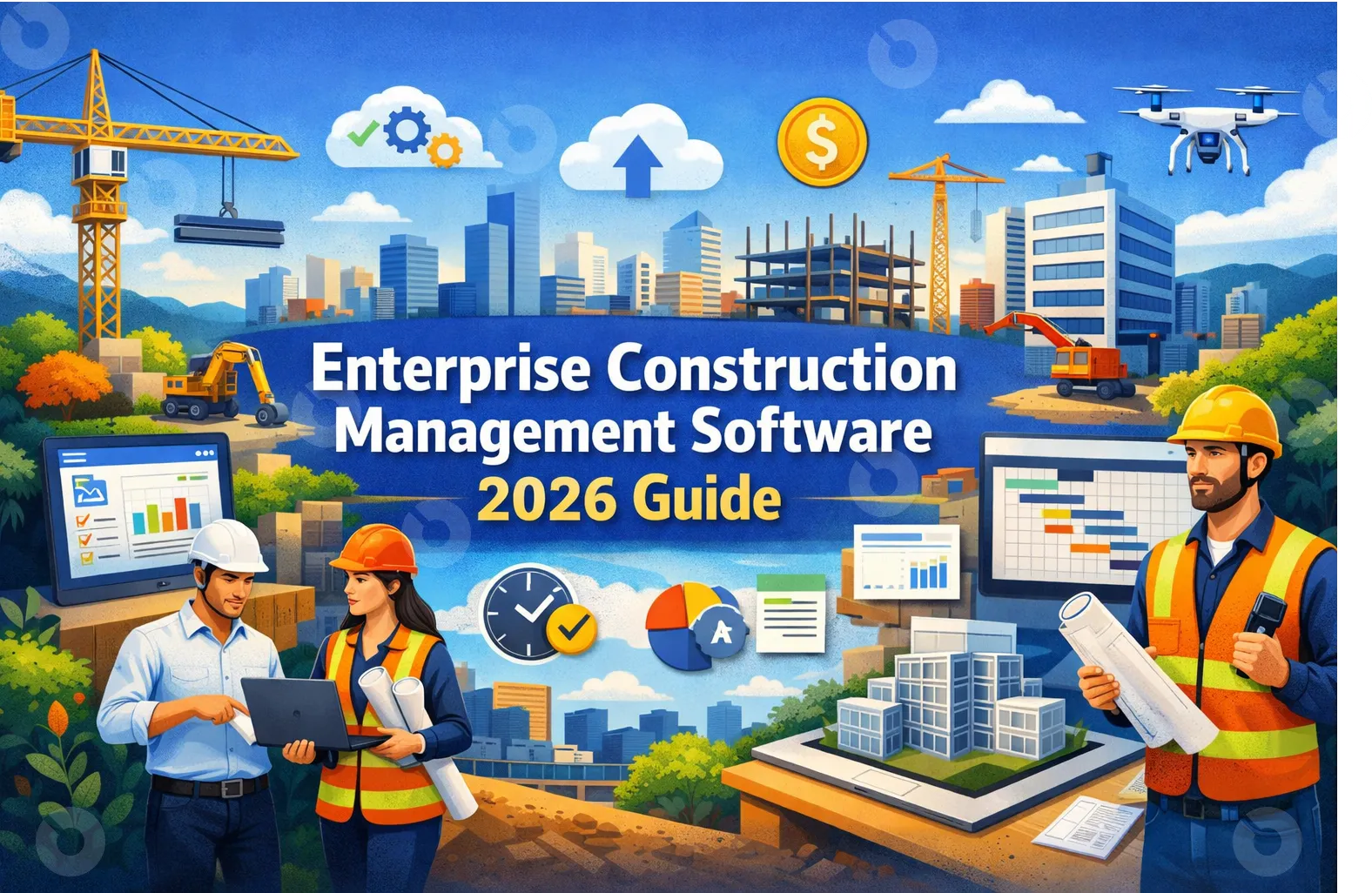
As construction companies scale, their operational challenges change dramatically. What works for a $20M contractor quickly breaks down at $100M — and at $500M+ in annual revenue, spreadsheets, disconnected tools and lightweight apps simply can’t keep up.
This is where enterprise construction management software becomes essential.
In this guide, we’ll break down what enterprise construction software really is, how it differs from mid-market tools, what functionality large contractors actually need, how much it typically costs and how to choose the best enterprise construction project management software for complex organizations.
What Is Construction Management Software (at the Enterprise Level)?
At its core, construction management software is used to plan, coordinate, track and control construction projects. It typically supports scheduling, documentation, communication and reporting.
But enterprise construction management software goes far beyond basic project tracking.
For large organizations, enterprise software must support:
- Multiple concurrent projects and programs
- Complex organizational structures (regions, divisions, joint ventures)
- High volumes of RFIs, submittals, change orders and documents
- Strict governance, auditability and compliance
- Executive-level reporting and portfolio visibility
- Integration with ERP, accounting and financial systems
- Long-term scalability without performance degradation
In short, enterprise software for construction is built to handle scale, complexity and risk — not just tasks.
Enterprise Construction Management Software for Contractors Over $500M
For contractors exceeding $500M in revenue, software decisions directly impact margins, risk exposure and delivery predictability.
At this level, teams need:
- Enterprise construction project management software that supports portfolio-level oversight
- Standardized workflows across regions and project types
- Real-time collaboration between owners, GCs, consultants and trades
- Strong permissioning and role-based access
- Reliable performance with thousands of active users
- Data consistency across years-long programs
Many organizations at this scale struggle because their tools were designed for smaller teams and retrofitted for enterprise use. The result is high license costs, long onboarding cycles and low adoption.
What Software Is Used in Construction Management Today?
Enterprise construction companies typically use a combination of systems, including:
- Enterprise construction management software (project execution, admin, collaboration)
- Construction enterprise resource planning (ERP) software
- Enterprise accounting software for construction companies
- Scheduling tools
- Document management systems
- Customer service and support platforms
The problem is fragmentation. When these systems don’t work together, teams lose visibility, duplicate effort and introduce risk.
Modern enterprises are increasingly consolidating workflows into complete construction enterprise software ecosystems, where project management, construction administration and collaboration live in one system and integrate cleanly with ERP and accounting.
Key Features of the Best Enterprise Construction Management Software
The best enterprise construction management software isn’t defined by a long feature checklist — it’s defined by how well it supports real enterprise workflows.
1. Scalable Project & Program Management
Enterprise platforms must support hundreds of projects across multiple business units without slowing down or becoming unstable.
2. Advanced Construction Administration
RFIs, submittals, meeting minutes, change orders and approvals must be structured, traceable and audit-ready.
3. Portfolio-Level Visibility
Executives need real-time insight into schedule health, risk, workload and performance across the entire organization.
4. Governance & Compliance
Enterprise software must support standardized processes, approval hierarchies and detailed audit trails.
5. Integration with ERP & Accounting
A true enterprise solution integrates with construction enterprise resource planning software and enterprise accounting software for construction companies, ensuring financial accuracy and reducing manual reconciliation.
6. Adoption at Scale
Even the most powerful platform fails if teams don’t use it. Enterprise software must be intuitive enough for daily use by PMs, office staff and field teams.
Enterprise Construction Software vs ERP: What’s the Difference?
A common misconception is that ERP systems can replace construction management software.
In reality:
- ERP software focuses on financials, payroll, procurement and accounting
- Enterprise construction management software focuses on execution, collaboration, documentation and delivery
The most effective organizations connect the two — rather than forcing one system to do everything.
Cost of Software for Enterprise Construction Companies
The cost of software for enterprise construction companies varies widely depending on scale, features and licensing models.
Typical cost considerations include:
- Per-user or per-project licensing
- Modules (project management, admin, reporting, integrations)
- Implementation and onboarding
- Training and support
- Ongoing customer service costs
For large organizations, the real cost is not the license — it’s inefficiency. Poor adoption, fragmented tools and manual processes often cost far more than the software itself.
This also applies to related systems, such as the cost of customer service software for enterprise construction companies, where disconnected support workflows slow down internal teams and external partners.
What Is the Best Project Management Software for Construction Enterprises?
There is no single “best” tool for every organization — but there are platforms better suited for enterprise environments.
The best enterprise construction project management software should:
- Support complex, multi-project organizations
- Provide clarity without unnecessary complexity
- Scale across regions and programs
- Integrate with ERP and accounting systems
- Be flexible enough to support different project types
- Deliver real value without months of onboarding
This is where INGENIOUS.BUILD stands out.
Why Enterprise Teams Choose INGENIOUS.BUILD
INGENIOUS.BUILD is designed for organizations that need enterprise-grade power without enterprise-grade friction.
Enterprise construction teams use INGENIOUS.BUILD to:
- Manage complex projects and portfolios in one unified platform
- Standardize construction administration across the organization
- Enable collaboration between owners, GCs, consultants and partners
- Maintain governance, auditability and transparency
- Integrate with existing ERP and accounting systems
- Improve adoption with a modern, intuitive user experience
Unlike legacy platforms, INGENIOUS.BUILD focuses on clarity, structure and real-world construction workflows, making it easier for large teams to operate consistently at scale.
Frequently Asked Questions
What is construction management software?
Construction management software helps teams plan, coordinate, document and control construction projects. At the enterprise level, it also supports governance, reporting and portfolio management.
What software is used in construction management?
Enterprise construction companies typically use a combination of project management platforms, ERP systems, accounting software and collaboration tools. Modern organizations aim to unify these systems as much as possible.
What is the best project management software for construction enterprises?
The best solution depends on organizational complexity, scale and workflows. Enterprise teams often choose platforms that balance power, scalability and usability — like INGENIOUS.BUILD.
How much does enterprise construction management software cost?
Costs vary widely, but for large companies the focus should be on ROI, adoption and efficiency — not just license price.
Is enterprise construction software suitable for contractors over $500M?
Yes — but only if it’s designed for scale. Software built for smaller teams often fails at enterprise complexity. Platforms like INGENIOUS.BUILD are designed with large organizations in mind.
Final Thoughts
Enterprise construction companies operate in one of the most complex, risk-heavy environments in any industry. Choosing the right enterprise construction management software is not just a technology decision — it’s a strategic one.
The right platform helps organizations:
- Reduce risk
- Improve delivery predictability
- Increase operational efficiency
- Enable collaboration at scale
- Support long-term growth
If your organization is evaluating enterprise construction software or rethinking its current stack, INGENIOUS.BUILD offers a modern, scalable alternative built specifically for complex construction environments. Get a personalized demo!