Informative
Distribution Center Construction Timeline: Complete Guide from Planning to Go-Live
From Groundbreaking to Go-Live: A Complete Distribution Center Construction Timeline Guide Covering Planning, Procurement, Construction, Automation & Operational Turnover.
Distribution centers are built under one overriding constraint - time. Unlike many commercial facilities, warehouse and logistics hubs are usually tied to:
- lease commitments
- supply chain expansion deadlines
- tenant occupancy dates
- automation vendor schedules
- regional fulfillment launch plans
That means the construction timeline is not just a scheduling exercise. It is directly tied to revenue, operations and investor expectations. A two-month delay on a distribution center can ripple far beyond the jobsite.
This guide breaks down the full distribution center construction timeline, realistic phase durations, the biggest schedule risks and how construction teams shorten time to operational handoff.
What Is the Typical Distribution Center Construction Timeline?
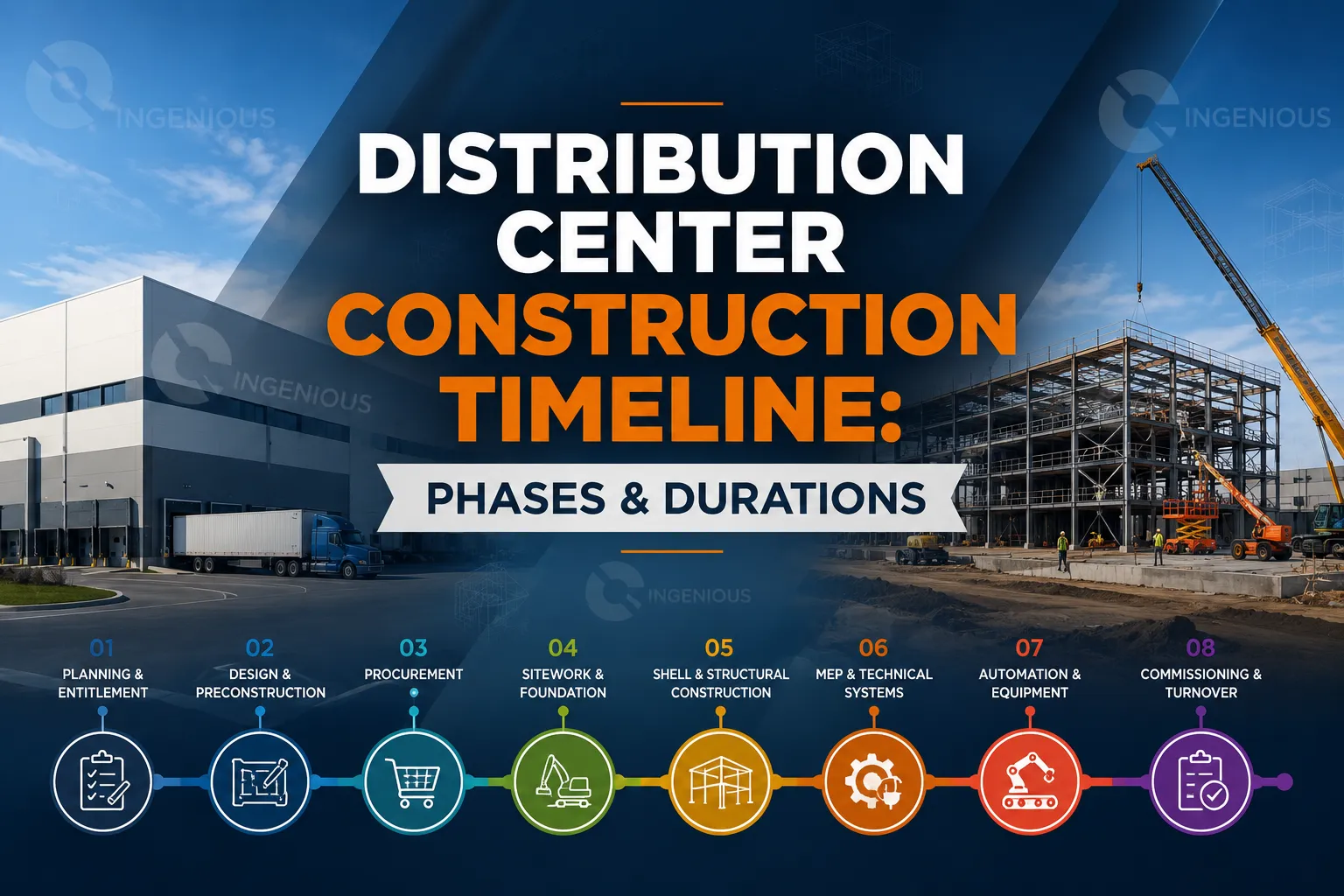
The typical distribution center construction timeline ranges from 9 to 18 months depending on building size, site conditions, permitting complexity, automation requirements and procurement lead times.
A standard warehouse project usually includes:
- planning and entitlement
- design and preconstruction
- procurement
- sitework and foundation
- shell and structural construction
- MEP and technical systems installation
- automation integration
- commissioning and turnover
In practice, the biggest determinant of speed is not just field productivity - it is how well approvals, procurement and technical packages are coordinated before bottlenecks occur.
How Long Does It Take to Build a Distribution Center?
This is one of the most searched questions around warehouse construction and the honest answer is: it depends heavily on project complexity.
Small regional warehouse (50,000–150,000 sq ft)
Approximate timeline: 7–10 months
Mid-size logistics facility (150,000–500,000 sq ft)
Approximate timeline: 9–14 months
Large fulfillment or automated distribution center (500,000+ sq ft)
Approximate timeline: 12–18+ months
Projects with conveyor systems, robotics, refrigeration or advanced security/IT packages often extend beyond standard shell construction durations because operational systems require separate commissioning.
The 8 Main Phases of Distribution Center Construction Timeline
Phase 1: Site Selection, Feasibility and Entitlement
Typical duration: 1-3 months
Before construction can begin, teams must confirm:
- zoning and land use feasibility
- truck circulation and access logistics
- utility capacity
- environmental constraints
- permitting path
This stage often determines whether the entire project can realistically hit the target occupancy date.
One common mistake is underestimating entitlement and municipal review durations.
Phase 2: Design Development and Preconstruction
Typical duration: 2-4 months
During this phase, teams finalize:
- warehouse layout
- loading dock counts
- slab requirements
- structural steel design
- MEP packages
- fire protection systems
- automation coordination assumptions
At the same time:
- budgets are refined
- schedules are developed
- subcontractor scopes are bid
The stronger the preconstruction effort, the fewer downstream timeline surprises.
Phase 3: Procurement of Long-Lead Materials
Typical duration: overlaps 1-4+ months
This phase often begins before field mobilization.
Critical long-lead items may include:
- structural steel
- roofing systems
- dock equipment
- HVAC equipment
- switchgear
- fire pumps
- automation infrastructure
Long-lead procurement is one of the biggest hidden schedule drivers in logistics facility construction.
Many distribution center delays are not caused by field labor, they are caused by materials not arriving when needed.
Phase 4: Sitework and Foundation
Typical duration: 1-3 months
This includes:
- grading and earthwork
- underground utilities
- stormwater systems
- pad preparation
- foundation pours
- slab prep
Site conditions can significantly affect this stage, especially in weather-sensitive regions or poor soil conditions.
Phase 5: Shell and Structural Construction
Typical duration: 2–5 months
This is the visible acceleration stage where the building begins to take shape.
Includes:
- steel erection
- wall panels
- roofing
- dock doors
- exterior envelope
For many owners, this phase appears to be the "main construction", but timeline success actually depends more on how earlier procurement and later systems integration are managed.
Phase 6: MEP, Fire Protection and Technical Infrastructure
Typical duration: 2-4 months
Once the shell is advancing, internal systems begin:
- electrical rough-in
- lighting
- HVAC
- fire suppression
- plumbing
- security conduits
- IT backbone
This phase requires strong coordination because multiple subcontractors are moving simultaneously.
Phase 7: Automation, Equipment and Commissioning Prep
Typical duration: 1-3 months
Modern logistics centers increasingly include:
- conveyors
- sortation systems
- robotics
- WMS-related hardware
- scanning and security systems
These packages often operate on separate vendor schedules and can become major critical path items if not integrated early.
This is one of the biggest differences between a simple warehouse and a true fulfillment center timeline.
Phase 8: Testing, Commissioning and Operational Turnover
Typical duration: 2-6 weeks
Before go-live, teams must complete:
- life safety inspections
- MEP commissioning
- dock equipment testing
- automation testing
- punch resolution
- owner/operator training
Construction substantial completion does not automatically mean operational readiness.
This handoff period is often underestimated.
Sample Distribution Center Construction Timeline by Month
- Months 1–2
Site due diligence, entitlement, schematic design
- Months 2–4
Design development, budgeting, procurement release
- Months 4–6
Sitework and foundations
- Months 5–9
Steel, shell, roofing, envelope
- Months 7–11
MEP rough-in, fire protection, technical systems
- Months 10–13
Automation/equipment install
- Months 13–14
Commissioning, inspections, turnover
Larger or more automated projects may stretch this significantly.
The Biggest Causes of Distribution Center Construction Delays
This is where most warehouse construction timelines slip.
Procurement bottlenecks
Late steel, switchgear, HVAC or dock equipment deliveries.
Change orders during technical coordination
Design revisions during MEP or automation integration.
Poor milestone visibility
Teams discover slippage too late because reporting is fragmented.
Vendor schedule misalignment
Automation vendors, shell contractors and commissioning teams are not synchronized.
Slow approvals
Submittals, RFIs and owner decisions lag behind field pace.
Most distribution center schedule failures are coordination failures, not just labor productivity failures.
How to Shorten a Distribution Center Construction Timeline
Experienced logistics developers typically accelerate delivery through:
Early release packages
Procure steel and long-lead equipment before full drawing completion.
Parallel path scheduling
Overlap procurement, shell and systems planning whenever possible.
Milestone-based contractor accountability
Track exact readiness dates instead of broad monthly reporting.
Centralized approval workflows
Keep RFIs, submittals and technical decisions moving quickly.
Real-time schedule and budget visibility
Leadership needs immediate visibility when slippage begins.
Why Timeline Visibility Is Usually the Real Problem
Many teams technically have a schedule.
What they do not have is:
- real-time milestone reporting
- contractor dependency visibility
- integrated procurement tracking
- one place to see emerging delays
By the time a monthly OAC meeting reveals slippage, recovery options are already limited.
This is why distribution center construction timelines increasingly require connected construction management software, not static CPM schedules alone.
How Construction Software Helps Keep Warehouse Timelines on Track
The right software allows teams to:
- track procurement milestones
- manage RFIs and submittals faster
- coordinate contractor action items
- connect cost impacts with schedule changes
- provide owner dashboards across all moving packages
For logistics projects, software is less about documentation and more about preserving schedule predictability.
Platforms like INGENIOUS.BUILD help owners, developers and contractors maintain one connected view of:
- budget status
- milestone completion
- contractor workflows
- pending approvals
- operational handoff readiness
which becomes critical when launch dates cannot move.
Final Thoughts
A distribution center construction timeline is rarely delayed by one dramatic event. It slips through dozens of smaller misses:
- late approvals
- procurement blind spots
- technical coordination issues
- contractor misalignment
The faster and more capital-intensive the facility, the less margin there is for fragmented oversight.
Teams that manage logistics facility timelines well do one thing differently: they treat schedule visibility as a live control system, not a monthly reporting document.
If your next warehouse or fulfillment build demands tighter milestone control, stronger contractor coordination, and faster issue response, INGENIOUS.BUILD can help centralize that process from preconstruction through turnover. Book a demo to see how schedule-critical logistics projects stay on track with real-time visibility.
FAQ
How long does it take to build a distribution center?
Most distribution centers take between 9 and 18 months depending on size, automation requirements and permitting complexity.
What is the longest phase of warehouse construction?
Shell construction and MEP/technical systems installation are usually the longest phases, though long-lead procurement often creates the biggest hidden delays.
What causes delays in distribution center construction?
The most common causes are procurement bottlenecks, slow approvals, change orders and poor coordination between technical vendors.
How can warehouse construction timelines be shortened?
By releasing long-lead procurement early, overlapping project phases, improving milestone accountability and using real-time construction management software.
When is a distribution center considered operationally complete?
Only after commissioning, life safety approvals, technical systems testing and operator turnover are fully completed.