|

MENU


.svg)
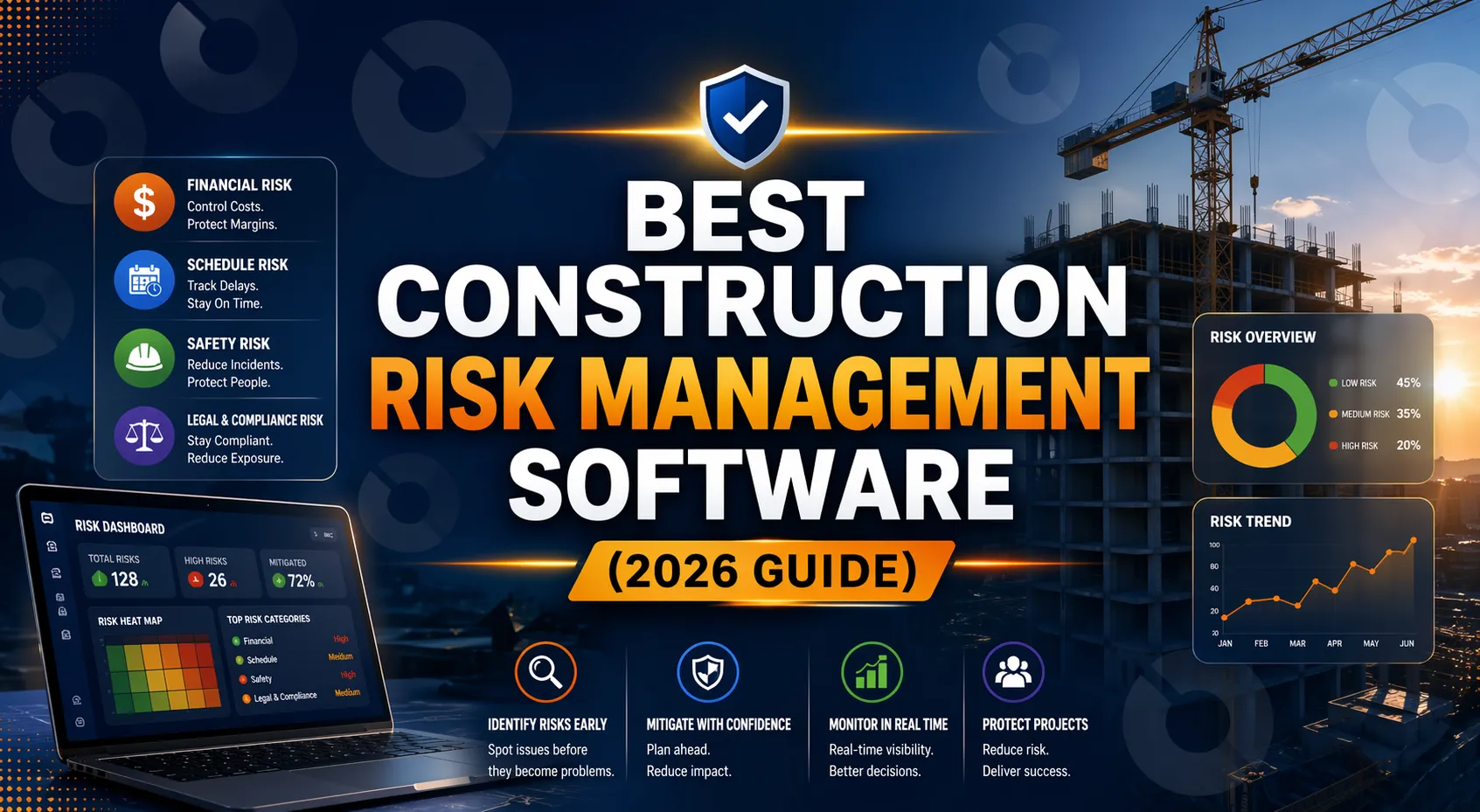
Risk is built into every construction project. From budget overruns and delays to safety incidents and legal exposure - what separates high-performing construction companies isn’t whether risks exist.
It’s how well they’re identified, tracked and managed in real time.
That’s why more companies are investing in construction risk management software - tools designed to reduce uncertainty and improve project outcomes.
In this guide, we’ll cover:
Construction risk management software is a digital platform that helps companies identify, assess, track and mitigate risks across construction projects, from financial and schedule risks to safety and compliance issues.
It typically allows teams to:
In practice, it transforms risk management from reactive problem-solving into a structured, proactive system built around real-time visibility and control.
Risk isn’t optional in construction, it’s constant. What matters is how well it’s managed.
Poor risk management directly impacts:
Industry research and project reports consistently show:
Projects with structured risk management processes are more likely to be delivered on time, on budget and with fewer disputes.
Without proper risk management:
With the right systems in place:
In construction, risk management isn’t just about avoiding problems, it’s about protecting margins and ensuring predictable project outcomes.
Modern tools typically cover:
The best platforms don’t treat these separately, they connect them into one system.
Most content lists risks. Very little explains how to actually manage them. A practical construction risk management process looks like this:
At preconstruction and planning stages
Not all risks matter equally
Prioritize based on:
Define clear actions:
This is where most teams fail.
Risks change daily - without real-time tracking, you’re reacting too late.
Instead of overwhelming you with dozens of tools, here are the platforms that actually cover different types of construction risk:
Best for: financial risk visibility and multi-project oversight
Best for: enterprise-scale risk and compliance
Best for: design and coordination risk
Best for: financial and operational risk (ERP-level)
Key takeaway: Different tools manage different risks - the best choice depends on where your biggest exposure is.
AI is increasingly used to:
While still evolving, AI is shifting risk management from reactive to predictive.
The best construction risk management tools typically include:
The goal: make risks visible early, before they impact the project
Focus on your biggest risk areas:
The best software aligns with your highest-risk areas, not just feature lists
Most construction companies don’t lack risk awareness - they lack connected systems to manage it effectively.
Risk management typically breaks down when:
The core problem isn’t risk itself, it’s lack of visibility and coordination
When risk is managed properly, it directly improves project performance across all key areas.
Effective risk management leads to:
Well-managed projects aren’t just safer, they’re more profitable and easier to scale.
Teams that manage risk effectively:
Risk management isn’t just a process - it’s a core driver of profitability and a real competitive advantage in construction.
If you’re currently managing risk through spreadsheets or disconnected tools, you’re likely reacting too late.
Modern platforms like INGENIOUS.BUILD help you:
Book a demo to see how proactive risk management actually works.
It’s the process of identifying, assessing and mitigating risks that could impact cost, schedule, safety or project outcomes.
Top tools include INGENIOUS.BUILD, Procore, Autodesk Construction Cloud and CMiC depending on project complexity.
It provides real-time visibility, reduces manual tracking and helps teams identify risks earlier.
Financial, schedule, safety and legal risks are the most common.

INGENIOUS.BUILD
.svg)
.svg)


Company Type

Product Solutions
Information
.svg)
Speak to a Product Specialist
Streamline your Development & Construction projects with our cutting-edge project management software.
Discover why people are switching to INGENIOUS today!
By submitting this form, you agree with our Privacy Policy.