Informative
All-in-One Construction Software vs Point Solutions: What Actually Scales in 2026?
Compare all-in-one construction software vs point solutions in 2026. Learn which approach scales better as projects, portfolios, and operational complexity continue to grow.
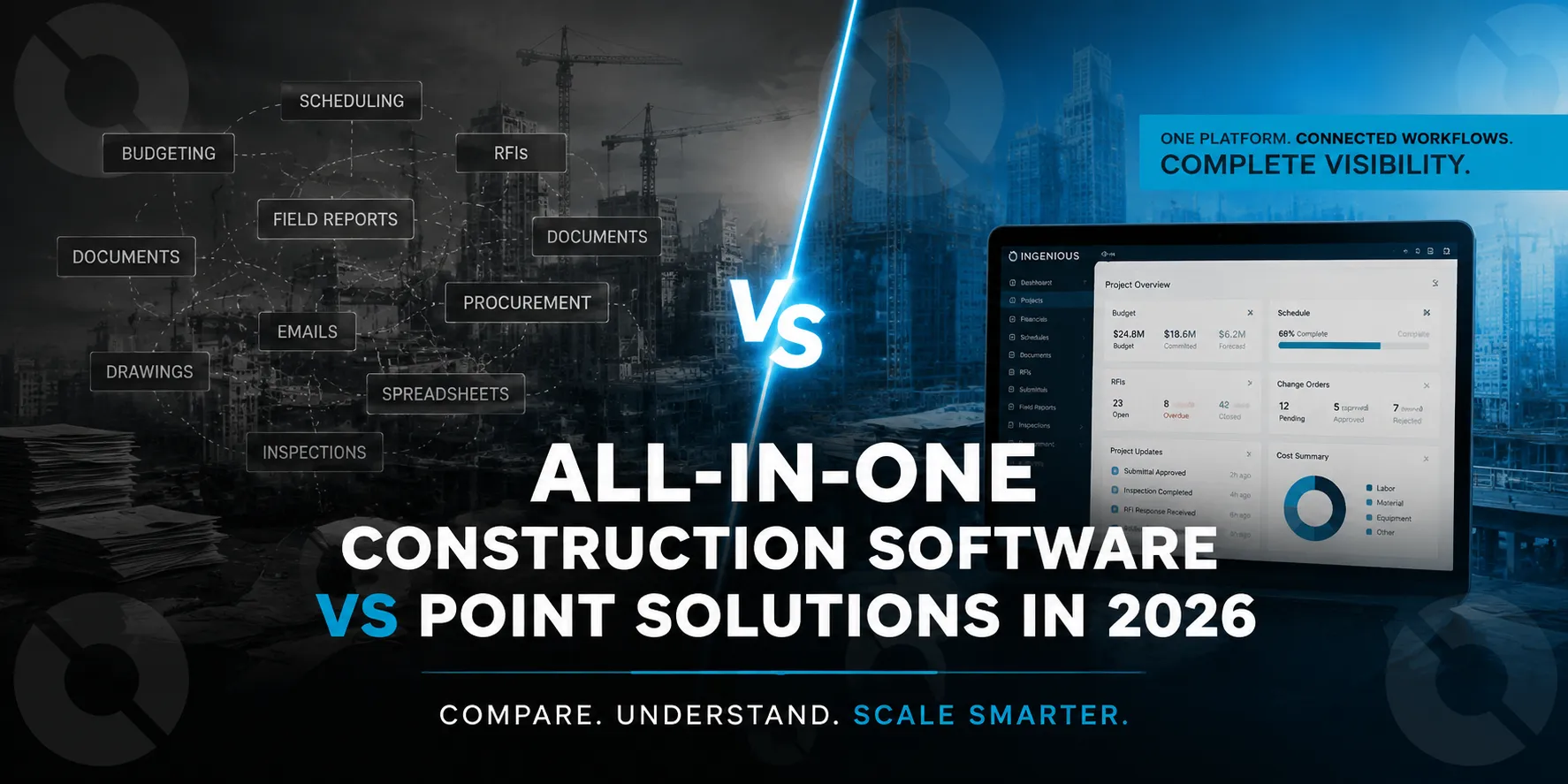
Construction teams did not intentionally create fragmented software stacks. Most companies adopted tools one problem at a time.
A scheduling platform solved scheduling issues. A budgeting tool improved cost tracking. Another app handled RFIs. Another managed drawings. Another supported field reporting. Then came spreadsheets, email workflows, shared drives, accounting systems and collaboration apps layered on top.
At first, this approach feels manageable.
But as projects grow larger and more complex, software fragmentation becomes an operational problem of its own.
Instead of improving coordination, disconnected systems often create:
- duplicate work
- reporting gaps
- approval bottlenecks
- inconsistent data
- version confusion
- delayed decision-making
- limited visibility across projects
This is why many construction teams are rethinking how they manage software in 2026.
The industry is gradually shifting away from fragmented point solutions and toward connected construction management platforms that centralize workflows across project teams.
The goal is not simply reducing the number of tools.It is improving operational visibility, coordination and scalability across the entire project lifecycle.
What Are Point Solutions in Construction?
Point solutions are specialized software tools designed to solve a single operational problem.
In construction, this often includes separate systems for:
- scheduling
- budgeting
- document storage
- RFIs and submittals
- field reporting
- procurement
- accounting
- punch lists
- collaboration
- inspections
Many construction companies adopt these tools gradually over time because each one solves a specific pain point quickly.
For example:
- a field app improves inspections
- a scheduling tool helps PMs
- a procurement platform supports bidding workflows
- an accounting system improves financial reporting
Individually, these tools may work well. The challenge appears when teams need all of those systems to work together consistently.
Why Construction Teams Adopt Point Solutions
Point solutions remain popular for good reasons. They are often:
- faster to implement
- easier to test
- highly specialized
- less expensive upfront
- attractive for department-specific workflows
For smaller teams or simpler projects, this can work effectively.
A contractor managing a handful of projects may not initially need a fully centralized operational platform.
In many cases, point solutions are also adopted organically. Different departments choose tools independently based on immediate operational needs.
The problem is not the software itself. The problem is what happens when project complexity outgrows the coordination model around it.
Where Point Solutions Start Breaking Down
Construction workflows are deeply interconnected.
Schedules affect procurement. Procurement affects budgets. RFIs affect field execution. Drawing revisions affect subcontractors, inspections and approvals simultaneously.
When these workflows live across disconnected systems, operational friction increases quickly.
One of the biggest issues is duplicate data management.
Teams often re-enter the same information into multiple systems because platforms do not share data effectively. That creates inconsistencies between reports, dashboards and field workflows.
Approval visibility also becomes fragmented.
A budget update may live in one system while related approvals happen through email and associated schedule impacts exist elsewhere entirely.
Over time, this creates:
- inconsistent reporting
- limited executive visibility
- unclear accountability
- slower decision-making
- audit trail gaps
- communication breakdowns between field and office teams
The larger the project portfolio becomes, the harder this fragmentation becomes to manage.
The Hidden Cost of Fragmented Construction Software
Most software fragmentation costs are operational rather than technical.
Construction companies rarely notice the full impact immediately because inefficiencies accumulate gradually across teams and projects.
Common hidden costs include:
- manual reporting work
- duplicate data entry
- delayed approvals
- inconsistent forecasting
- communication gaps
- version confusion
- slower issue resolution
- rework caused by outdated information
- fragmented project visibility
These issues often become most visible during:
- rapid company growth
- large multi-stakeholder projects
- portfolio expansion
- executive reporting cycles
- disputes or audits
- complex procurement and approval workflows
At that stage, teams often realize they are spending more time coordinating systems than managing projects.
Construction Communication vs Construction Coordination
This is one of the most important distinctions in modern construction operations.
Communication is the exchange of information.
Coordination is the structured management of workflows, approvals, responsibilities, schedules and execution.
Many point solutions improve communication within one operational area.
But construction projects require coordination across all operational areas simultaneously.
For example:
- a field reporting app may improve inspections
- a scheduling platform may improve timelines
- a budgeting tool may improve cost tracking
But if those workflows are disconnected, project teams still lack centralized operational visibility.
That visibility gap becomes increasingly expensive as projects scale.
What All-in-One Construction Software Actually Solves
All-in-one construction management platforms are not simply trying to replace multiple tools.
Their primary value is operational continuity.
Instead of managing workflows separately, centralized construction platforms connect:
- budgets
- schedules
- RFIs
- approvals
- procurement
- document control
- field reporting
- meeting minutes
- action items
- executive reporting
inside one operational environment.
This improves:
- visibility across stakeholders
- reporting consistency
- accountability
- workflow traceability
- coordination speed
- audit readiness
- portfolio oversight
The goal is not eliminating specialization entirely.
It is reducing fragmentation between critical project workflows.
All-in-One Construction Software vs Point Solutions
Point solutions are typically optimized for depth within one workflow.
All-in-one construction platforms are optimized for coordination across workflows.
Point solutions may offer:
- highly specialized features
- lightweight implementation
- department-specific flexibility
But as project complexity increases, disconnected systems often create visibility and coordination challenges.
Centralized construction management platforms help solve this by creating:
- one shared source of project information
- connected workflows across departments
- centralized reporting and approvals
- consistent audit trails
- better field-to-office coordination
- real-time operational visibility
The difference becomes especially important on:
- large commercial developments
- multi-project capital programs
- infrastructure projects
- owner-led portfolios
- fast-moving design-build environments
At scale, coordination often matters more than isolated feature depth.
Why Construction Teams Are Consolidating Software
Construction software consolidation is accelerating because project complexity is increasing faster than fragmented systems can support.
Several trends are driving this shift:
- larger project portfolios
- tighter schedules
- AI-driven reporting expectations
- increasing compliance requirements
- more stakeholders across projects
- greater executive demand for real-time visibility
- sustainability and ESG reporting pressure
Disconnected workflows make all of these challenges harder to manage.
This is why many owners, developers, and contractors are reevaluating whether their software stack still supports how projects actually operate.
When Point Solutions Still Make Sense
Point solutions are not inherently bad.
In some cases, they are the right operational choice.
They often work well when:
- teams are small
- workflows are highly specialized
- projects are relatively simple
- operational processes are still evolving
- implementation speed matters more than centralization
Some organizations also intentionally keep specialized tools for very technical workflows like BIM coordination, estimating, or advanced scheduling.
The key question is not whether point solutions are good or bad.
It is whether the overall operational environment remains manageable as the business scales.
Common Signs Your Construction Software Stack Is Becoming a Problem
Many teams do not recognize software fragmentation as an operational issue until coordination problems become frequent.
Warning signs often include:
- duplicate reporting across teams
- inconsistent project data between systems
- heavy reliance on spreadsheets and manual updates
- unclear approval ownership
- project updates buried across tools and inboxes
- field and office teams working from different information
- executive reporting taking too long to assemble
- growing integration maintenance issues
These are usually signs that operational complexity has outgrown the current software structure.
Why Owners and Developers Care About Centralized Visibility
Owners and developers often experience fragmentation differently than contractors.
For them, the biggest issue is usually visibility.
When workflows are disconnected, owners struggle to maintain:
- portfolio-level reporting
- budget visibility
- audit-ready documentation
- approval traceability
- standardized workflows across projects
- real-time insight into project status
As organizations scale, centralized operational visibility becomes increasingly important.
This is one reason why owner-side construction management software adoption is growing rapidly across large capital programs and commercial development portfolios.
Why Construction Software Consolidation Is Accelerating in 2026
Construction operations are becoming more data-driven.
Organizations increasingly need:
- real-time forecasting
- portfolio analytics
- sustainability reporting
- centralized cost visibility
- audit-ready workflows
- AI-supported operational insights
Disconnected software stacks make this difficult because information remains fragmented across systems.
Connected construction management platforms create a stronger operational foundation for these emerging workflows.
That is why software consolidation is increasingly becoming a strategic operational decision rather than simply a technology decision.
How INGENIOUS.BUILD Fits Into This Shift
INGENIOUS.BUILD is designed around connected construction operations rather than isolated workflows.
The platform centralizes:
- budgets
- schedules
- RFIs
- approvals
- meeting minutes
- action items
- procurement workflows
- document management
- reporting
inside one operational environment.
Instead of relying on fragmented systems, project teams can coordinate directly within connected workflows tied to actual project execution.
This improves visibility across owners, developers, architects, contractors, and field teams while reducing operational friction caused by disconnected tools.
Final Thoughts
Construction teams adopted point solutions because they solved immediate operational problems quickly.
But as projects, portfolios, and stakeholder complexity increase, software fragmentation often becomes a problem itself.
The issue is rarely the individual tools.
It is the operational gaps between them.
That is why many construction organizations are moving toward centralized construction management platforms that improve coordination, visibility, reporting consistency, and workflow continuity across the full project lifecycle.
The future of construction operations is not simply more software.
It is more connected operations.
INGENIOUS.BUILD helps construction teams centralize workflows, reduce fragmentation, and manage projects with greater operational clarity.
Book a demo to see how connected construction management workflows improve visibility across your projects and teams.
FAQ
What is all-in-one construction software?
All-in-one construction software is a centralized platform that combines project management, budgeting, RFIs, document control, scheduling, approvals, and reporting inside one connected system.
What are point solutions in construction?
Point solutions are specialized software tools designed to solve one operational problem, such as scheduling, field reporting, estimating, or procurement.
Why do construction software stacks become fragmented?
Construction software stacks often become fragmented because teams adopt tools independently over time without centralized workflow planning.
What are the risks of fragmented construction software?
Common risks include duplicate data entry, inconsistent reporting, approval delays, communication gaps, version confusion, and limited operational visibility.
When should construction teams consolidate software?
Teams usually consolidate software when project complexity, portfolio growth, reporting requirements and coordination challenges outgrow fragmented workflows.
Are all-in-one construction platforms better than point solutions?
Not always. Point solutions can work well for smaller or highly specialized teams. However, all-in-one platforms often scale better for organizations needing centralized visibility and connected workflows across projects.