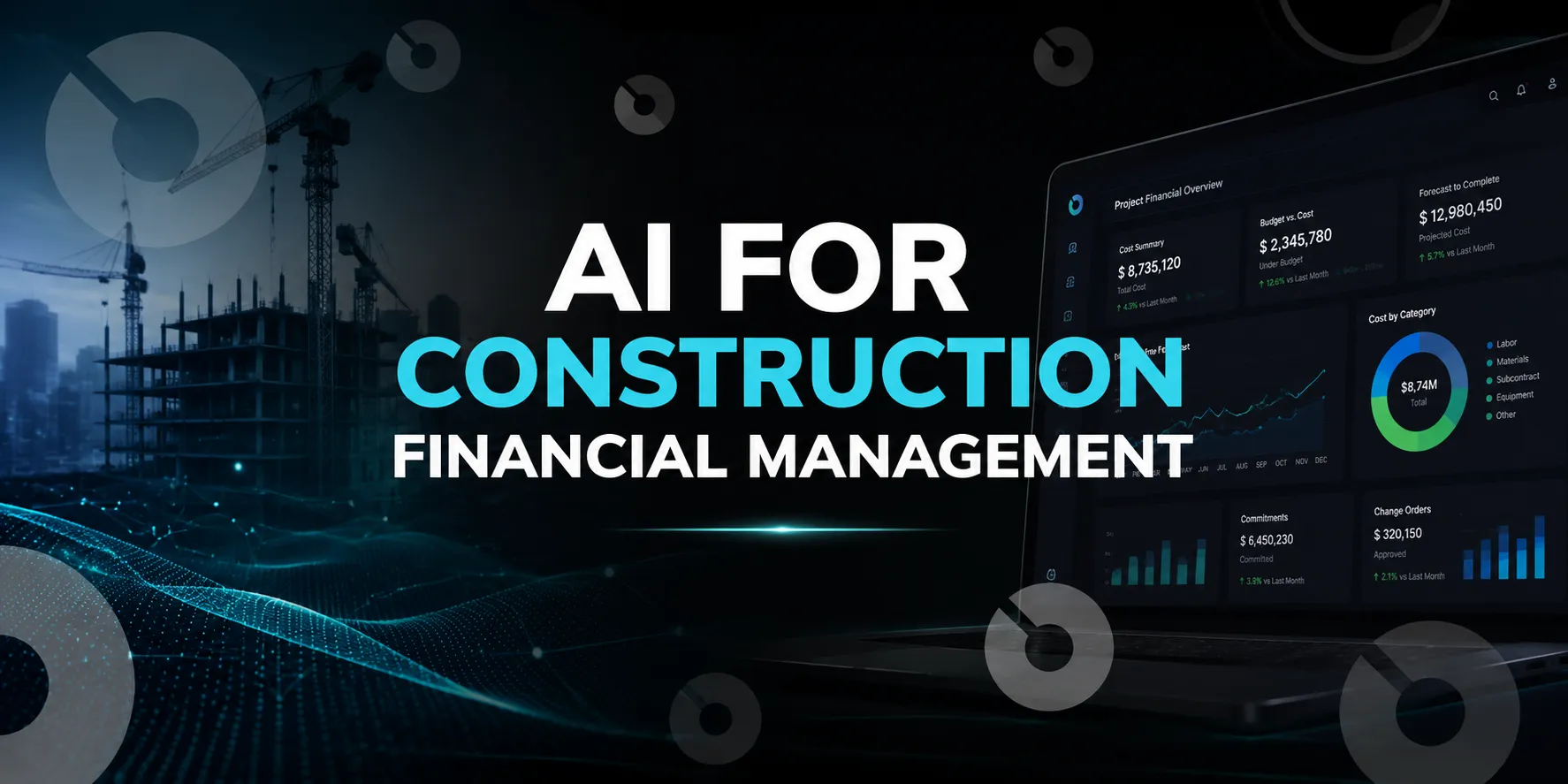
Informative
AI-Powered Change Order Management in Construction: What Is Actually Possible in 2026
Discover how AI-powered change order management helps construction teams reduce approval delays, control costs, prevent disputes, and keep project budgets accurate in real time.
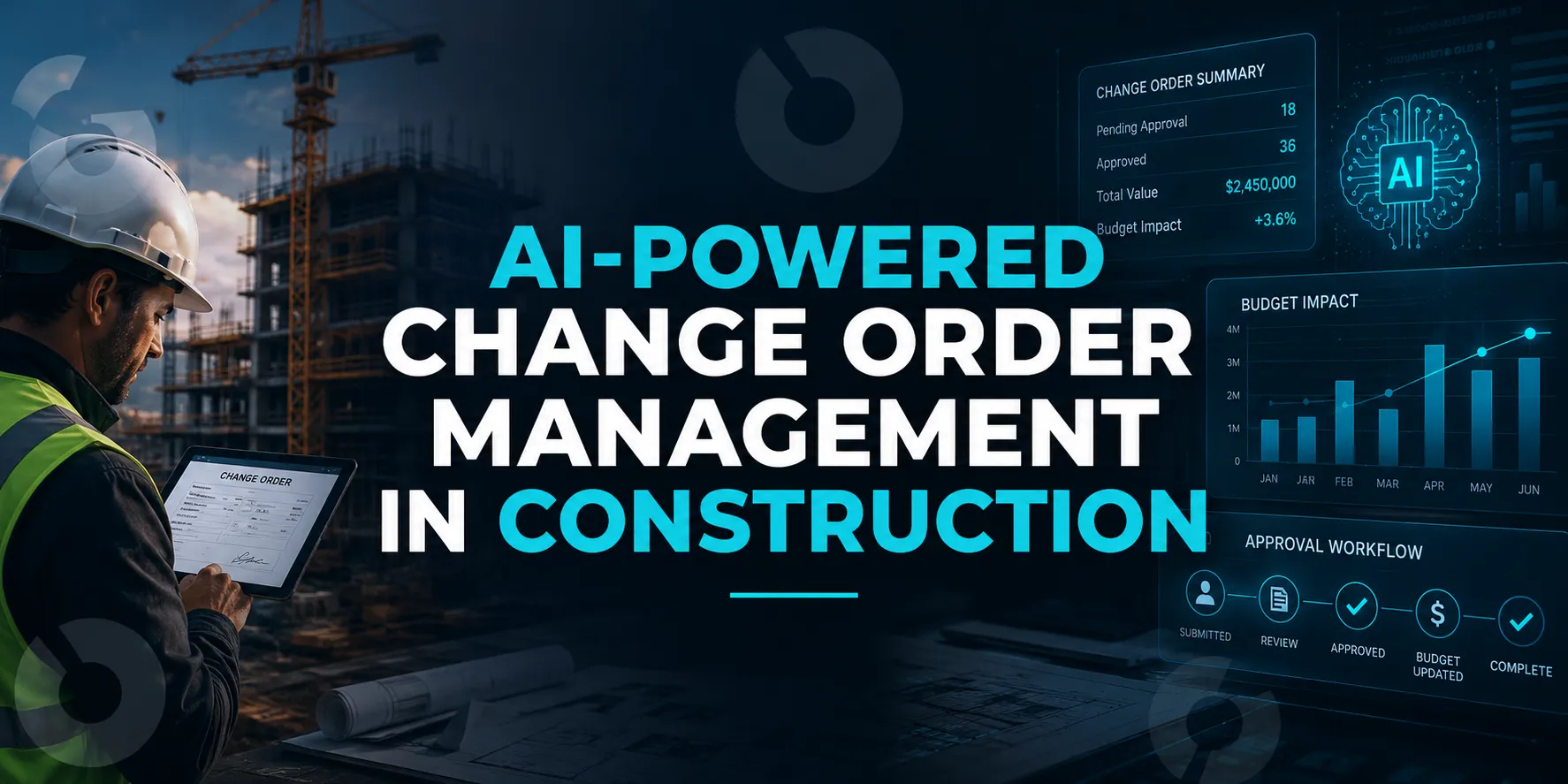
Change orders do not kill construction projects all at once. They do it gradually - through delayed approvals, undocumented scope additions, disputed costs, and cash flow gaps that compound across the project timeline until the original budget is unrecognizable.
Eighty-five percent of US construction projects experience cost overruns and change orders are among the primary drivers. The problem is not that change orders happen. On any complex capital project, scope changes are expected. The problem is how they are managed: manually, slowly and across disconnected systems that leave every party working from a different version of the truth.
AI construction management software has changed what is operationally possible. AI-connected change order workflows, when built on live project data rather than periodic exports, reduce processing times by 70 percent or more, create audit-ready documentation at the moment of change, and connect every approved or pending modification directly to its budget and schedule impact. For owners, developers, GC and owner's reps managing capital projects across the United States, that is not a marginal improvement. It is a structural change to how financial risk accumulates on a project.
This guide explains how change orders work, where the process breaks down without software support, what AI-powered change order management actually delivers, and what to look for when evaluating construction platforms in 2026.
What Is a Construction Change Order?
A change order is a formal modification to a construction contract that documents a change in scope, cost or schedule from the original agreed terms. It is the legally binding record that a project has deviated from its baseline and that all parties have acknowledged and approved that deviation.
Change orders arise from a range of sources: unforeseen site conditions, owner-directed scope additions, design errors or omissions, value engineering decisions, regulatory changes and supply chain disruptions. Some are avoidable with better pre-construction planning. Many are not. On large commercial and mixed-use projects in the US, dozens to hundreds of change orders are typical across the life of a project.
Each change order involves at minimum a scope description, a pricing breakdown, a time impact analysis, formal approval from the relevant parties and integration into the master contract and budget. Handling that process accurately and quickly on every one of those modifications, across every active project, is where most construction teams struggle.
Why Change Order Management Fails Without the Right System
The failure mode is almost always the same. A change event occurs in the field. Someone documents it - in a text message, an email, a handwritten note or a T&M ticket. That document moves through an informal chain of communication before it becomes an official change order request. By the time it reaches the right person for approval, days or weeks have passed. The original documentation has been transcribed, interpreted or summarized at least once, introducing errors. Budget impact has not been calculated against the live contract. The approval may come back with questions the original field record cannot answer.
24 days average processing time from T&M ticket to submitted change order is the industry norm for manual processes. During those 24 days, the work has typically already been performed. The cost has already been incurred. Any dispute about what was agreed happens in retrospect, against documentation that was never designed to serve as legal evidence.
This is the scenario that produces construction disputes. Not dramatic fraud or negligence, but ordinary process failure: the right information not recorded at the right time, not connected to the right contracts and budgets, not visible to the right people until it is too late to address without conflict.
The 2023 Arcadis Global Construction Disputes Report documented a 42% jump in dispute values in North America. Change orders are among the most frequent sources of formal disputes. That jump reflects the accumulated cost of manual change order processes running at scale across increasingly complex projects.
The Real Cost of Poorly Managed Change Orders
There are four categories of financial damage that come directly from change order management failure, and they affect every stakeholder on the project, not just the GC.
- The first is profit erosion. When a contractor performs work without an approved change order in place, or when the change order price is disputed after the fact, the difference between what was performed and what gets paid comes out of margin. On projects with thin margins, a handful of disputed change orders can eliminate profitability entirely.
- The second is cash flow disruption. Change orders that sit in approval queues stall pay applications downstream. A GC waiting on an approved change order before submitting a draw is a GC carrying the cost of that scope on their balance sheet until resolution. Specialty trades waiting on GC approval before they can bill experience the same cash flow pressure. This cascades through the entire subcontractor chain.
- The third is schedule impact. Change orders that are not processed quickly introduce uncertainty into scheduling. Crews that should be moving forward wait for direction. Material procurement decisions stall. The schedule float that existed at the start of a project disappears into the change order backlog.
- The fourth is relationship damage. Disputed change orders are among the leading causes of trust breakdown between owners and contractors. An owner who does not understand why a change order is necessary, or who receives documentation they cannot verify, becomes adversarial. That adversarial posture makes every subsequent change order harder to approve, regardless of its merits.
All four of these failure modes are connected by a single common cause: the absence of a real-time, shared, traceable record of what changed, when, at what cost, and with whose approval.
What Makes AI Change Order Management Different
Traditional change order software digitizes the existing process. It replaces paper forms with electronic forms and email chains with workflow notifications. That is an improvement. It is not a transformation.
AI-powered change order management, when built on a platform where all project data lives in one place, changes the process itself rather than just the medium.
The difference starts with data access. When an AI model can read the live contract, the current master budget, the approved change order log, the pending change order queue, and the committed cost records simultaneously, it can do things a workflow tool cannot. It can calculate the real-time budget impact of a new change order before it is submitted. It can flag a change order that overlaps with an existing approved modification. It can surface the contract clauses most relevant to a disputed scope item. It can tell a project manager, in plain language, what the current committed cost exposure is across all active change orders and how that exposure compares to the contingency remaining.
For a deeper explanation of how AI accesses live project data on a unified platform, the article on MCP vs. native AI integrations in construction software covers the architectural distinction between AI that is genuinely connected to project data and AI that is a chatbot layered on top.
The practical outcomes of AI-connected change order management are measurable. Processing times that average 24 days manually can fall to 3.5 days or less with digital automation. AI-assisted documentation reduces the gap between field occurrence and formal record. Real-time budget integration means owners see the financial impact of a change order at approval, not at the next reporting cycle.
How Long Does Change Order Approval Take and What AI Does to That Timeline
The average manual change order process in the United States moves through five stages, each with its own delay risk.
- Identification. A site condition changes, a design conflict emerges, or an owner requests an addition. Someone on site documents it. With manual processes, this documentation is informal — a photo, a note, an email. With AI-connected software, the documentation happens in the platform at the moment of the event, timestamped and tied to the relevant contract and cost code.
- Pricing. The contractor calculates the cost of the change. Manually, this means pulling the relevant contract section, checking unit costs, calculating labor and material quantities, and producing a pricing breakdown outside the system. With AI-connected software, unit costs, contract markups, and cost code structures are already in the platform. Pricing calculations draw on live data rather than manual lookups.
- Submission. The change order request moves from the contractor to the owner or owner's rep for review. Manually, this is an email with attachments. With integrated software, submission happens inside the platform with a traceable record of who submitted, when and what documentation was included.
- Review and approval. The owner or owner's rep reviews the scope, pricing and contract basis. Questions go back to the contractor. Revisions come back for re-review. Without software support, this cycle has no defined timeline and no escalation mechanism. With automated workflows, approval routing is predefined, response deadlines are tracked and stalled approvals are flagged automatically.
- Budget integration. Once approved, the change order value needs to move from the pending log to the committed cost total and update the forecast. Manually, this is a spreadsheet update that happens whenever someone gets to it. With AI-connected software, budget integration is automatic at the moment of approval.
The cumulative effect of AI-supported processing across all five stages is what produces the 70 percent reduction in processing time that the industry's best-documented platforms deliver. That is the difference between 24 days and 3.5 days, repeated across every change order on every project.
Change Orders Across the Project Lifecycle
Change order volume and character differ across project phases and the software requirements differ accordingly.
In pre-construction, the relevant activity is establishing the change order framework: defining the markup structure, documenting the approval authority matrix, setting response deadlines and creating the cost code structure that change orders will map to. Getting this right before a project starts reduces ambiguity for every change event that follows. INGENIOUS.BUILD's Project Management module supports pre-construction workflow setup, including approval routing and team structure, that carries through to the Construction Administration and financial change order processes.
During construction, change orders arrive continuously and need to be processed without disrupting production. The critical requirements are speed, documentation quality and real-time budget visibility. A change order that takes three weeks to approve while the affected crew is standing by is a schedule and cost problem, not just an administrative one.
In closeout, the change order record becomes a legal and financial document. Every change order must be reconciled against the contract, the final budget and the lender's or owner's audit requirements. Platforms where change orders were managed in isolation from the financial record produce closeout reconciliations that require months of manual work. Platforms where change orders are connected to the master budget from the moment of submission produce closeout-ready financial records as a byproduct of normal operations.
What to Look For in Construction Change Order Software
When evaluating construction platforms for change order capability, the features that matter most are not the most prominently advertised. Here is the evaluation framework that separates genuinely capable platforms from digitized paper forms.
- Real-time budget integration is the first test. When a change order is approved, does the budget update automatically? When a change order is pending, is the potential exposure visible in the cost forecast? Platforms that require manual reconciliation between the change order log and the budget introduce the same lag and error risk as spreadsheets.
- Approval workflow configurability is the second. Can approval routing be structured to match your organization's actual authority matrix? Can it enforce response deadlines? Can it escalate automatically when approvals stall? A workflow that routes every change order to the same person regardless of value or type is not a workflow — it is an inbox.
- Audit trail quality is the third. Every version of a change order, every comment, every approval action, and every revision should be permanently recorded with a timestamp and the identity of the person who made it. This record is what wins or settles disputes. Platforms that allow edits without version history are a liability in any contested change order situation.
- Cross-module connectivity is the fourth. Change orders do not exist in isolation. They affect contracts, budgets, schedules and RFIs. A platform where the change order module is disconnected from the contract record and the master budget requires manual data entry at every handoff. Each manual handoff is a potential error and a potential dispute.
- AI data access is the fifth. Can the platform's AI tell you — right now, without building a report — what your current change order exposure is, how it compares to contingency, which change orders are pending approval and for how long, and what the budget impact would be if all pending changes were approved? If the answer requires a report run or a spreadsheet pull, the AI is not connected to live project data.
How INGENIOUS.BUILD Handles Change Orders
INGENIOUS.BUILD is a unified construction project management platform where change orders, contracts, budgets, and project documentation all live in the same connected environment. The change order workflow inside the Project Financials module is connected to the master project budget in real time, which means every pending and approved change order is reflected in the cost forecast the moment it enters the system.
For owners and developers who need to report accurate cost exposure to lenders or equity partners, this means the financial picture they see in the platform is always current — not current as of the last time someone updated a spreadsheet.
For general contractors managing multiple active change orders across a project, the approval workflow is automated and configurable: routing rules are set once, response deadlines are enforced, and stalled approvals are surfaced automatically rather than discovered at the next owner meeting.
For owner's reps overseeing multiple projects simultaneously, the portfolio view shows change order activity and budget exposure across all active projects without requiring a separate report from each project team.
INGENIOUS.BUILD's AI capabilities, built on the Model Context Protocol, give every stakeholder direct access to live change order data through natural language queries. A project manager can ask the platform what the current exposure is across all pending change orders and receive an answer drawn from the live budget — not from a cached report, not from the last export, but from the actual current state of the project.
Teams using INGENIOUS.BUILD report 10 times fewer change-order disputes compared to previous workflows, and savings of 2 to 4 hours per day on financial management tasks. Both outcomes trace directly to the same root cause: when change orders are documented accurately at the time of occurrence, processed quickly through defined approval workflows and integrated automatically into the live budget, the information gaps that produce disputes close before disputes can form.
Across North American capital projects in commercial development, mixed-use residential, institutional construction and infrastructure, those outcomes are the difference between a project that closes on time and on budget and one that ends in arbitration.
Change Orders and the 2026 US Regulatory Environment
The US regulatory environment around change orders shifted materially at the start of 2026. California's SB 440, which took effect January 1, created a standardized statutory process for change order disputes on large private construction projects, establishing formal timelines and documentation requirements that did not previously exist in statute. SB 61, effective at the same time, capped retention at 5 percent, reducing a lever that owners and GCs had historically used to manage change order payment disputes informally.
These California changes signal a broader industry direction. Standardized documentation requirements, formal dispute timelines and retention caps are likely to spread to other states as the construction industry's dispute costs continue to rise. For construction teams operating anywhere in the United States, the direction is clear: change orders that were manageable through informal documentation practices in 2022 require defensible, timestamped, audit-ready records in 2026.
Software platforms that produce those records as a byproduct of normal operations are not optional infrastructure in that environment. They are the compliance baseline.
If your team is managing change orders manually, through email, or across disconnected systems, and you want to see how a unified platform with AI-connected change order workflows changes the financial picture on your projects, book a demo with INGENIOUS.BUILD.
Frequently Asked Questions
What is AI-powered change order management in construction?
AI-powered change order management uses artificial intelligence connected to live project data — contracts, budgets, committed costs, approval records — to automate and accelerate how construction change orders are documented, priced, routed for approval, and integrated into the project budget. Unlike basic workflow tools that digitize paper forms, AI-connected change order management calculates budget impact in real time, flags approval delays automatically, and gives project teams immediate answers about their change order exposure without requiring manual report runs.
How long does change order approval typically take in construction?
With manual paper-based processes, industry data shows an average of 24 days from the initial T&M ticket to formal change order submission. With digital change order software, that timeline can be reduced to 3.5 days or less — a reduction of more than 70 percent. The gap between these timelines is where most change order disputes originate: work is performed and costs are incurred before documentation and approval catch up, creating contested records that are difficult to resolve without a formal audit trail.
What causes most construction change order disputes?
The most common causes are incomplete documentation, delayed approval processing, and disconnected financial records. When a change order is not documented at the time of the event, pricing becomes disputed in retrospect. When approval takes weeks, the work may have already been completed in a way that differs from what was eventually approved. When the change order is not connected to the live budget, owners and contractors are reconciling different versions of the financial record. Platforms that document changes in real time, route approvals through defined workflows, and integrate automatically with the master budget eliminate each of these failure modes.
How do AI tools reduce change order disputes on construction projects?
AI reduces change order disputes by closing the information gaps that disputes feed on. When AI has access to live contract records, it can verify that a change order's scope is outside the original contract before it is submitted, not after it is disputed. When AI is integrated with the budget, it shows owners the financial impact of a change order at the moment of approval rather than in a report three weeks later. When AI maintains a permanent, timestamped record of every submission, revision, and approval action, there is no ambiguity about what was agreed and when. INGENIOUS.BUILD reports 10 times fewer change-order disputes among teams using the platform compared to previous workflows.
What should I look for in construction change order software in 2026?
The five most important capabilities are: real-time budget integration that updates automatically when a change order is approved or submitted; configurable approval workflows with defined routing, response deadlines, and escalation triggers; a complete audit trail with version history, timestamps, and user identity for every action; cross-module connectivity to contracts, RFIs, and schedule data; and AI access to live change order data that can answer natural language queries without requiring manual report generation. Platforms that satisfy all five are genuinely different from those that satisfy only the first two.
How do change orders affect construction project budgets?
Every approved change order increases the committed cost of a project. Every pending change order represents potential future exposure. The difference between these two numbers, relative to the contingency remaining in the budget, is the real-time financial risk position of the project. On projects managed manually, that risk position is only visible when someone builds a reconciliation report — which may happen monthly or less frequently. On platforms with real-time budget integration, the risk position is visible continuously, allowing teams to identify budget exposure early enough to make meaningful decisions.
Are there new US regulations affecting construction change orders in 2026?
Yes. California's SB 440, effective January 1, 2026, created a standardized statutory process for change order disputes on large private construction projects, including formal timelines and documentation requirements. SB 61, also effective January 1, 2026, capped retention at 5 percent on most private projects. These laws increase the documentation standards construction teams need to meet and signal a broader US regulatory direction toward formalized change order processes. Platforms that produce timestamped, audit-ready change order records as a standard output of normal operations are the most defensible position for teams operating in this environment.
Which construction project types have the most change orders?
Complex capital projects with multiple design disciplines, long timelines, or challenging site conditions generate the most change order activity. This includes commercial development, mixed-use residential, institutional construction such as healthcare and education facilities, infrastructure, and large-scale renovation projects. Owner-rep-managed portfolios across multiple simultaneous projects face the highest administrative burden, because change order volume across a portfolio requires consistent tracking and reporting standards that are difficult to maintain manually.