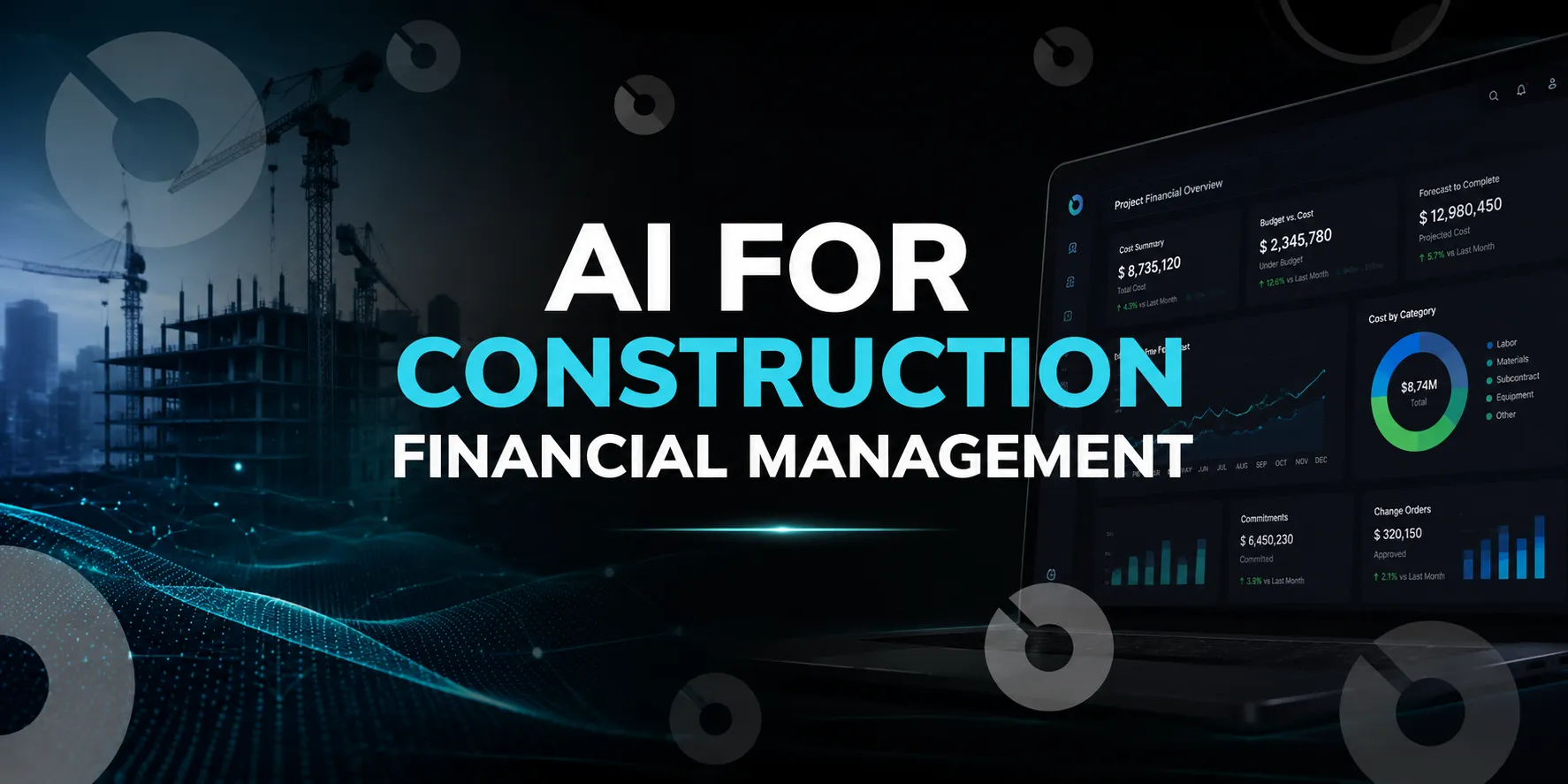
Informative
Technology in Construction Management: What Actually Changed
A look at how modern construction tech reshapes project management in 2025—boosting efficiency, collaboration, and visibility while giving PMs the tools to build smarter.
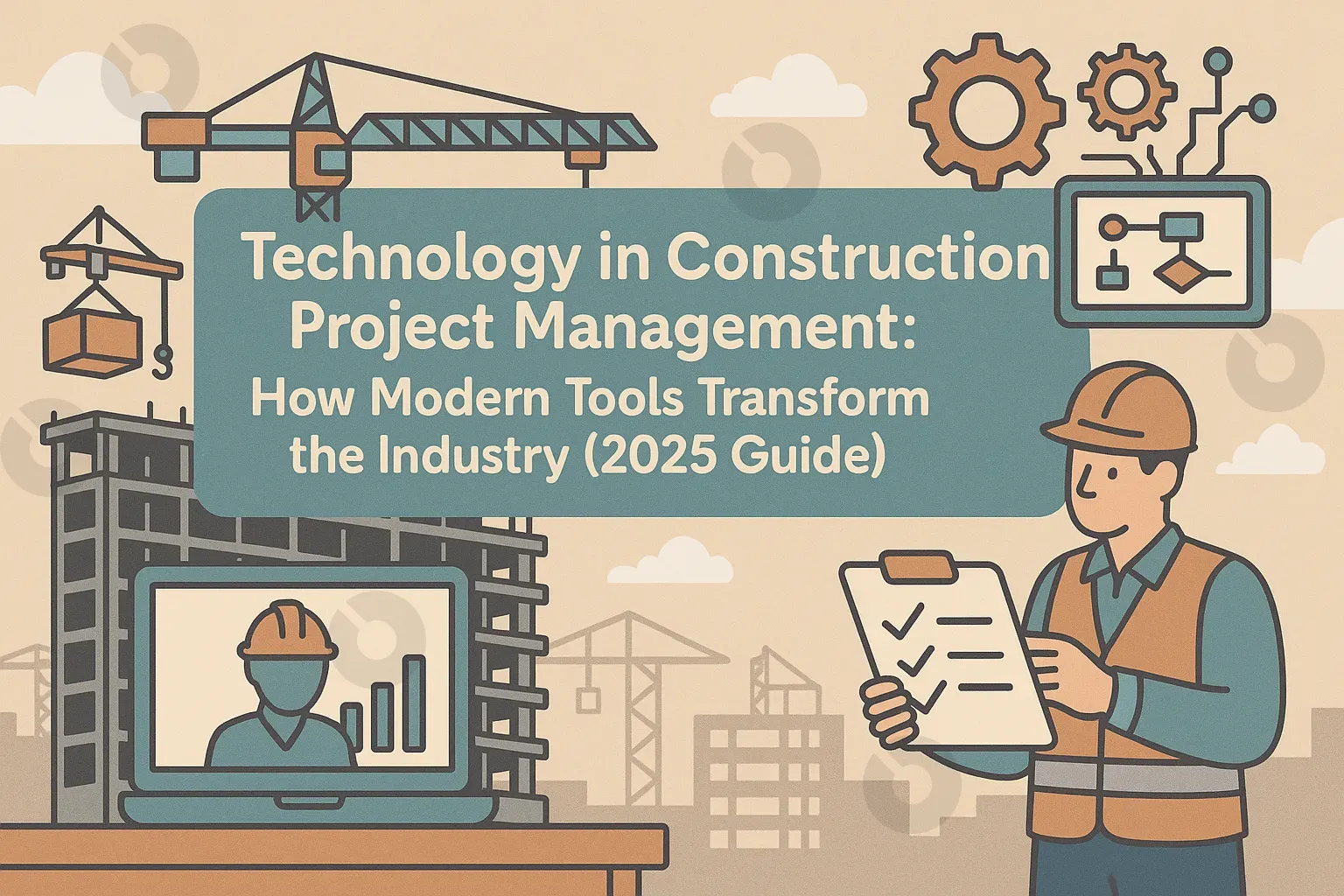
Walk onto a jobsite in 2026 and you'll find more technology than most people expect. Tablets in the trailer, telematics on the excavator, a drone that flew the site last Tuesday, a project management platform with four hundred documents in it, sensors in the concrete.
Then ask the project manager what the job costs to date and whether the schedule holds. If the honest answer involves opening three systems and calling someone, you've found the real state of construction technology.
The industry solved data collection. It has not finished solving what to do with the data. That gap is where most of the remaining value sits, and it's a more useful thing to understand than another list of emerging technologies.
What construction technology and management means
Construction technology and management refers to the combination of digital systems and structured management practices used to plan, coordinate, control and document a construction project.
In practice it covers three things: the platforms that hold project data, the workflows those platforms enforce, and the management discipline that determines whether people actually follow them. The third one is why two companies running identical software get different results.
As an academic discipline, construction management programs now teach digital project delivery, BIM coordination and data management alongside estimating, scheduling and contract administration. The job changed, and the training followed.
What actually changed, and what didn't
- Genuinely transformed: document control and version management, field-to-office communication speed, financial visibility during a project rather than after it, the audit trail behind decisions, and the ability of distributed teams to work from the same information.
- Improved but not solved: scheduling reliability, cost predictability, coordination between trades. Better tools have helped. They haven't eliminated the underlying difficulty, which is that construction happens in physical space with weather, labor and supply chains involved.
- Largely unchanged: the industry's overall productivity record, which has famously lagged other sectors for decades. More software hasn't fixed this, and anyone claiming their platform will is overselling.
That last point is worth sitting with, because it reframes the question. If technology hasn't solved productivity industry-wide, then the value isn't in adoption for its own sake. It's in specific, narrow improvements that compound: fewer RFIs lost, fewer decisions made from stale numbers, less time assembling reports.
The integration gap
Here's what most companies actually have: plenty of software, and no ability to answer a cross-cutting question without manual work.
The pattern repeats across categories. Equipment telematics is a good example. Machine connectivity is now commonplace, and as JLG's director of product management for connected solutions has put it, collecting data is only part of the equation. Traditional telematics reports location, hours and maintenance status, then requires a person to review it, work out what it means and communicate the next step. The data exists. Turning it into action is still manual.
Substitute almost any other category and the sentence holds. Daily reports get captured and nobody reads them. Submittal logs are complete and nobody can tell you which trade is slowest. Budget data is current and the schedule impact of a cost overrun still takes someone an afternoon to work out.
Construction technology integration, meaning the connections between systems rather than the systems themselves, is where the remaining gains are. It's also less interesting to talk about than drones and robots, which is roughly why it gets less attention than it deserves.
The core technology categories
- Project management platforms hold the project layer: RFIs, submittals, change orders, documents, drawings, meetings, tasks and the collaboration between parties. This is the system of record most other things connect to.
- Construction administration tools cover the documentation workflows specifically, meaning RFIs and submittals through review, approval routing, version tracking and closeout. Often the same platform, though some teams split them.
- Scheduling systems run from CPM engines like Primavera P6 through to lookahead and pull planning tools used with the trades. These are genuinely different layers rather than competing products.
- Field and mobile tools capture what's happening on site: daily reports, safety observations, progress photos, punch items, quality checks. The value depends entirely on whether the capture reaches the office systems without a re-entry step.
- Financial and contract management covers budgets, commitments, change orders, forecasts and pay applications. When this is disconnected from the project layer, cost impact is always discovered late.
- Design and BIM tools handle models, coordination and clash detection during design, with varying degrees of connection to what happens during construction.
Emerging technology, rated honestly
Most coverage of construction technology treats everything on the horizon as equally imminent. It isn't. Here's a more useful sort.
- Mature and worth adopting now. Drones and reality capture, meaning 360-degree cameras, LiDAR scanning and photogrammetry, are common on larger jobsites and deliver clear value for progress documentation, as-built comparison and dispute reduction. Reported payback tends to fall in the 12 to 18 month range. Cloud project management and construction administration platforms sit here too.
- Working, but narrower than the marketing. Digital twins are real and genuinely useful when they're fed by continuous reality capture and connected to BIM. The gap is that many "digital twin" implementations are really just a 3D model that was accurate on the day it was made. Ask what updates it and how often. Wearables and site sensors for safety are similar: the technology works, the value depends entirely on whether anyone acts on the alerts.
- Real but targeted. Construction robotics has moved past pilots and onto active sites, but in narrow roles. Bricklaying, rebar tying, autonomous earthmoving, layout drilling. Each automates one repetitive task alongside a crew rather than replacing one. Payback horizons are longer, commonly cited at two to three years or more.
- Early, or overstated. 3D printing of structures is real and building real houses, and it remains a small share of construction by volume. Fully autonomous jobsites are a long way out. Anything described as eliminating a trade is worth heavy skepticism.
The pattern worth noticing: the mature technologies are the ones that capture or organize information. The less mature ones are the ones that physically build. That ordering makes sense and it's unlikely to reverse soon.
Equipment management technology
Equipment is the category where sensors arrived earliest and where the data-to-decision gap is clearest.
Modern construction telematics combines GPS location, OEM machine diagnostics, engine performance, utilization rates, fuel monitoring, operator behavior data and maintenance alerts. Most major manufacturers run their own platforms, including Caterpillar's Product Link, Komatsu's KOMTRAX and Volvo's CareTrack, alongside third-party fleet systems.
The practical questions it answers well: where is the machine, how many hours has it run, is a service interval due, how much time is it idling, and which units are underutilized enough to redeploy or return.
The harder questions it answers poorly on its own: whether equipment cost is tracking against the budget line for that activity, whether a machine sitting idle is a utilization problem or a schedule problem caused by an upstream delay, and whether the maintenance you deferred last month contributed to the failure this month.
Those require equipment data to connect to project cost codes and the schedule. Most fleets run telematics in a system that doesn't talk to either. The idle time is visible. The reason for it isn't.
A reasonable first step for most contractors is less ambitious than the marketing suggests: get utilization and idle data into the hands of the people making deployment decisions, and connect equipment cost to job cost codes. Predictive maintenance and autonomous equipment are real and advancing, but they sit on top of a data foundation most fleets haven't finished building.
IT and construction
The IT function in construction has a harder job than in most industries, and it's worth naming why.
- The office is the easy part. Servers or cloud, endpoints, identity management, the standard corporate stack. Nothing unusual.
- The jobsite is the problem. Every project is a temporary office in a location that may have no infrastructure, possibly no cellular coverage, dust, weather and equipment that doesn't survive being dropped. Connectivity gets solved project by project and then dismantled.
- The user base is unusually varied. A single project spans executives, project managers, superintendents, field engineers, subcontractor foremen and trade workers, with enormous variation in device comfort. Software that works for one group may be unusable for another.
- External access is mandatory. Construction requires people outside your organization in your systems. That's a security requirement most corporate IT models aren't designed around.
- Cybersecurity risk is real and underestimated. Construction firms hold financial data, contracts, design documents and payment instructions, often with lighter security than a comparably sized firm in another industry. Payment fraud targeting construction disbursements is a known and recurring problem, and it usually exploits process rather than technology.
For mid-size contractors who can't justify a dedicated IT department, the common pattern is an operations leader owning the technology stack with external managed services underneath. That works, as long as someone genuinely owns it rather than defaulting to whoever is most comfortable with computers.
What technology actually delivers
Being specific here is more useful than listing benefits.
- Version control that holds. The failure mode of building from a superseded drawing largely disappears when there's one authoritative source and the field can reach it. This is probably the single largest reduction in rework available from software.
- Response time visibility. You can see that an RFI has been open eleven days. That doesn't make the reviewer faster, but it makes the delay a fact rather than a suspicion, which changes the conversation.
- Documentation that exists without effort. Approvals, revisions and decisions carry timestamps and attribution by default. Disputes get shorter because what can be proven is clearer.
- Cost visibility during the project. Knowing where you stand in week fourteen rather than at closeout is the difference between correcting course and reporting a variance.
- Reporting that isn't a project. When portfolio status is a filter rather than a manual assembly job, leadership asks questions more often, which is generally good.
The honest disadvantages
- Tool sprawl. Companies accumulate systems faster than they retire them. Each addition was justified. The aggregate is a stack nobody can explain, with reconciliation work distributed across people who each think it's a small part of their week.
- Adoption failure. Software the field doesn't use is worse than no software, because it creates a second system while everyone keeps using the first. This is usually a rollout and usability problem rather than a resistance problem, though it gets blamed on resistance.
- Data quality. Analysis inherits the quality of its inputs. Inconsistent cost coding and stale asset records produce confident, wrong answers, and this is the constraint on most AI initiatives in construction right now.
- Implementation underestimated. The subscription is the visible cost. Configuration, migration, training and integration frequently exceed it in year one.
- Dependency. Your project records live in someone else's system on terms that renew. Data export rights matter more than most buyers check.
- Change fatigue. Teams that have been through three platform migrations in five years are not being difficult when they're skeptical about the fourth.
Why adoption fails
The limiting factor is rarely the software. Industry research suggests around 70% of contractors operate without a formal technology roadmap, which means most adoption decisions are made reactively, one tool at a time, in response to a specific pain. The barrier that comes up most often in surveys isn't capability or even cost. It's organizational readiness.
A few patterns account for most failures.
- Nobody defined what success looks like. The tool gets bought to solve a vaguely stated problem, so there's no way to tell afterward whether it worked. This also makes it impossible to justify the next investment.
- The rollout skipped the people who'd use it daily. Evaluations run by decision-makers routinely select software that field teams and project administrators quietly abandon. Those two groups spend the most hours in the system and are consulted least.
- Training was a session rather than a process. One demo during onboarding, then nothing. People who miss it or join later learn by guessing, and inconsistent use becomes normal.
- The old process never got shut off. If the spreadsheet still exists, people will use the spreadsheet. Running both indefinitely is how a new system becomes a second system.
- It was launched on a project already in trouble. New software arriving mid-crisis gets blamed for the crisis and discarded with it.
The version of this that actually works tends to be unglamorous: one project, a team that wants it, a defined measure of success, and a hard date when the old method stops.
How to tell whether it's working
Vague satisfaction isn't evidence. A few things you can actually measure before and after.
- RFI and submittal turnaround time. Easy to pull, directly tied to schedule, and it moves quickly if the tool is being used.
- Time spent assembling reports. Ask whoever produces the monthly report how long it takes now versus before. This is often the largest single time saving and the least tracked.
- Rework attributable to outdated information. Harder to measure, but even a rough count of incidents caused by someone working from a superseded document tells you whether version control is holding.
- Change order documentation completeness. What percentage have a clear approval trail. This one predicts dispute exposure.
- Actual usage. Whether the field is logging in, not whether they have accounts. Most platforms report this and most organizations never look.
Measure a baseline before you implement. Almost nobody does, which is why so many technology investments can only be defended with anecdotes.
What separates companies that get value
The difference isn't budget or tool selection. Three things show up consistently.
They consolidated where data is tightly coupled rather than buying the best tool for each category independently. They gave someone real ownership of the technology stack, with authority to say no. And they fixed data discipline, meaning consistent cost codes and naming conventions, before expecting analysis to work.
None of that is a purchasing decision, which is inconvenient for everyone selling software.
It looks different depending on your size
Generic technology advice assumes a mid-size general contractor. The right answer shifts considerably with scale.
- Small contractors, under roughly 20 people. The realistic goal is one system that handles project documentation and one that handles accounting, connected well enough that nothing gets keyed twice. Adding specialized tools at this size usually creates more coordination work than it removes. Spreadsheets are still doing real work here and that's fine.
- Mid-size, roughly 20 to 200. This is where stacks get tangled, because the company is large enough to have specialized needs and not large enough to have someone managing the architecture. The highest-value move is usually consolidating the project layer and naming an owner for technology decisions, in that order.
- Large contractors and enterprise owners. Integration becomes the dominant problem rather than selection. There's a budget for specialist tools and enough systems that the seams cost real money. Dedicated technology roles make sense at this scale, and the failure mode shifts from too few tools to too many.
- Owners and developers at any size. The center of gravity is financial and portfolio visibility rather than field execution, which means adopting a GC-shaped stack produces detailed field data and no clean answer to what the portfolio costs.
Where INGENIOUS.BUILD fits
INGENIOUS.BUILD consolidates the layers that are tightly coupled: project financials, project management and construction administration in one system, so budgets, contracts, change orders, RFIs, submittals and closeout share a data structure rather than a nightly sync.
It isn't a CPM scheduling engine, an accounting system or a telematics platform, and on a complex project you'll still run some of those alongside it. What it's built to be is the system of record for the project layer, with the multi-party structure construction actually requires. Owners, developers, owner's reps, GCs, subcontractors and design teams each work in their own workspace, connected on shared projects, rather than external parties getting read-only access that pushes coordination back into email.
Every workspace includes a native MCP server, so Claude, ChatGPT, Gemini or any MCP-compatible model can read live project data across the workspaces you're authorized to access. Given that the integration gap is the core problem described in this article, that matters: AI can answer from current data rather than from an export someone ran on Monday.
Book a demo if closing that gap is what you're working on.
The short version
Construction technology has moved further than its reputation suggests and less far than vendor marketing claims. Data collection is largely solved. Turning data into decisions is not.
The companies getting real value aren't the ones with the most tools. They're the ones who consolidated the systems that need to share data, gave someone ownership of the architecture, and did the unglamorous work of making their data consistent enough to trust.
FAQ
What is construction technology and management?
The combination of digital systems and structured management practices used to plan, coordinate, control and document construction projects. It covers the platforms holding project data, the workflows they enforce, and the management discipline determining whether teams follow them.
How is technology transforming construction project management?
Most significantly in document version control, field-to-office communication speed, financial visibility during rather than after a project, and automatic audit trails. Scheduling reliability and cost predictability have improved without being solved, and industry-wide productivity has changed less than adoption levels would suggest.
What is construction technology integration?
Connecting construction systems so data flows between them rather than being re-entered or reconciled manually. It's distinct from adoption, and it's where most remaining value sits, since many companies now own plenty of software but still can't answer cross-cutting questions without manual work.
How does construction tech impact equipment management?
Telematics provides GPS location, machine diagnostics, utilization, fuel consumption, operator behavior and maintenance alerts, with major OEM platforms including Caterpillar Product Link, Komatsu KOMTRAX and Volvo CareTrack. The limitation is that equipment data usually isn't connected to project cost codes or the schedule, so idle time is visible while the reason for it isn't.
What are the disadvantages of technology in construction?
Tool sprawl, adoption failure when field teams find software harder than the process it replaced, data quality problems that undermine analysis, implementation costs exceeding subscription costs in year one, vendor dependency, and change fatigue in teams that have already been through multiple migrations.
Why is IT harder in construction than other industries?
Jobsites are temporary locations often without infrastructure or reliable connectivity, the user base spans executives to trade workers with widely varying device comfort, external parties must have access to internal systems, and each project effectively requires standing up and later dismantling a remote office.
What is digital construction project management?
Managing construction projects through connected digital systems rather than paper, spreadsheets and email, covering documentation, scheduling, cost control, field capture and multi-party collaboration in software rather than parallel manual processes.
Has construction technology actually improved productivity?
Unevenly. Specific workflows have improved measurably, particularly document control, communication speed and financial visibility. Industry-wide productivity has not moved as much as adoption levels would suggest, which points to integration and data quality rather than tool availability as the constraint.
Which construction technologies are mature enough to adopt now?
Drones and reality capture, cloud project management platforms, and BIM for coordination are production-ready with well-documented use cases. Digital twins and safety wearables work but deliver value only when continuously updated and acted on. Robotics is real but narrow, automating individual repetitive tasks. 3D printing of structures remains a small share of overall construction.
Why do construction technology implementations fail?
Usually organizational readiness rather than the software. Common causes include no defined measure of success, evaluations that exclude daily users, training treated as a one-time session, the old process never being shut off, and launching on a project already in trouble.
How do you measure whether construction technology is working?
Track RFI and submittal turnaround time, hours spent assembling reports, incidents of rework caused by outdated information, the percentage of change orders with complete approval trails, and actual login activity by field teams. Establish a baseline before implementing, which most organizations skip.
Does the right construction technology depend on company size?
Substantially. Small contractors benefit most from two well-connected systems rather than many specialized ones. Mid-size firms typically need to consolidate the project layer and name an owner for technology decisions. Large organizations face integration rather than selection as the dominant problem.